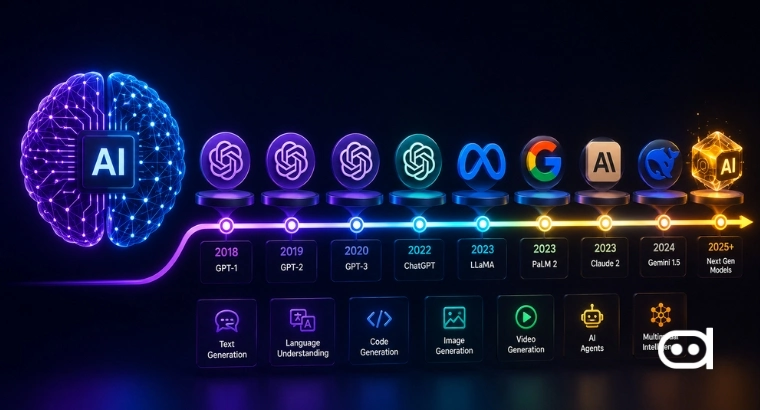
The pace of AI model evolution has been speeding up dramatically over the last few years. What used to take years now happens in months, and the top AI companies keep rolling out faster, smarter, and more specialized models at an unprecedented pace. Take OpenAI’s GPT series, Google’s Gemini, or Anthropic’s Claude – each AI family seems to follow its own development road. Yet they’re all still competing to push the limits of reasoning, imagination, coding, image synthesis, video creation, and multimodal intelligence.
Keeping track of AI model timelines isn’t just “interesting” anymore; it’s essential. Developers need to figure out which versions actually support specific APIs, businesses want more capable options for day-to-day workflows, researchers compare results across generations, and everyday users keep asking whether upgrading to a newer version is even worth the trouble.
Quick Overview of AI Model Evolution
| AI Family | Latest Version | Release Date | Category | Best For |
| GPT | GPT-5.6 (including the Sol, Terra, and Luna models) | July 2026 | Multimodal LLM | General AI, coding, writing, reasoning |
| Gemini | Gemini 3.5 Flash | May 2026 | Multimodal LLM | Productivity, reasoning, Google ecosystem |
| Claude | Claude Sonnet 5 | June 2026 | Multimodal LLM | Long-context reasoning, coding |
| Grok | Grok 4.5 | July 2026 | Multimodal LLM | Real-time reasoning, X platform integration |
| Veo | Veo 3.1 | October 2025 | Video Generation | AI-generated videos |
| Nano Banana | Nano Banana 2 Lite | June 2026 | Image Generation | Image editing and visual creation |
| Luma Ray | Luma Ray 3.2 | June 2026 | Video Generation | Cinematic AI video production |
| DeepMind | Genie 3 | August 2025 | World Model | Interactive environments and simulation |
Timeline of Every Major AI Model Family
GPT (OpenAI)
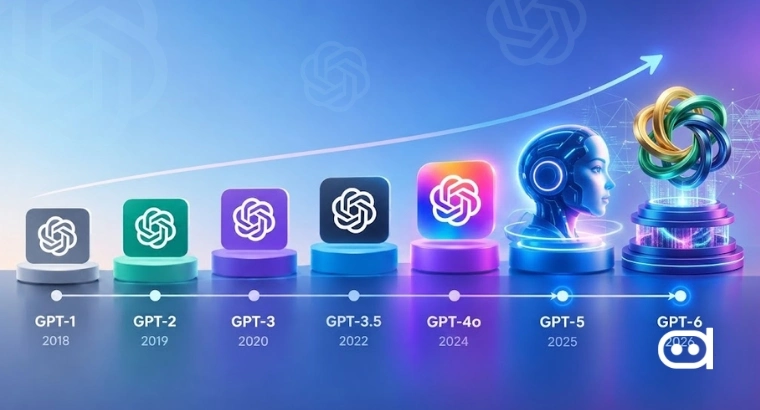
The GPT family is one of the most influential examples of AI model evolution, helping shape what we see today in generative AI. Ever since GPT-1 launched in 2018, OpenAI has kept pushing forward, expanding what its models can do across GPT versions. With each new release, the jump has been noticeable, especially in language comprehension, deeper reasoning, software development, multimodal abilities, and tool use.
Over time, GPT models evolved from text-only setups to assistants that can handle images, audio, files, and even more complex tasks. Nowadays, GPT is showing up in applications for education, software development, healthcare, customer support, and enterprise automation too.
To better understand how OpenAI’s models have progressed over the years, explore our GPT Version Timeline, which covers every major release, key improvements, and milestones in the GPT family.
Gemini (Google)
Google’s Gemini family shows a single unified vision for multimodal artificial intelligence. It was rolled out as the successor to Bard, and Gemini ended up becoming Google’s main flagship AI model family, building on experience from DeepMind and Google Research. Each new step in the Gemini version history brought real gains in reasoning, coding, understanding multiple modalities, and long context handling with more agent-like capabilities.
Gemini is also deeply integrated across Google’s ecosystem, showing up in Search, Workspace, Android, and Cloud services. As Google’s AI strategy keeps changing, Gemini stays right at the center of their push to make intelligent assistants that can operate across text, images, audio, video, and code, while serving billions of users around the world.
Learn more in our Gemini version history.
Claude (Anthropic)
Anthropic’s Claude lineup has gained a reputation for strong reasoning while also placing real focus on AI safety and reliability. Starting with the early Claude models, each version brings noticeable upgrades for coding, math reasoning, document review, and long-context handling. Many companies now rely on Claude for dependable AI assistance with research, writing, programming, and various enterprise workflows.
Anthropic’s Constitutional AI direction also sets it apart, as it aims for responses that are helpful, honest, and harmless while still maintaining competitive benchmark results. And as organizations push AI deeper into critical business processes, Claude keeps getting updated with sharper reasoning, improved multimodal capabilities, and productivity features that help save time.
Explore the complete Claude version history.
Grok (xAI)
Grok is xAI’s rapidly evolving family of AI models, designed to compete with the top large language models. Since the first release, Grok has evolved with each new step, with big boosts in reasoning, coding, multimodal comprehension, and overall benchmark results. The newest Grok models show even more polished skills in mathematics, scientific thinking, software development, and chat-based AI.
Grok offers close integration with what’s happening live on the X platform, so in many cases it can answer with fresher context. A deep analysis of the Grok version history highlights that xAI upgrades its models frequently and iterates quickly on the product, while expanding its reach across both consumer and enterprise AI use cases.
Learn more about the complete Grok version history and compare every major release.
Veo (Google Video)
Veo is Google’s flagship family of AI video creation models, and it counts as one of the most important moves the company has made in generative media. With the latest release, the platform now offers better video realism, improved prompt adherence, more consistent motion, smarter scene understanding, and advanced audio generation. Veo helps users craft top-tier videos just from natural language prompts and also supports more complex creative workflows for marketers, filmmakers, educators, and content creators.
With each new version, the gap between AI-made video and professionally produced video seems to narrow, largely because you get better visual fidelity, more convincing graphics, and longer, more coherent sequences. And as the demand for AI-powered video production keeps rising, Veo has turned into one of the major platforms pushing forward the evolution of AI models in video tech.
Compare every Veo release in our detailed Veo version history.
Nano Banana (Google Image)
Nano Banana is Google’s image-generation and editing model that makes visual creation feel much more conversational. It is not like the usual image generators that stick to text-to-image output; instead, Nano Banana leans heavily on iterative editing, object substitution, style transfer, background rewrites, and ongoing visual polishing. The edits come out accurate while the whole image stays coherent even after multiple iterations.
It is useful for designers, marketers, creators, and everyday users who want professional-looking image editing without learning specialized software. And as Google keeps investing more in multimodal AI, Nano Banana shows the shift as image generation moves beyond simple prompt-based processes toward more interactive visual co-working between humans and AI.
See how Nano Banana evolved across generations in our Nano Banana version history.
Luma Ray
The Luma Ray family is known for high-quality AI video creation, especially for people who want a cinematic look, natural movement, and careful scene layouts that feel real. Since the first version, the platform has kept iterating on motion accuracy, prompt understanding, camera movement, lighting realism, character consistency, and even rendering. The Ray models make professional video production less of an ordeal because, instead of dealing with the usual animation tools, you can describe what you want in plain natural language.
As AI video technology becomes more competitive, Luma Ray seems to stand out for its real focus on realism while still giving you creative control. The company has also released many updates over time, which have expanded what filmmakers, advertisers, game developers, and digital artists can do. The big idea is production-ready visuals, without all the extra time and resources that normally go into complex video making.
See how Luma Ray has evolved over time in our detailed Luma Ray versions.
Genie (DeepMind)
DeepMind’s Genie family stands out in the evolution of AI models, as it leans more toward interactive world models than toward purely chat or conversational AI. Instead of generating text responses, Genie learns how virtual environments behave by analyzing large amounts of video data and transforming it into playable, interactive worlds. Each generation in the Genie version history has expanded the complexity, realism, and responsiveness of these AI-generated environments.
Researchers view Genie as an important step toward more capable embodied AI systems that can understand physical interactions, simulate environments, and support robotics, gaming, and scientific research. Genie’s progress seems more research-driven, and the releases line up like milestones, with each new version marking real leaps in world modeling and interactive AI rather than just incremental tweaks.
Explore the complete Genie version history.
Which AI Family Moves Fastest?
Not all AI families evolve at the same speed. In real life, commercial AI providers tend to ship updates way more often than research-heavy teams, so you end up seeing obvious differences in the AI version history.
OpenAI’s GPT family and Google’s Gemini have been among the fastest released in the history of AI model releases. Big changes show up every few months, with smaller tune-ups that add up, such as better reasoning, wider context windows, and more multimodal abilities that feel integrated rather than bolted on. Anthropic’s Claude follows a similar pace, especially as enterprise adoption increases and coding performance becomes a more competitive race.
xAI’s Grok has had one of the quickest development arcs among the newer players. Since its launch, Grok has received several major upgrades in a short span, suggesting xAI is leaning into rapid iteration and real-time responsiveness rather than slower refinement.
Then there are creative AI models like Veo, Nano Banana, and Luma Ray. Those tend to move in response to breakthroughs in image and video generation, rather than traditional language modeling. Their updates often bring big leaps in visual fidelity rather than the steady incremental polish you’d normally expect.
Meanwhile, DeepMind’s Genie is more research-paced. So instead of frequent product drops, new Genie versions usually appear when there are major advances in world-model research. That means the timeline feels slower, but the scientific impact is more substantial.
FAQ’s
How often do AI models get updated?
Leading commercial AI providers frequently release improvements. Major versions typically arrive every several months, while smaller performance, safety, and feature updates may occur much more frequently.
Which AI model has the longest version history?
OpenAI’s GPT lineup has one of the longest and most carefully documented version trails, starting with GPT-1 then moving on through several newer generations that keep getting more capable over time.
How do I know which AI model version to use?
It depends on what you’re using it for. The newer versions give you stronger reasoning, better multimodal handling, quicker responses, and more consistent reliability. However, older versions may remain suitable for specific APIs, legacy workflows, or cost-sensitive applications.
Are older AI model versions still available?
In many cases, yes. Some providers continue supporting previous versions through APIs or enterprise offerings, although older models are eventually retired as newer generations become more capable. Availability varies between providers, so it’s important to review each company’s current support policy before building long-term workflows.