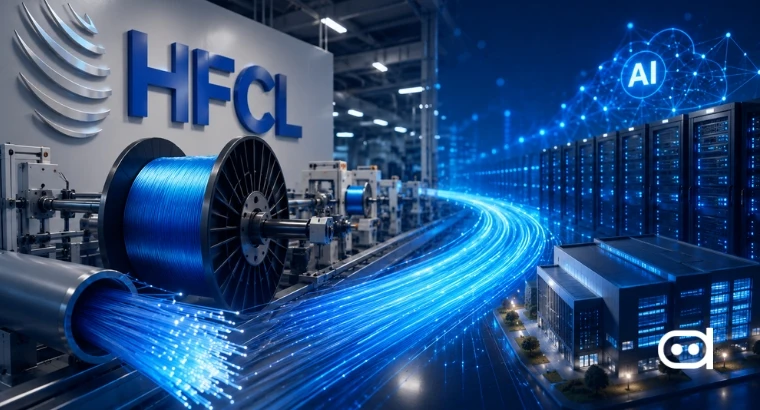
HFCL, an Indian company, is accelerating its optical fiber production as artificial intelligence data center expansion ramps up. The organization says that demand from hyperscalers and cloud providers bolsters, pushing it to boost manufacturing capacity. This is because the demand outpaces supply. With artificial intelligence workflows driving the need for massive network architecture, HFCL places itself as the provider of optical connectivity solutions for upcoming data centers. It bets that a worldwide artificial architecture boom will lead to high demand for fiber optic networks. It fulfills twin objectives of fueling native optical fiber programs and cater to international hyperscalers.
Why HFCL Is Ramping Up Fiber Production
HFCL states that the rise in artificial intelligence data center building has parallelly increased the demand for optical connectivity. This is the reason that the company plans to expand its manufacturing processes. According to Managing Director Mahendra Nahata, the issue is to balance the growing demand. The organization said it is receiving inquiries from several hyperscalers and plans to push production to meet the growing demand.
The company believes that the demand for high-count fiber optic cables will surge over the next five years as more countries build to prepare AI data centers. Nahata also noted that demand from North America, Europe, and Asia has yet to reach its full potential, indicating sizeable opportunities remain ahead. HFCL has also began manufacturing optical preforms, a shift expected to develop raw material balance, decrease production costs, and boost supply chain resilience, while giving consumers a plan to confide in.
AI’s rapid growth consistently changes architectural requirements. Unlike traditional workloads, artificial intelligence applications require more computing power. This creates more demand, lower latency, and easier data transfer capacity. Fiber optic cables are a key component because they allow high-bandwidth communication between servers, storage, and networking equipment. To monetize on this trend, HFCL recently introduced OptiQ AI, an embedded optical connectivity portfolio created for hyperscalers and cloud service providers.
The portfolio blends fiber optic cables, patch cords, cable assemblies, cassettes, enclosure panels, and related accessories, helping operators to source connectivity solutions from a one-stop vendor. As per HFCL, the integrated offering helps decrease adoption complexity while supporting migration to next-generation 800G and 1.6T network structures for AI. Industry estimates quoted by the organization project global AI infrastructure spending to reach $750 billion by the end of 2026, with data center capacity expected to boost 3.5 times, emphasizing why the need for optical networking equipment will increase.
Also Read: Meta Chooses Alberta for First Canadian AI Data Center Amid Climate Debate
What Role Do Hyperscalers Play in HFCL’s Strategy?
Hyperscalers have become one of HFCL’s massive growth prospects. The organization said it is in conversation with several global hyperscalers. They have positioned themselves as a connectivity partner managing optical networking products with procurement and construction. Now, HFCL is gaining recognition from big hyperscalers and telecom carriers across the globe, bolstering its position in the AI environment. The strategy is already gaining monetary momentum.
On July 10, 2026, HFCL announced a $52 million international order to supply its OptiQ AI connectivity portfolio. Industry researchers expect hyperscale data centers to become the fastest-growing part of the market, including Amazon, Microsoft, Google, and Meta. These companies will heavily invest in AI-ready facilities, supplemented by high-end infrastructure.
What It Means for India’s AI Supply Chain
HFCL’s expansion depicts a comprehensive shift in India’s role within the AI infrastructure supply-demand chain. While the organization plans to supply optical fiber for the government’s BharatNet 3 program, it is parallelly targeting international AI data center projects to cater to high-density fiber-connected demand. According to KPMG, India’s data center value chain could represent a $90 billion opportunity by FY2035, extending beyond construction into networking, energy systems, and supporting services. KPMG also noted that AI-led workflows change how data centers are created, making high-end networking architecture necessary. As hyperscalers expand around the world, organizations supply the connectivity technology that helps cloud providers and chip manufacturers.
HFCL plans to fixate on one of the fastest-growing parts of the AI economy by expanding its fiber production and optical connectivity portfolio. As hyperscalers plan to build AI data centers, demand scales for both computing hardware and network infrastructure needed to connect those systems. With accelerating inquiries from customers around the world, novel manufacturing funding, and an increasing presence in AI data center connectivity, HFCL bets that fiber optics will remain the core technology powering the next phase of AI infrastructure.