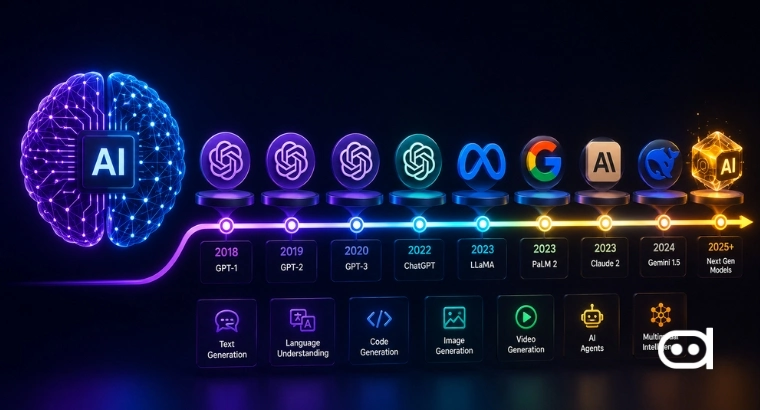
Google’s journey has been one of the most influential ones in the fast-evolving field of artificial intelligence. The company has come a long way from Bard to the highly developed Gemini AI models and has become an AI-first giant instead of just being a search-centric one. The Gemini AI Timeline over the years shows how AI has progressed from giving simple text feedback to its now multimodal reasoning ability, which supports a variety of applications from programming to video-making. Learn more about the different Gemini AI versions, what they can do uniquely, and how the Gemini AI history is leading us to the future where AI is truly agentic with each step.
Gemini AI Timeline: Version-by-Version Evolution
The table below gives a summarized comparison of the most significant versions in the Google AI model timeline.
| Features | Launch Year | Model Category | Multimodal Support | Context Window | Reasoning Ability | Agentic Capabilities | Tool & API Use | Speed | Cost Efficiency | On-Device Support | Primary Use Cases | Availability Status | Best For | Pricing Plan |
| Gemini 1.5 Pro | 2024 | Pro | Yes (text, image, audio, video) | Up to 2M tokens | Strong enterprise reasoning | Yes (tool use, agents) | Full API, tool & function calling | Moderate | Higher cost | Limited (via APIs) | Complex analysis, enterprise AI | Legacy / replaced | Deep research & enterprise workflows | Premium/enterprise API tiers |
| Gemini 1.5 Flash | 2024 | Flash | Yes (same modalities) | Up to 1M tokens | Moderate, speed-optimized | Limited | Yes | Fast | Lower cost than Pro | Limited | High-volume text/multimodal processing | Legacy / replaced | Fast multimodal tasks | Lower API tier |
| Gemini 2.0 | 2025 | Flash / Pro experimental family | Yes | Up to ~2M | Good general reasoning | Yes (experimental) | Full tooling integration | Balanced | Varies by tier | App-integrated | Everyday conversational tasks | Retiring in 2026 | Broad usage & entry AI | Mixed free + paid tiers |
| Gemini 2.5 Pro | 2025 | Pro | Yes (advanced) | Up to 1M | State-of-the-art reasoning | Yes (multi-tool workflows) | Yes (Vertex AI & Studio) | Slower than Flash variants | More expensive at scale | API & cloud | Research, code & long-context work | Active | Advanced reasoning & code generation | Higher tier in AI Studio & Vertex |
| Gemini 2.5 Flash | 2025 | Flash | Yes | ~1M | Excellent for daily tasks | Yes | Yes (Vertex AI & Studio) | Faster & highly responsive | Cost-effective high-volume ops | API & cloud | Chat, summarization, function calling | Active | Cost-effective production apps | Mid-tier API pricing |
| Gemini 3 Pro | 2025 | Pro | Yes (cutting-edge) | ~1M+ | Leading reasoning across benchmarks | Yes (high-level coding agents) | Full enterprise tool suite | Best for complex tasks, slower than Flash | Premium enterprise pricing | API & cloud | Elite reasoning, coding, planning | Active | Highest reasoning & capability | Premium enterprise costs |
| Gemini 3 Flash | 2025 | Flash | Yes (optimized) | ~1M | Strong reasoning with low latency | Yes (optimised for responsive agents) | Full enterprise & app integrations | Very fast with high quality | Lower than Pro, high performance | App default model (Gemini app) | Fast responses for broad use cases | Active / default in apps | Speed plus strong reasoning | Lower than Pro but billable |
| Gemini 3.1 Flash Image | 2026 | Multimodal image generation & editing | Text, image, audio, and video inputs with text & image outputs | Large context support | Moderate | Basic | Gemini API, Vertex AI | Very Fast | High | No | Image generation & editing | Available | Creative professionals | API usage pricing |
| Gemini 3.1 Pro | 2026 | Frontier multimodal reasoning model | Native multimodal | Up to 1M+ tokens | Advanced | Advanced | Gemini API, Vertex AI | High | Moderate | No | Coding, research, enterprise AI | Available | Developers and enterprises | Premium API pricing |
| Gemini 3.1 Flash-Lite | 2026 | Lightweight multimodal model | Native multimodal | Long-context support | Strong for lightweight tasks | Good | Gemini API, Vertex AI | Ultra-fast | Excellent | Limited deployments | Chatbots, automation, classification | General Availability | High-volume applications | Lowest-cost Gemini 3.x model |
| Gemini 3.5 Flash | 2026 | Frontier agentic AI model | Native multimodal | Extended long-context support | Frontier-level reasoning | Excellent | Gemini API, Vertex AI | Fast with advanced reasoning | Moderate | No | AI agents, coding, enterprise workflows | Available | Complex autonomous workflows | Premium API pricing |
| Gemini 3.5 Flash-Lite | July 2026 | Lightweight Flash model | Text, image, video, audio, PDF input; text output | 1 million tokens | Optimized for lightweight reasoning | Supports autonomous subagents | Function calling, Computer Use, Search, structured outputs | Fastest model in the 3.5 family | Lowest-cost Gemini 3.5 model | Cloud deployment | High-throughput automation, extraction, parsing | General Availability | Batch processing, APIs, lightweight AI tasks | $0.30 per 1M input tokens and $2.50 per 1M output tokens |
| Gemini 3.6 Flash | July 2026 | Advanced Flash workhorse model | Text, image, video, audio, PDF input; text output | 1 million tokens | Advanced reasoning with improved accuracy | Optimized for multi-step AI agents | Full tool support including Computer Use, code execution, search, and function calling | Flash-level latency with higher intelligence | Lower overall inference cost than Gemini 3.5 Flash | Cloud deployment | Coding, reasoning, multimodal AI, agent workflows | General Availability | Enterprise AI agents, developers, advanced applications | $1.50 per 1M input tokens and $7.50 per 1M output tokens |
| Gemini 3.7 Flash | August 2026 | Flash (fast, efficient workhorse model in the Gemini 3 series) | Text, image, video, audio, PDF. | Up to 1M+ input tokens, 65,536 output tokens | Thinking supported at low, medium and high (minimal not supported) | Built for agentic tool use and multi-step execution with computer use in preview | Function calling, code execution, file search, structured outputs, URL context, Google Search and Maps grounding | High (optimised as a low-latency Flash model) | High, $0.75 input and $3.75 output per 1M tokens (through Dec 31, 2026) | No, cloud-based available via Gemini API, not an on-device Nano model | Everyday coding, agentic workflows, tool use, multimodal understanding | Stable and available, now superseded by Gemini 3.8 Flash | Developers wanting speed and low cost with strong coding and agent support | Free tier in Google AI Studio. Paid Tier: $0.75/million input tokens & $3.75/million output tokens (2026); from January 2027, this changes to $1.50/million input and $7.50/million output from January 2027. |
| Gemini 3.8 Flash | September 2026 | Flash (most intelligent workhorse model in the Gemini 3 series) | Text, image, video, audio, PDF. | Up to 1M+ input tokens, 65,536 output tokens | Thinking supported and enabled by default, improved coding reasoning over 3.7 | Built for autonomous agents and long horizon, multi-step workflows | Function calling, code execution, file search, structured outputs, URL context, Google Search and Maps grounding | High, matches 3.7 Flash on speed, though more verbose per task | High, $0.75 input and $3.75 output per 1M tokens (through Dec 31, 2026), 50% off | No, cloud-based available via Gemini API, not an on-device Nano model | Long-horizon coding, autonomous agents, complex enterprise and multimodal workflows | Current Flash model, generally available | Developers needing stronger reasoning and task completion at the Flash price point | Free tier in Google AI Studio. Paid Tier: $0.75/million input tokens & $3.75/million output tokens (2026); from January 2027, this changes to $1.50/million input and $7.50/million output from January 2027. |
History of Gemini AI: How Google’s AI Models Got Smarter
The tale of Gemini AI history is one of perpetual transformation. Google did not simply launch a standalone model. They fostered an ecosystem where different levels of AI have been characterized by their speed and intelligence.
Gemini 1.5 Pro
Gemini 1.5 Pro was the breakthrough in the Gemini AI release timeline, as it brought a whole new data processing era. It disclosed a huge change in neural architecture by getting an MoE design, which permitted the rise in intelligence without the computational costs. This model was extremely well-suited to long-context tasks, and it solved the problem of AI forgetting the beginning of a conversation. By allowing the upload of huge codebases and videos as long as one hour, it set the new industry standard of what a professional-grade AI could do.
Main Features:
- 1 Million Token Context: The feature of reading entire libraries of books or processing hour-long videos at once.
- Mixture-of-Experts (MoE): This kind of architecture made it possible for the model to be more effective by activating the most fitting experts in the network for a particular task.
- Native Multimodality: Native understanding of audio, video, and text without needing separate translation layers.
Challenges and Limitations:
- Long prompts caused high latency.
- High cost for API users compared to the later Flash versions.
Who Should Use This Version?
The companies and institutions that deal with very large datasets or read through extensive legal documents.
Gemini 1.5 Flash
The 1.5 Flash was a critical turning point in the Google Gemini model updates, as it was the most agile. Google understood that high reasoning was essential, but many developers needed a model that could respond in milliseconds for customer-facing applications. 1.5 Flash had been created with a technique called distillation, wherein a large teacher model (like Pro) teaches the most efficient reasoning patterns to a smaller student model. Consequently, it became a light and compact powerhouse that still had the enormous token context window.
Main Features:
- Sub-300ms Latency: Tailored for almost instant replies.
- Distillation Training: It learned the best shortcuts from 1.5 Pro to maintain high quality at a fraction of the size.
- Massive Throughput: Perfect for processing thousands of user queries simultaneously.
Challenges and Limitations:
- Lower reasoning depth for advanced symbolic logic.
- Struggled with very complex “needle in a haystack” retrieval tasks.
Who Should Use This Version?
Developers who work on applications with high traffic or real-time summarization tools.
Gemini 2.0
Gemini 2.0 ushered in the Live API era and signified a great leap in Gemini AI advancements over time. In contrast to the previous versions, which had batch processing, Gemini 2.0 was intended for continuous stream reasoning and thus could see and hear the world at the same time with almost no delay. This model made the Gemini App sense the emotional tone in the user’s voice and react similarly. It was the time when AI transitioned from being a tool you query to being a partner you talk to in real time.
Main Features:
- Real-time Streaming: Audio and video conversations could be held with almost no latency at all.
- Native Tool Use: Significant improvements in its ability to navigate websites and use Google Workspace tools autonomously.
- Refined Persona: A more helpful, less “robotic” conversational style that users found more engaging.
Challenges and Limitations:
- Initial rollout was limited to specific geographic regions.
- High energy consumption for Live video features.
Who Should Use This Version?
Daily users wanting a hands-free assistant and developers building interactive voice apps.
Gemini 2.5 Pro
Fast-paced models suffered from hallucinations, but this particular version was tuned specifically to the problem by the use of a reasoning chain that was built into the model. When a difficult prompt is given, 2.5 Pro actually pauses the process to think internally before providing an output, and thus, the human process of double-checking one’s work is being mimicked. By promoting slow thinking on hard problems, Google 2.5 Pro became the industry’s most reliable logic engine for professional use.
Main Features:
- Chain-of-Thought (CoT) Native: The model pauses to reason before generating an answer, leading to 90%+ accuracy on math benchmarks.
- Vibe Coding: A breakthrough in natural language software engineering, allowing non-coders to build full web apps.
- PhD-Level Logic: Significant wins on GPQA benchmarks for science and physics.
Challenges and Limitations:
- Thinking Mode can take 10-20 seconds for complex queries.
- Extremely high token usage during reasoning phases.
Who Should Use This Version?
Software engineers and researchers who want precise results more than fast ones.
Gemini 2.5 Flash
The Pro variant was about reasoning, while 2.5 Flash was superfast for multimodal generation and editing with the help of the built-in Nano Banana imaging software. It was the very first model to provide users with the ability to do conversational in-painting, where one could change the entire picture or video just by telling what change they want. It was a historic revolution for the digital storytelling world since it had the power to keep the same visual quality throughout multiple generations.
Main Features:
- Conversational Image Editing: Users could “talk” to the image to change colors, add objects, or fix lighting.
- Multi-Image Fusion: The power to merge reference images into an entirely new, coherent scene.
- Character Consistency: Retaining the same character’s appearance throughout various generated frames.
Challenges and Limitations:
- Still struggles with rendering very fine text (smaller than 12pt) in images.
- High reliance on specialized GPU clusters leads to occasional queue wait times.
Who Should Use This Version?
It is meant for content creators, social media managers, and designers.
Gemini 3 Pro
Gemini 3 Pro represents the current pinnacle of the Gemini AI versions, specifically designed for Agentic Autonomy. The new model does not limit itself merely to responding to queries, and can carry out multi-stage digital work. Its operations include web browsing, making a detailed travel schedule for several days, working on financial spreadsheets, and checking legal documents against each other, all of which it does just like a human. The whole process is supported by a frontier reasoning core, which is capable of unlocking the gates to problems that were once believed to be beyond the reach of AI.
Main Features:
- Autonomous Planning: It can plan a project, conduct web research, write code, and execute it without human intervention.
- Frontier Reasoning: Scored a record-breaking 91.9% on the GPQA Diamond benchmark.
- Deep Research Agent: Access to the most advanced search grounding, capable of synthesizing hundreds of sources into a single report.
Challenges and Limitations:
- Very high cost per million tokens ($2.00 input / $12.00 output).
- Requires high-speed internet for multimodal grounding features.
Who is the target audience for this version?
People and developers involved in the development of autonomous AI agents and business leaders.
Gemini 3 Flash
Gemini 3 Flash created a huge buzz in the market by being the best performer, even compared to the Pro models of the previous year, while still keeping the price low. One of its main features is agentic coding, meaning it can build and debug entire software systems with lightning speed. It represents the democratization of advanced AI, providing high-tier reasoning capabilities to free users and small developers alike.
Main Features:
- Agentic Coding: Quite surprisingly, it scored a higher percentage than the 3 Pro model in the SWE-bench Verified coding test (78%).
- Lightning Speed: 3x faster than the 2.5 series with 30% fewer tokens used for everyday tasks.
- Massive Scaling: Priced at just $0.50 per million tokens, making it the most cost-efficient high-reasoning model.
Challenges and Limitations:
- Slightly lower general knowledge breadth compared to the Pro version.
- Concision can sometimes lead to overly brief answers for creative writing.
Who is the target audience for this version?
The default choice for almost all developers and the standard model in the free Gemini app.
Gemini 3.1 Flash Image
Google introduced Gemini 3.1 Flash Image in May 2026, a dedicated multimodal model in the Gemini AI Timeline, meant for high-speed image creation and editing. Instead of the usual text-to-image setups, this Gemini AI version leans into back-and-forth workflows where you can keep editing the image using natural language. It can take text, images, audio, and video inputs, with text and image outputs offering a more flexible creative AI option. Its sub-two-second latency and solid character consistency make it extra appealing for design and marketing tasks.
Main Features:
- Fast text-to-image plus image refinement
- Multi-turn conversational editing
- Built-in support for generating and polishing images
- Character consistency across successive edits
- Several supported aspect ratios
- Tuned for quick creative cycles
Challenges and Limitations :
- Best tuned for 1024×1024 resolution
- Not really aimed at ultra-cinematic style generation
- Enterprise features depend on API access
Who Should Use This Version?
This Google Gemini model update is well-suited to designers, marketers, social media creators, educators, and developers building visual AI applications, especially when speed and iterative control matter.
Gemini 3.1 Pro
Released in February 2026, Gemini 3.1 Pro quickly became Google’s main flagship reasoning model, significantly improving coding, scientific reasoning, long-context understanding, planning, and multimodal intelligence. Built with complex enterprise and developer workloads in mind, this Gemini AI version powers advanced AI agents that handle long documents, software engineering tasks, research assistance, and sophisticated tool use. Google itself frames it as one of its top most capable multimodal foundation models for professional use cases.
Main Features :
- Frontier-style reasoning performance
- Really solid coding abilities
- Long context processing that doesn’t drop off quickly
- Advanced multimodal comprehension across different input types
- Good support for agent-driven workflows
- Native integration with the Gemini API and Vertex AI
- Handles tangled reasoning across huge datasets, while still keeping accuracy stable
Challenges and Limitations:
- Costs more for inference compared with Flash models
- For smaller, lighter tasks, it can feel slower than Flash-Lite
- The premium features are mostly aimed at enterprise deployments
Who Should Use This Version?
Gemini 3.1 Pro fits best if you’re a software developer, an enterprise team, a researcher, a data scientist, or any organization building advanced AI applications that require deeper reasoning and reliable multimodal performance.
Gemini 3.1 Flash-Lite
Google launched Gemini 3.1 Flash-Lite in May 2026 as the most cost-efficient model across the Gemini 3 lineup. It’s built for high-volume processes, so it leans hard toward speed, affordability, and low latency, but still keeps solid multimodal abilities. The idea seems aimed at developers and businesses who have to chew through huge request numbers, without compromising on quality. Even though it’s smaller than Gemini 3.1 Pro and Gemini 3.5 Flash, it still takes in text, images, audio, and video inputs. Google also tuned Flash-Lite for classification tasks, summarization, translation, document processing, and conversational AI, which means organizations can roll it out at scale while keeping operational costs in check.
One of the more noticeable perks users mention is Flash-Lite’s ability to manage millions of API requests at a much lower cost than the bigger Gemini models, while still delivering output that stays dependable enough for day-to-day use. Overall, the mix of capability and efficiency makes it a go-to option for production environments where throughput and response time matter more than deep, frontier-style reasoning.
Main Features:
- Low-latency replies for real-time applications
- Native multimodal input support
- Cost-efficient API pricing for large-scale runs
- Good results for summarization, translation, and classification
- Tuned for chatbots and customer support automation
- Simple setup via Gemini API and Vertex AI
Challenges and Limitations:
- Less capable than Gemini Pro or Gemini 3.5 Flash for advanced reasoning
- May fumble with really intricate coding and research work
- Agentic capabilities feel more limited than other top flagship options
- Not built for the most demanding enterprise reasoning loads
Who should use this version?
Gemini 3.1 Flash-Lite works well for startups, SaaS platforms, customer support providers, educational platforms, and developers shipping high-volume AI apps where response speed and cost-friendliness are the main deal.
Gemini 3.5 Flash
Released in May 2026, Gemini 3.5 Flash is Google’s next-gen middle path between cutting-edge intelligence and fast execution. While Flash-Lite leans hard into efficiency and Pro leans into deep reasoning, Gemini 3.5 Flash blends both strengths by keeping inference quick while also improving reasoning, coding, multimodal understanding, and agent-like behaviors. Google built it so AI agents can plan tasks, use external tools, handle large documents, interpret images, and help automate complicated workflows with minimal latency. It also tends to do better on instruction following and long-context performance than earlier Flash models. That combination makes it a solid fit for enterprise use cases that want both quick responsiveness and output quality that doesn’t fall apart. As Google’s AI ecosystem continues to evolve, Gemini 3.5 Flash has become one of the more flexible choices for developers and businesses.
Main Features:
- Advanced thinking with Flash-like speed
- Better coding and overall software engineering performance
- Real multimodal skills that cover text, images, audio, and video
- Enhanced tool calling and agent workflows
- Long context support for enterprise-style documents
- Built to run well in production for AI assistants and automation tasks
Challenges and limitations:
- It can cost more via the API than Flash-Lite
- Some deeper enterprise features need paid plans
- Large-scale autonomous workflows may still benefit from higher-tier models
Who should use this version?
This version in the Gemini models timeline is a good fit for enterprises, software developers, AI startups, researchers, and teams building intelligent assistants, coding tools, document analysis platforms, and workflow automation systems.
Gemini 3.5 Flash-Lite
Gemini 3.5 Flash-Lite launched in July 2026 and is Google’s quickest and cheapest option inside the Gemini 3.5 line. It was made for high-volume AI workloads, so it builds on the earlier Flash-Lite Gemini AI versions but with stronger coding performance, more reliable agent-like execution, and better reasoning. At the same time, it reduces latency and also keeps the operating costs low. Google really leaned into this model for teams that want to chew through a huge number of requests efficiently.
Main Features:
- Fastest and lowest-cost Gemini 3.5 model
- 1 million token context window
- Tool calling and Computer Use support already built in
- Better coding and cleaner structured data extraction
- Tuned for autonomous subagents and API driven workloads
- Stays consistent when run at scale without blowing up inference costs.
Challenges and Limitations:
- Less capable than Gemini 3.6 Flash when the task leans hard on deep reasoning
- Not aimed at advanced multi-agent planning
- Even with multimodal inputs, it returns text only
Who Should Use This Version?
Gemini 3.5 Flash-Lite fits developers, startups, SaaS products, customer support automation, document processing, and large-scale enterprise workflows where throughput matters. The model is available via Google AI Studio, the Gemini API, Vertex AI, and also on enterprise platforms. Developers can use it through paid API pricing, while Gemini app users get Flash-powered experiences under eligible Free and Google AI Pro plans.
Gemini 3.6 Flash
Released in July 2026, in line with the latest Gemini models, Gemini 3.6 Flash feels like Google’s latest workhorse model for developers and enterprises in the Gemini AI Timeline. It builds on Gemini 3.5 Flash with stronger coding output, more capable multimodal reasoning, lower token usage, and smoother handling of complex agentic workflows. Google says it uses roughly 17% fewer output tokens than Gemini 3.5 Flash while maintaining higher quality across coding, knowledge work, and multimodal jobs, so in practice it comes off as both quicker and more cost-friendly for production deployments.
Main Features:
- Advanced multimodal reasoning
- Enhanced coding and software engineering capabilities
- Native computer use support
- Function calling and search grounding
- Improved long-context understanding
- Reduced token usage for lower operating costs
Challenges and Limitations:
- Higher API pricing than Flash-Lite
- Cloud-only deployment
- Designed mainly for text output even when it gets multimodal inputs
Who Should Use This Version?
Gemini 3.6 Flash is a solid choice for software developers, enterprise AI teams, researchers, AI agent builders, and organizations that are rolling out advanced coding assistants or multimodal applications. Developers have said it hits the sweet spot between intelligence, speed, and pricing, making it a good fit for production AI agents.
The model is available via Google AI Studio, the Gemini API, Gemini App, Gemini Enterprise, and Vertex AI. API customers get access on a pay-as-you-go pricing model, while people using Gemini apps can tap into supported Flash experiences through eligible Google AI subscription plans.
Gemini 3.7 Flash
Gemini 3.7 Flash made its debut in August 2026 as the next iteration in the Gemini 3 series of natively multimodal reasoning models. Google positioned it as its high-speed, efficient Flash model, built for everyday coding, agentic tool use and reliable multi-step execution. It accepts text, images, video, audio and PDFs, returns text, and carries a context window of just over one million input tokens. It has replaced its predecessor Gemini 3.6 Flash while keeping the same standard pricing.
Main Features:
- Thinking supported at low, medium and high levels for adjustable reasoning depth
- Google Search and Google Maps grounding for up-to-date, real-world answers
- Multimodal input across text, images, video, audio and PDFs
- Low cost and high speed, making it a practical default for high-volume work
- Large context window of just over 1 million input tokens for long documents and codebases
- Handles everyday coding and agentic tasks well for its tier, with reliable multi-step execution
Challenges and limitations:
- No image or audio generation, and no Live API support, so it is text-out only
- The “minimal” thinking level is not supported and returns an error
- Computer use is only available in preview, not general release
- Now superseded by Gemini 3.8 Flash, so it is no longer the latest Flash model
Who Should Use This Version?
The main users are developers, startups and businesses building coding tools, agents and multimodal applications that need speed and low cost at scale.
Gemini 3.8 Flash
Gemini 3.8 Flash launched on September 2, 2026, three weeks after Gemini 3.7 Flash. Google claims that the model is its most intelligent Flash model, engineered for long-horizon software engineering, autonomous agents and complex enterprise workflows. Since it’s built upon 3.7 Flash, it follows the same tradition of accepting text, images, video, audio and PDFs, returns text, and carries a context window of just over one million input tokens. With this release, Google has placed more emphasis on reasoning and task completion than on a larger context window.
Main Features:
- Built for long-horizon coding, autonomous agents and complex enterprise workflows
- Same 1 million token context window and 64K output ceiling as 3.7 Flash
- Improved coding reasoning, with users reporting noticeably fewer hallucinations
- Thinking enabled by default, with adjustable reasoning depth
- Full tool support, including function calling, code execution, search grounding, URL context and file search
- Computer use supported in preview
- Multimodal input across text, images, video, audio and PDFs
- Same price as 3.7 Flash, at 50% off through the end of 2026
Challenges and limitations:
- No image or audio generation; text output only
- More verbose than 3.7 Flash, so it can cost more per completed task despite the identical rate
- Slower time-to-first-token, reportedly around 13 seconds, which is poor for interactive use
- Computer use is only available in preview, not general release
- Not a new base model; it is built on 3.7 Flash, so gains are in reasoning, not raw context
Who Should Use This Version?
The main users in focus are developers, and businesses running coding agents, long multi-step workflows and complex multimodal or enterprise tasks that benefit from stronger reasoning and higher completion rates.
Our Verdict
The Google Gemini AI evolution has transitioned from merely fetching information to experimenting with thinking by itself. Within two years, context windows have multiplied, and costs have decreased significantly. Google has set its sights high by offering a “thinking” model for the difficult problems (Pro) and a “fast” model for all the other tasks (Flash).
FAQ’s
What is the difference between the Gemini Pro and Gemini Flash models?
The Gemini Pro models are heavyweight and are intended for high-level reasoning, complex coding, and thorough research. Flash models are designed mainly for fast and cost-effective use, suitable for real-time and high-volume tasks.
Does Gemini AI support multimodal inputs?
Indeed, all models in the Gemini AI release timeline are virtually multimodal. They can handle and process text, images, audio, video, and code files at the same time.
Which Gemini AI version is best for developers and businesses?
For real production applications, the Gemini 3 Flash is the best option owing to the good mix of its speed and depth of reasoning that is equivalent to a Ph.D. level. For very critical research or intricate logic, the preferred version is Gemini 3 Pro.
Is Gemini AI available for free, or does it require a paid plan?
Gemini can be accessed for no cost through both the web and mobile apps. Subscription to Gemini Advanced or a paid API tier is necessary for accessing advanced features, increased rate limits, and the most powerful Thinking models.
What industries benefit the most from Gemini AI?
-Software Development: For feel-good coding and agentic debugging.
-Legal & Finance: For document analysis that covers a wide range of context windows.
-Gaming: For interacting with NPCs and world creation in real-time.
-Education: For one-on-one, multimodal teaching.
How should users choose the right Gemini AI version for their needs?
Select Flash if you require speed, low cost, or real-time interaction. Select Pro if you need the utmost accuracy, complex strategic planning, or if you are doing scientific research.