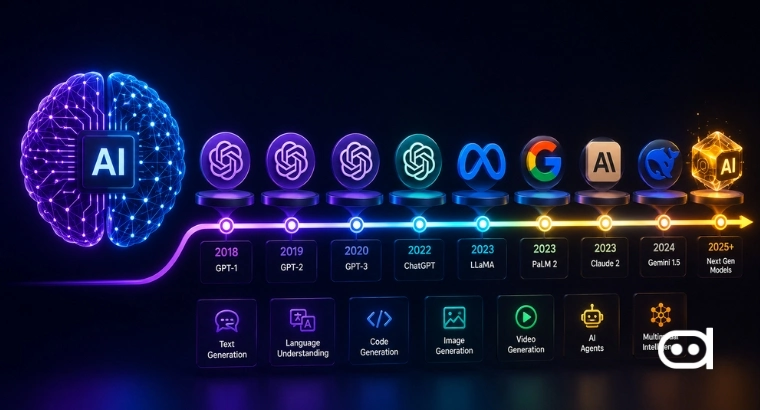
The Generative Pre-trained Transformer (GPT) series has changed artificial intelligence from a research curiosity to a mainstream tool, empowering innumerable interactions daily. The realization about the evolution of GPT versions over the years reveals how each one launched breakthroughs in language understanding and practical applications across industries.
GPT Version Comparison Table
| Features | GPT model release dates | Parameters | Training Data | Text Quality | Capabilities | Accessibility | Architecture Improvements | Safety & Alignment | Use Cases | Integration | Languages Supported | Pricing Plan |
| GPT-1 | June 2018 | 117M | Books + Wikipedia | Basic, coherent for short passages | Simple text generation | Research only | Vanilla Transformer | Minimal safeguards | Research | None | English only | Not public |
| GPT-2 | Feb 2019 | 1.5B | Larger web crawl | More fluent, but still repetitive | Storytelling, summarization | Research + limited API | Larger Transformer | Limited filtering | Creative text experiments | None | Mostly English | Not public |
| GPT-3 | June 2020 | 175B | Broad internet text, books, code | Strong fluency, context up to 2048 tokens | Coding, Q&A, creative writing | OpenAI API, enterprise integrations | Scaling breakthrough | RLHF introduced | Writing, coding, chatbots | API integrations begin | Dozens of languages | API pricing (per token) |
| GPT-3.5 | Mar 2022 | ~175B (optimized, fine-tuned) | Expanded + fine-tuned dataset, human feedback | More coherent, 4k–8k tokens, better reasoning | More stable, better chat, RLHF tuned | API + ChatGPT free/Plus | Optimized transformers + instruction tuning | Safer, instruction-following | Customer support, productivity, tutoring | Microsoft integration (Azure, Office) | ~95 languages | API + ChatGPT Plus ($20/month) |
| GPT-4 | Mar 2023 | Estimated 1T (not disclosed, mixture-of-experts architecture) | Vast, curated multilingual, multimodal data | Human-like, 8k–32k+ tokens, advanced reasoning | Multimodal (text + images), strong reasoning, advanced coding | Widely available via ChatGPT (Free/Plus/Enterprise) | Mixture of Experts (MoE), multimodal architecture | Reinforcement + Constitutional AI | Enterprise AI, multimodal apps, research | Microsoft Copilot, ecosystem partners | ~100+ languages, stronger multilingual fluency | ChatGPT Free (GPT-3.5), Plus (GPT-4), Enterprise |
| GPT-5 | Aug 2025 | Estimated multi-trillion scale (MoE, highly efficient routing) | Massive multimodal (text, image, audio, video, code) with continuous updates | Near human-level, deeper reasoning, context > 200k tokens | Fully multimodal (text, image, audio, video), superior reasoning, planning, memory | Available via ChatGPT, Microsoft Copilot, enterprise APIs | Advanced MoE, improved efficiency, memory systems | Advanced alignment, real-time adaptation, global compliance | Complex workflows, enterprise automation, multimodal agents | Deeper ecosystem: Microsoft, Adobe, enterprise suites | 100+ languages, near parity with English in many | Likely tiered: Free (GPT-4), Plus/Pro (GPT-5), Enterprise custom |
| GPT-5.2 | December 2025 | Not publicly disclosed | Large-scale multi-domain data | Highly structured, professional-grade outputs | Long-context reasoning, coding, vision, agentic workflows | ChatGPT & API | Enhanced reasoning depth and tool coordination | Improved factuality and mental-health safeguards | Knowledge work, coding, research, automation | NA | Multilingual | NA |
| GPT-5.3-Codex | February 2026 | Context Window of 128,000 tokens | General GPT-5 knowledge with advanced coding and software engineering training | Technical, precise, code-focused | Agentic coding, debugging, software development, tool use, long-running tasks | Paid ChatGPT plans via Codex app, CLI, IDE extension, and web | Faster inference, improved reasoning, enhanced coding performance | Enhanced safeguards with cyber-risk routing and Trusted Access program | Software engineering, automation, debugging, code generation | Codex app, IDE extensions, CLI, web (API planned) | Multiple programming and natural languages | $1.75 per 1 million input tokens and $14.00 per 1 million output tokens |
| GPT-5.3 Instant | March 2026 | Context Window of 128,000 tokens | Diverse multimodal training optimized for conversational AI | Natural, fluent, and conversational | Faster conversations, improved web search, stronger writing, reduced hallucinations | Available to all ChatGPT users and developers through the API | Better conversational flow, fewer unnecessary refusals, improved factual accuracy | Improved refusal behavior while maintaining existing GPT-5 safety framework | Everyday productivity, research, writing, web-assisted answers | ChatGPT and API | Multilingual support | $1.75 per 1 million input tokens and $14.00 per 1 million output tokens |
| GPT-5.4 | March 5, 2026 | Context Window of 1,050,000 tokens (1M+ for API) | Advanced multi-domain dataset with improved reasoning data | Highly structured, accurate, and professional outputs | Strong reasoning, coding, tool usage, and document creation | Available in ChatGPT, API, and Codex | Improved reasoning efficiency and tool integration | Reduced hallucinations and improved factual accuracy | Professional workflows, coding, research, and enterprise tasks | Works across tools, spreadsheets, documents, and APIs | Multilingual support | NA |
| GPT-5.5 | April 23, 2026 | Context Window of 1 Million tokens (922K input / 128K output) | Enhanced dataset with a deeper focus on agentic workflows and real-world tasks | More intuitive, context-aware, and refined responses | Advanced agentic workflows, autonomous task execution, and deeper reasoning | Available in ChatGPT, Codex, and rolling out in API | Better intent understanding, higher autonomy, and improved efficiency | Stronger safeguards, cybersecurity controls, and misuse prevention | Advanced automation, scientific research, coding, and large-scale workflows | Deeper integration with tools, systems, and multi-step workflows | Enhanced multilingual understanding | NA |
| GPT-5.6 | July 9, 2026 | Core context window of 1,050,000 tokens, a maximum output cap of 128,000 tokens | Large-scale multimodal dataset with updated post-training and reinforcement learning (details undisclosed) | More accurate, coherent, and efficient than previous GPT versions | Advanced reasoning, coding, scientific research, cybersecurity, computer use, and long-horizon agentic workflows | ChatGPT (eligible paid plans), OpenAI API, Codex, ChatGPT Work | Three-tier family (Sol, Terra, Luna), configurable reasoning effort, improved performance per token, Ultra mode for complex tasks | Stronger safeguards, improved misuse detection, enhanced cybersecurity protections | Software development, enterprise automation, research, design, data analysis, AI agents | ChatGPT, OpenAI API, Codex, enterprise applications | Multiple languages | API Rates (Per 1 Million Tokens): GPT-5.6 Sol: $5.00 input / $30.00 output GPT-5.6 Terra: $2.00 input / $12.00 output GPT-5.6 Luna: $0.20 input / $1.20 output |
| GPT‑6 Astra | September 3, 2026 | Not disclosed by OpenAI | Not disclosed yet; alignment improvements made from pre-training data through reinforcement learning | OpenAI’s strongest to date, with better instruction-following and fewer refusals of safe requests | Advanced coding, multi-step agentic tasks, science, computer use and cybersecurity | Rolling out via the Daybreak cyber program first, then Plus, Pro, Business and Enterprise, then API and AWS | Stronger reasoning and robustness training; however, specifics of architecture are not yet disclosed | First model at the Critical cyber tier, much more robust to jailbreaks and prompt injection than GPT-5.6 Sol; broad misalignment monitoring; monitorability has decreased | Software engineering, autonomous agents, scientific work, defensive cybersecurity | ChatGPT, OpenAI API, AWS, and Codex | Multilingual, no specific language list published | Free ChatGPT tier with limits; paid ChatGPT plans (Plus, Pro, Business, Enterprise) and usage-based API pricing |
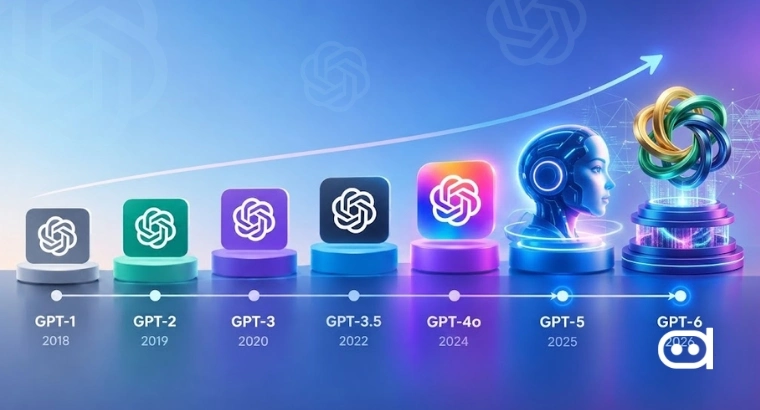
The GPT Version Timeline: How AI Evolved Over the Years
GPT-1
Launched in June 2018, OpenAI’s initial GPT Version showcased the transformer architecture’s language generation capabilities, ushering its unsupervised pre-training, along with supervised fine-tuning, into the limelight. This breakthrough marked the birth of generative pre-trained transformers in natural language processing.
Main Features:
- First transformer decoder implementation for language generation
- Ability to transfer learning in NLP tasks.
- Generate contextually relevant text.
Challenges and Limitations:
- The limit of only 117 million parameters made it inept at interchanging complexities.
- Very repetitive and sometimes nonsensical outputs.
- Had to be very finely-tuned for any kind of task.
- No harm-prevention or content-filtering mechanisms included.
Who Should Use: Research only, and will never be available for commercial use.
GPT-2
Released in February 2019, GPT-2 expanded to 1.5 billion parameters and stunned researchers with its text fluency. OpenAI initially withheld the full model due to concerns over misinformation and malicious use. It became the first AI model to spark global debate on responsible release strategies.
Main Features:
- Increased parameters enabled sophisticated outputs.
- Improved text coherence and context understanding.
- Better at creative writing and working across domains without task-specific training.
Challenges and Limitations:
- Initial release restrictions due to safety concerns.
- Inconsistent outputs.
- Demanding computational load.
Who Should Use: Content creators, researchers, and developers through APIs and open-source implementations.
GPT-3
In June 2020, GPT-3 released with 175 billion parameters, setting a new benchmark for generative AI capabilities. Its human-like responses fueled applications across writing, coding, and creative industries. The release cemented OpenAI’s leadership in scaling large language models.
Main Features:
- Large-scale architecture enabling complex reasoning.
- Few-shot and zero-shot learning without fine-tuning.
- Exceptional performances in diverse subjects.
- Available through API for commercial applications.
- Supports over 100 languages.
Challenges and Limitations:
- High computational cost restricts its access.
- Inability to update itself with real-world knowledge.
- Produces outputs that can be potentially biased.
Who Should Use: Businesses, developers, and content creators through the OpenAI API with various pricing options.
GPT-3.5
Introduced in March 2022, GPT-3.5 refined GPT-3’s performance with better reasoning and factual accuracy. It powered the first public version of ChatGPT, transforming how people interact with AI conversationally. This update bridged the gap between research prototypes and real-world deployment.
Main Features:
- Integration of reinforcement learning from human feedback.
- Better at following instructions and conversation flow.
- Better at refusing inappropriate requests.
- Better factual accuracy and less harmful outputs.
- Optimized for dialog applications.
Challenges and Limitations:
- Knowledge cutoff prevents awareness of recent events.
- Sometimes gets shaky when dealing with uncertain information.
- Cannot retain information learned in separate individual conversations.
- Not so good at complex mathematical reasoning.
- Cannot browse the internet.
Who Should Use: Millions access it through ChatGPT’s free tier, and ChatGPT Plus subscribers ($20/ month) get priority access.
GPT-4
Debuting in March 2023, GPT-4 added multimodal capabilities, enabling understanding of both text and images. It brought major leaps in reliability, safety, and complex reasoning — powering ChatGPT Plus. Businesses adopted GPT-4 widely for content creation, analytics, and customer engagement.
Main Features:
- Text and image processing capability
- Greatly enhanced reasoning and coding abilities
- Better factual accuracy
- Better safety with human value alignment
- Plugin ecosystem for real-time information access
Challenges and Limitations:
- Less capable of image-generation than specialized models
- Token limits for processing longer documents
- Premium pricing, limiting accessibility
Who Should Use: Professionals, researchers, and businesses through ChatGPT Plus or API access.
GPT-5
Launched in August 2025, GPT-5 represents the next evolution in multimodal intelligence across text, vision, and audio. It introduces adaptive memory and real-time workflow integration for enterprise and creative applications. With GPT-5, OpenAI moves closer to a truly general-purpose AI that can learn, reason, and assist dynamically. For developers and enterprises, GPT 5 with Codex further enhances AI-powered coding, automation, and real-time software development workflows.
Main Features:
- Reasoning and problem-solving that almost reach human levels.
- One of the top multimodal ai model in 2026
- Extended memory and long conversation context.
- Agent-like behaviors to execute sub-tasks toward complex task execution.
- Stronger alignment and overarching safety protocols.
Challenges and Limitations:
- Initially available only to premium subscribers.
- Users might get over-reliant and lose their critical thinking.
- Continued accuracy issues in specialized domains.
- Concerns about job displacement and societal impact.
Who Should Use: Enterprise users and professionals via the ChatGPT Pro subscription ($200 a month).
GPT-5.2
GPT-5.2 was introduced in December 2025 and is considered one of the most sophisticated GPT versions over the years tailored to professional knowledge and lengthy agentic tasks. One of the primary reasons why it is regarded as a significant turning point is that it was able to conquer the entire spectrum of writing, coding, data-analysis, vision, and multi-step workflows just to name a few. For instance, in the earlier versions, it could only answer questions, whereas GPT-5.2 is specifically optimized for performing whole tasks with total use of tools right from the starter to the finish line.
Main Features:
- Superior Vision: GPT‑5.2 has fewer hallucinations with a 30% reduction in occurrences of responses with errors on a set of de-identified queries from ChatGPT.
- Enhanced Agentic Capabilities: The areas of interactive coding, code reviews and bug finding have shown measurable improvements in this GPT version.
- Superior Coding Performance: The model has reached new levels of excellence in the field, outperforming the others in SWE-Bench Pro and other software engineering measurements.
- Expanded Long-Context Understanding: The Thinking of GPT‑5.2 is ranked highest on OpenAI MRCRv2. It can perform deep analysis, summarization, and synthesis of extensive documents such as contracts, research papers, and reports with precision.
Challenges and Limitations:
- Increased power consumption and cost as compared to the older OpenAI GPT timeline versions
- Generation of complex outputs may take longer than usual
- Humans are still needed to supervise the process of making critical decisions
Who Should Use: GPT-5.2 can be used by developers, researchers, enterprise teams, analysts, and users who regard AI as an integral part of their work every day.
GPT-5.3-Codex
OpenAI rolled out GPT 5.3 Codex Version in February 2026 and positioned it as its most capable agentic coding model right now. It builds on GPT-5.2-Codex and, in practice, feels like it delivers more solid programming results alongside better reasoning and a more professional knowledge base. Developers can tackle difficult coding tasks that require research, tool use, debugging, and even deployment, beyond simply writing code. It also offers roughly 25% faster execution and response time, which they attribute to infrastructure changes and inference improvements. Another kind of milestone is that OpenAI reportedly used earlier builds of this GPT Version while developing its own stack for troubleshooting, evaluation, and deployment support.
Main Features:
- More advanced agentic coding that can coordinate steps rather than only generate text
- Better reasoning when software gets complicated with multi-module projects
- Swifter runs and quicker responses
- Longer-running task support with persistent context
- Access is available via the Codex app, CLI, IDE extension, and also the web
Challenges and Limitations:
- API availability is still in the “rolling out” phase, so it is not uniform
- Some high-risk cybersecurity prompts may get automatically routed to earlier models for safety
- It is mainly optimized for software engineering, rather than general conversation
Who Should Use This Version?
GPT 5.3 Codex Version is designed for software developers, DevOps engineers, AI researchers, and technical teams handling large-scale coding efforts. At the moment, it is accessible with paid GPT Version plans inside the Codex ecosystem, while broader API access is still planned for a later window.
GPT-5.3 Instant
Released in March 2026, GPT 5.3 Instant Version is the newest conversational model in the OpenAI GPT timeline. It is different from Codex because it’s tuned for everyday ChatGPT chats to feel quicker, smoother, and more useful. OpenAI refined the model using what people reported, by cutting down unnecessary refusals, reducing over-the-top disclaimers, making answers more accurate, and giving richer results when you use web search. There’s also better writing quality, a more natural back-and-forth conversation, all while keeping the same GPT-5 safety framework.
Main features
- Faster responses for typical conversations
- Better web search integration with richer context
- Improved factual accuracy, fewer hallucinations
- More natural writing and a conversational vibe
- Less “no” when it’s not needed, while still staying safe
Challenges and limitations
- Some non-English languages still need work, especially on tone and fluency
- Response style customization is still changing and evolving
- The focus is general productivity, not advanced coding workflows
Who should use this version?
GPT-5.3 Instant is aimed at regular GPT Version users, students, professionals, writers, marketers, and basically anyone who wants quicker, higher-quality AI help for daily tasks. It’s available to all GPT Version users, and if you’re a developer, you can reach it via the API using the gpt-5.3-chat-latest model.
GPT-5.4
The release of GPT-5.4 in March 2026 represents a significant advancement in the development timeline of GPT versions, which business and professionals use as their primary tool. The system provides practical benefits through its unified model, combining enhanced reasoning abilities with improved coding proficiency and tool integration functions. This evolution of GPT delivers precise results through an optimized process, requiring fewer testing cycles to achieve outcomes and enabling faster work for developers and business users.
Main Features:
- Provides advanced reasoning capabilities that enable users to solve structured problems effectively.
- Delivers strong coding capabilities through its Codex-level intelligence-based execution.
- Has built-in computer functions that enable users to automate their work processes.
- Enables users to create spreadsheets, presentations, and documents.
- Supports up to 1M+ tokens, enabling users to perform extended and complicated tasks.
- Achieved better factual accuracy because it produced fewer hallucinations.
Challenges and Limitations:
- A main GPT-5.4 drawback is that it requires significant computational power to complete intricate tasks.
- Provides limited independent operation capabilities when compared with current models.
- Access to premium features available through paid subscription plans.
Who Should Use This Version?
GPT-5.4 functions as an ideal tool for developers, analysts, and enterprise teams who work on complex workflows that require coding and handling large volumes of data.
GPT-5.5
The release of GPT-5.5 in April 2026 marks a new development for the GPT version timeline, now offering a smarter autonomous system than before. The system improves its capability to comprehend human intentions and fulfill tasks through expanded functionality from GPT-5.4. This version operates as a collaborative assistant that requires minimal supervision to handle challenging tasks that need multiple steps to complete.
Main Features:
- Now supports users in managing complete workflows through its enhanced agentic capabilities.
- Provides better performance in coding tasks, as well as debugging and system-level reasoning tasks.
- Achieves greater task performance because it requires fewer tokens to complete each task.
- Users can operate advanced tools while moving between different software applications without problems.
- Excels at research tasks, data analysis work, and document generation activities.
- Achieves higher accuracy because it maintains better context information, which supports better decision-making.
Challenges and Limitations:
- The GPT-5.5 version costs more than earlier versions because of its advanced features.
- Needs more development to reach full autonomous operation capability.
Who Should Use This Version?
Professionals, developers, researchers, and enterprises who require automation and specialized problem-solving capabilities should use this GPT-5.5 version.
GPT-5.6
Launched on July 9, 2026, GPT-5.6 represents the latest step in the GPT version timeline, introducing a more flexible model family, including GPT-5.6 Sol, Terra, and Luna, rather than just one main model. In this latest GPT version, Sol is the flagship, aimed at heavier reasoning tasks and professional knowledge work. Terra sits in the middle with balanced everyday performance, and Luna is built for the fastest, most cost-friendly inference. Taken together, they show a noticeable shift in OpenAI models toward capability tiers that can operate independently while still addressing different user needs, depending on how people actually work day to day.
Main Features:
- Three specialized model tiers (Sol, Terra, and Luna)
- Upgraded coding, reasoning, cybersecurity, and scientific capabilities
- Better performance per token, with lower inference costs overall
- Enhanced computer-use and long-horizon agentic workflows
- Configurable reasoning effort with an Ultra mode for high-pressure jobs
- Stronger safety, alignment, and misuse protection
- Offers frontier-level performance, improves efficiency, while cutting down the cost of complex AI workloads
Challenges and Limitations:
- Public architecture and parameter count are still undisclosed
- Premium reasoning features depend on eligible paid plans
- Some advanced GPT-5.6 capabilities are still being rolled out across OpenAI products
Who Should Use This Version?
The GPT 5.6 version works especially well for developers, researchers, enterprises, software engineers, cybersecurity professionals, and businesses building AI-powered applications. Free users get access to selected GPT models and more basic ChatGPT features. Meanwhile, Plus, Pro, Business, and Enterprise subscribers get access to GPT-5.6 Sol, higher reasoning settings, ChatGPT Work, Codex integration, and a bundle of more advanced productivity features. Developers can also use all GPT-5.6 OpenAI models through the API with usage-based pricing.
GPT‑6 Astra (Current & Latest)
GPT-6 Astra launched on September 3, 2026, as OpenAI’s most capable broadly deployed model. OpenAI describes this GPT version as a generational step up in cybersecurity, software engineering, science, and computer use, and it is the company’s first model to reach the Critical cybersecurity level of its Preparedness Framework. That means, with the right tools and access, it can find previously unknown security flaws and develop ways to exploit them across well-protected systems without a person guiding each step. President Greg Brockman even said, “Welcome to the AGI era,” though independent benchmarkers were more measured and some questioned whether GPT 6 Astra meets OpenAI’s own definition of AGI.
Main Features:
- OpenAI’s strongest model yet for coding and complex software engineering on real codebases
- Handles multi-step agentic tasks, building websites, documents, spreadsheets, and presentations
- First model at the Critical cybersecurity tier, scoring 100% on ExploitBench against 78.5% for GPT-5.6 Sol
- More robust to jailbreaks and prompt injection than GPT-5.6 Sol, including over long tasks
- Better aligned than its predecessor, with about half as many high-severity misalignment flags in testing
- Acts more safely in browsing and workplace settings, avoiding unauthorized transactions and data loss
- Broad misalignment monitoring across all tool-using activity in deployment
Challenges and limitations:
- The latest GPT version’s Critical cyber capability carries real misuse risk, so the public model refuses offensive tasks such as building exploits
- Monitorability has decreased; the model is better at controlling its own reasoning and can sometimes evade internal monitors under adversarial testing
- OpenAI does not disclose parameters, training data, or a specific language list
- Less-restricted cyber access is limited to vetted defenders through the Daybreak program
- Independent testing has not confirmed the strongest capability and AGI claims, which come from OpenAI
Who Should Use This Version?
The main users for the latest version of GPT 6 are developers, engineers, researchers, and businesses working on coding, autonomous agents, scientific tasks, and defensive security.
The Future Beyond GPT-6
One would expect future GPT versions comparison to incorporate the accrual of reasoning abilities, enhanced personalization, improved memory systems, and multimodal integration, i.e., systems that work across multiple sensory modalities, including text, audio, video, and others.
In simpler words, it’s believed that GPT-6 and beyond will:
- Greatly refine logical reasoning and solve math problems.
- Personalize brilliantly, creating personal learning plans based on the preferences and specific learning styles of individual users.
- Retains context across chats due to better remembering capacity.
- Handle the integration of an extremely advanced multimodal system arising from complex real-world scenarios
Potential problems:
- Increasing regulations and compliance requirements.
- Ethical questions regarding consciousness and rights for AI.
- AI alignment to guarantee that these models remain beneficial as their capabilities increase.
- Computational costs and energy consumption for both training and deployment.
FAQs
Is GPT-5.5 free to use?
GPT-5.5 offers free basic access while its full range of features becomes accessible through paid subscriptions that include Plus, Pro, and Enterprise plans.
Does GPT-5.5 support coding and Codex tools?
Yes, GPT-5.5 provides advanced coding tools that work seamlessly with Codex to aid developers.
What are the drawbacks of GPT-5.4?
The GPT-5.4 version demands extensive computational power while offering users fewer independent operation abilities.
Why was GPT-2 considered dangerous initially?
OpenAI initially did not release GPT-2 in full over raised suspicions of nefarious use, though these concerns were largely manageable with safeguards in place.
Has ChatGPT gotten smarter?
Yes, over time, ChatGPT has improved in reasoning and accuracy. GPT-4 and GPT-5 have considerably improved in complex problem-solving skills.
How is GPT-4 different from GPT-3?
GPT-4 introduced multimodal capabilities for processing images and text, improved reasoning abilities, better safety measures against misuse, and better factual accuracy.
Is GPT-5 available to the public?
It is available through a ChatGPT Pro subscription and select API access.