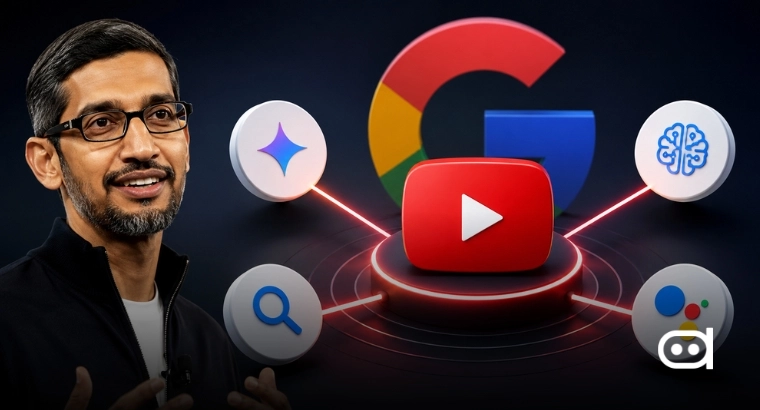
In a recent conversation, Sundar Pichai talked about how Google will unfold its upcoming plans. His message was lucid when he stated that Google is not trying to look appealing; instead, it wants the artificial intelligence to be useful. As Sundar Pichai highlighted that artificial intelligence is integrated within Google, especially in coding, this deep presence reshapes how Google designs its products across Gemini, Search, and YouTube. Google focuses on developing AI as more proactive, practical, and human-focused without affecting creator economies.
What Does Google Plan to Do With AI?
Sundar Pichai spoke about his vision where AI should exist as a mechanism that blends seamlessly into daily life operations. In his opinion, the future of AI is multimodal, agentic, and integrated into daily life products. Instead of placing Gemini as an ordinary chatbot working on prompts, Google wants it to become assistive and more involved. The idea is that artificial intelligence should help users efficiently, steadily, and create content with fewer friction.
Sundar Pichai also said that Google depends on AI, including its coding. This internal adoption puts volume on Google’s aim that artificial intelligence will be a part of daily operations. By building artificial intelligence into familiar tools rather than integrating it into a single application, Google aims for consistency, which matters more than experimentation.
Google’s declaration resembles what Sundar Pichai spoke about in the conversation. The company calls this AI Agentic Gemini space, where artificial intelligence collaborates with users to perform tasks across workflows rather than answering structured questions. Gemini aims for human interaction, allowing customers to generate, edit, and refine content through words and conversation.
Gemini Omni, in particular, is placed as a model that works across several surfaces, including the Gemini applications, Google Flow, and creator-centric products such as YouTube Shorts and YouTube Create. This advocates Sundar Pichai’s point that Google aims to embed a consumer-centric approach.
Rather than embedding artificial intelligence in the backend systems, Google places it within tools people already use to generate and publish content. Similarly, Google emphasizes that verification tools like Content Credentials and SynthID rebuild trust, security, and reliability as artificial intelligence-generated content becomes the norm.
Also Read: Jeff Bezos Says AI Will Reshape Labour Markets For the BetterYoutube at the core of Google
Why Is YouTube the Foundation for AI Testing?
YouTube is key to Google’s upcoming ventures because it is interconnected with creators and users. Pichai spoke about new features such as Ask YouTube and Ask Chat, making the platform interoperable and interactive. These introductions raise the issue: if AI answers the questions by itself, will people spend less time watching videos, and will creators lose their watch time?
Pichai emphasized this concern and said that Google’s aim is to keep YouTube creator-focused. In his opinion, artificial intelligence should help consumers explore the videos in depth and not act as a replacement for creators, weakening the human-to-human connection.
Google suggests that artificial intelligence in YouTube is meant for research, helping users to find similar videos, understand the content substantially, and engage with the content deliberately. YouTube places creators as the base of the platform, even if the artificial intelligence tool becomes more distinguished.
Across the interview and Google’s official blogs, one point keeps reappearing. The point is that AI should benefit people rather than replace them. Pichai’s arguments suggest that Google focuses on long-horizon success and amplifying human creativity. This idea is viable on YouTube, where the balance between sovereignty and creativity is intricate.
If artificial intelligence betters discovery and context without affecting creators, it boosts Google’s stance that advanced AI correlates with human ecosystems. By focusing on agentic systems that assist the audience, Google places artificial intelligence as a hidden layer that enhances products without breaking the creator dynamics.
In the interview, Google presents the AI strategy as practical. Instead of unnecessary claims, Google focuses on placing artificial intelligence as useful. Gemini, Search, and YouTube are key to this ambition, where AI can learn and generate. The company’s focus on agentic systems, multi-agent interaction, and creating security suggests that Google sees artificial intelligence as a long-horizon shift rather than short-term development. Whether this human-focused approach succeeds and propels further depends on Google’s actions scaling across its system.