Microsoft has rolled out MAI-Cyber-1-Flash, its first AI model focused entirely on cybersecurity, and integrated it into MDASH, the company’s multi agent system for spotting and fixing vulnerabilities. This is not just another tech launch; it shows where cybersecurity is heading. AI isn’t only about writing code anymore. Now, it is helping teams find, confirm, and repair software flaws. Microsoft argues that as attackers use AI to hunt for vulnerabilities faster and cheaper, defenders need their own AI tools that can keep up with the surge in threats.
Microsoft does not treat MAI-Cyber-1-Flash like a standalone model. Instead, they present it as one part of a bigger security workflow. The company says the combination of the model, its historical security data and the MDASH agent framework is what enables higher performance while reducing operational costs. The announcement also puts the model in direct comparison with Mythos, making it one of the key reference points in Microsoft’s evaluation.
What is MAI-Cyber-1-Flash?
MAI-Cyber-1-Flash is Microsoft’s first dedicated model for cybersecurity. The model goes through tough vulnerabilities in complicated codebases and operates within MDASH. This system coordinates a bunch of AI agents, each focused on finding and fixing vulnerabilities. Microsoft takes a layered approach. Instead of putting a single giant AI model in charge, they let specialized models handle routine security tasks while larger models are reserved for more complex cases.
According to Microsoft, the model includes several key characteristics:
- Built specifically for cybersecurity instead of general AI tasks.
- Integrated into MDASH, Microsoft’s multi agent vulnerability identification and remediation harness.
- Derived from the MAI-Thinking-1 model lineage.
- Designed to handle up to 90% of all tasks, allowing GPT 5.4 to manage only the remaining 10% of exceptionally hard tasks.
- Combined with GPT 5.4, the system achieved 95.95% on the CyberGym benchmark.
- Delivers the same workflow at 50% lower cost than Microsoft’s previous MDASH configuration.
- Developed with a security first calibration and evaluated through Microsoft’s AI Red Team, adversarial testing and an independent third party assessment.
MDASH does not rely on just one AI. It is backed by more than 100 agents crafted by cybersecurity specialists. These agents team up to pinpoint, check, and fix vulnerabilities. The company says this multi agent setup is especially useful because vulnerability management has become an always on task instead of something performed through occasional security scans. Beyond software vulnerability analysis, Microsoft also introduced Project Perception, an agentic security system that will eventually use MAI-Cyber-1-Flash across additional security workflows to continuously monitor systems, patch weaknesses and close new threat vectors.
Microsoft AI Releases MAI-Cyber-1-Flash: A 5B-Active-Parameter Cyber Model That Pushes MDASH to 95.95% on CyberGym. It is their first cyber defense model built ground up to find the most challenging vulnerabilities in complex code bases. [137B total, 5B active parameters]
— Marktechpost AI (@Marktechpost) July 28, 2026
The… pic.twitter.com/6vDOE0tVlD
How MAI-Cyber-1-Flash Compares With Mythos
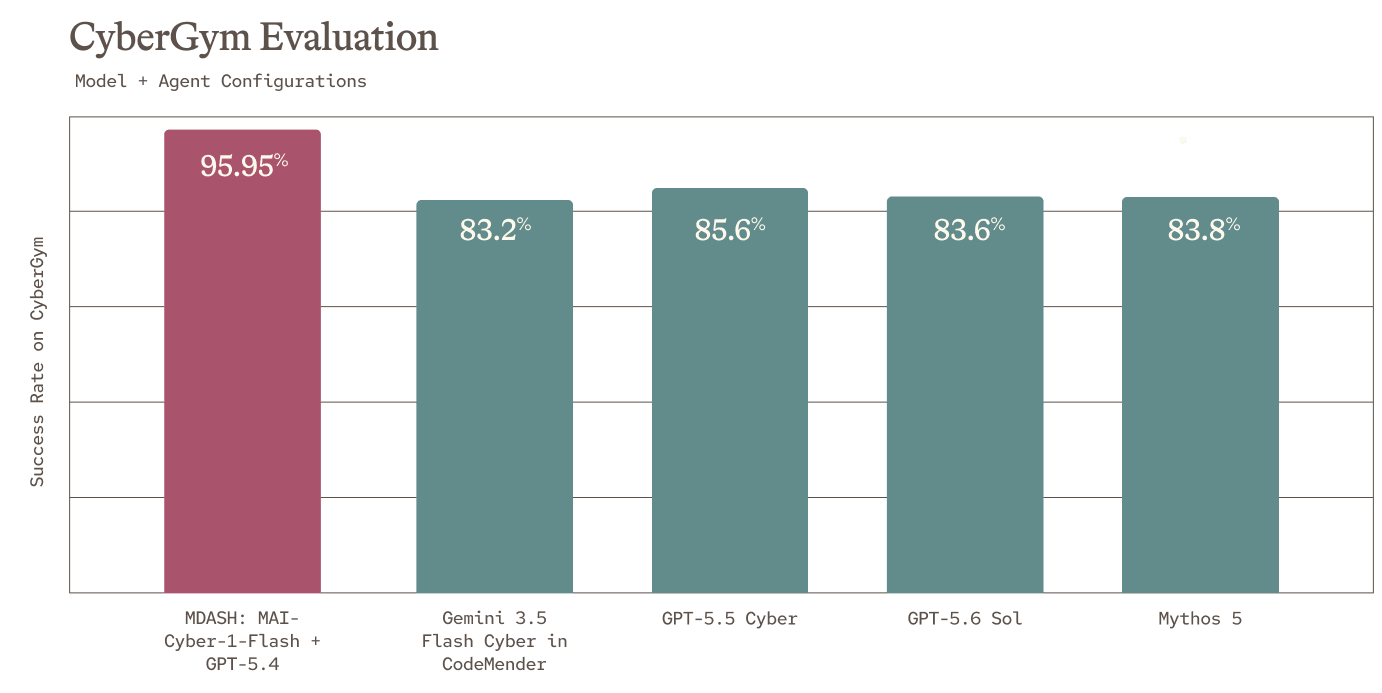
One of the notable aspects of Microsoft’s announcement is that it directly compares its new cybersecurity system with Mythos using the CyberGym benchmark. Rather than comparing general AI capabilities, Microsoft focuses on how well cybersecurity systems reason across large codebases to discover real vulnerabilities. According to Microsoft’s published benchmark, MDASH with MAI-Cyber-1-Flash and GPT 5.4 scored 95.95%, while Microsoft states the result is +12 points above Mythos. The comparison is presented as evidence that Microsoft’s multi model architecture performs better on this specific benchmark.
Another big difference lies in how the systems are built. Microsoft relies on MAI-Cyber-1-Flash as a compact, specialized model to handle most security tasks. Only the most difficult cases are escalated to GPT 5.4. This split helps the platform keep high performance and cuts computing costs by half compared to their old MDASH system.
Microsoft also argues that its advantage extends beyond the model itself. Their formula includes three factors: the model itself, deep historical security data, and the MDASH agent system. They tap into over 100 trillion security signals every day, plus practical knowledge from 1.6 million customers. Microsoft sees all this historical data as fuel for continuous reinforcement learning and training the system using real vulnerabilities, attacks, fixes, and defense outcomes.
The comparison with Mythos therefore is not limited to benchmark scores. Microsoft’s announcement frames MAI-Cyber-1-Flash as a part of an integrated cybersecurity platform where specialized AI models, large scale security data and coordinated AI agents work together. In Microsoft’s view, this combined approach is intended to improve vulnerability detection, prioritize remediation and support continuous defensive operations rather than relying solely on a single large AI model.
Also read: Microsoft Launches MAI-Code-1-Flash on GitHub Copilot, Bringing a New In-House AI Coding Model