The artificial intelligence industry continues to move fast, with companies introducing new models that aim to improve coding, reasoning, and agent based capabilities. One model which is drawing a lot of attention lately is GLM-5.5 from Z.ai. Early reports say it is going to be released with open weights and advanced AI agent features. Even though Z.ai has not officially launched it yet, GLM-5.5 has already become a topic of discussion, mostly because of what users expect from its features and performance.
Right now, everything we know about GLM-5.5 comes from preview articles and early media coverage, and not detailed technical documentation from Z.ai itself. These reports say Z.ai is working on a model built for software development, handling long contexts, and powering autonomous AI agents and workflows. While several key details have been shared, there are still many aspects of the model that remain unknown until an official release.
What Is GLM-5.5 and How It Works
GLM-5.5 at a glance
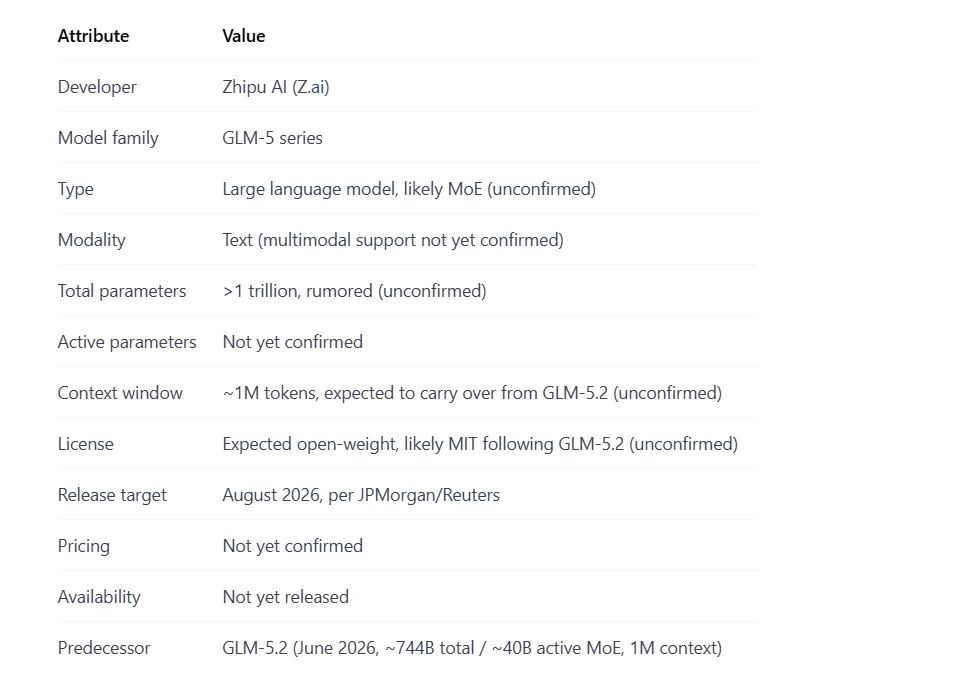
GLM-5.5 is pitched as the next big step in Z.ai’s series of large language models. Based on what has been shared, GLM-5.5 is designed with a strong focus on coding, reasoning, and running AI agents that can tackle complex projects with less need for human intervention. GLM-5.5 is expected to be open weight, that means developers and researchers not only get to use it but can also access the trained weights, run the model themselves, fine tune it, or reshape it for their own uses. They are not stuck depending on a cloud service. This approach is a big deal for organizations wanting more control and flexibility over how they use AI.
According to these reports, GLM-5.5 is expected to feature more than 1 trillion parameters, putting it among the largest open weight AI models. Along with this, the model is also expected to support a reported 1 million token context window, letting it process massive amounts of information in a single session. That kind of context window means the model can follow long threads, whether you are talking about lengthy documents, big codebases, or extended chats, without losing track.
GLM-5.5 also aims to boost AI agent functionality. Instead of just responding to one prompt at a time, it should handle more complex, multi step tasks, planning moves, writing code, solving problems, and moving workflows forward, with minimal guidance. This agent method is supposed to make AI systems more practical for real work instead of simply generating text.
Coding is another area where GLM-5.5 is expected to perform strongly. Reports say GLM-5.5 is engineered for software engineering tasks, so it can help with programming, debugging, and code generation. Since it is built with a big context window, it can handle long running coding sessions, diving into bigger code files or project histories without getting lost. These previews also say GLM-5.5 builds on the progress made by earlier GLM models, which pushed forward on reasoning skills, coding help, and handling longer contexts. GLM-5.5 is the next step of that development.
GLM-5.5 Leak: It Beats Fable 5,
— Md Ismail Šojal 🕷️ (@0x0SojalSec) July 26, 2026
Z..ai is reportedly preparing a much bigger jump than expected.
– Positioned to compete directly with Fable 5 & Mythos
– May skip GLM-5.3 entirely
– August launch target
– Rumored 1T+ parameters
– Open-weight
– 1M context window
– Built for… pic.twitter.com/8iFSwdbp3G
Availability and What We Do Not Know Yet
Although interest in GLM-5.5 continues to grow, many important details are still unavailable. Based on the reports, the model is expected to be released around August 2026, but an official launch date has not been confirmed by Z.ai. There is also no official model card available yet. As a result, many technical details remain uncertain. The reports discussing more than 1 trillion parameters and a 1 million token context window are based on early information, and these specifications have not been formally confirmed through official documentation.
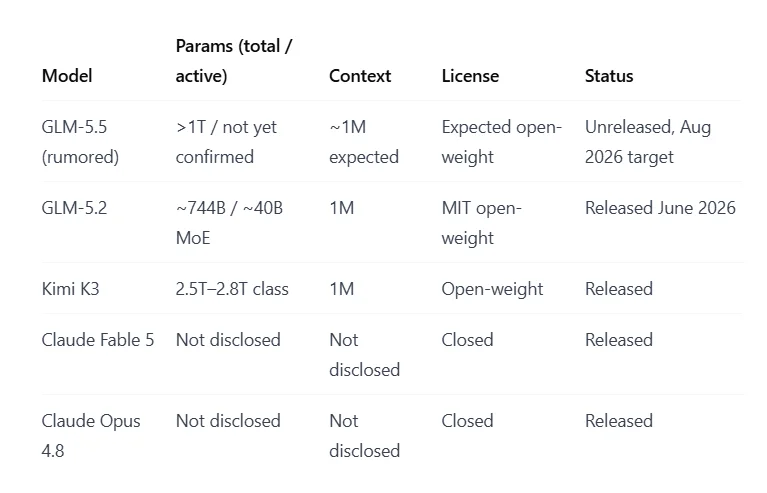
Another unknown specification is how GLM-5.5 will perform against other leading AI models. While the available articles suggest that it is being developed to compete in areas such as coding, reasoning, and agent based workflows, there are currently no independent benchmark results or verified performance comparisons available. Until official evaluations are published, it is not possible to measure its capabilities against competing models.
Pricing is another area that remains unclear. The reports do not provide information about whether GLM-5.5 will be offered through paid APIs, free access, or other licensing options. Similarly, hardware requirements, deployment options, and supported platforms have not yet been officially detailed. GLM-5.5 should be viewed as expectations rather than confirmed facts since the model has not been publicly released and details about its final architecture, benchmark scores, and real world performance are still unknown.
Also read: GLM 5.2 Surpasses Claude Fable 5, Tops DesignArena Rankings