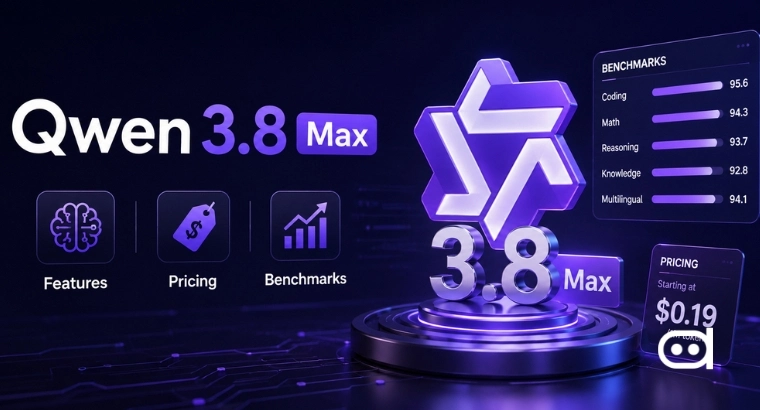
Alibaba Cloud has launched Qwen 3.8-Max on August 3, 2026 a 2.4-trillion-parameter model that will be distributed under a open-weights with license not yet published. Developed to compete directly with commercial APIs operated by Western firms like OpenAI and Anthropic, this release introduces long-horizon agentic autonomy alongside a 1-million-token multimodal context window. By providing the global developer community with downloadable model weights, Alibaba allows organizations to host, modify, and execute this frontier-class architecture on independent infrastructure.
The announcement has drawn substantial attention across technical forums, where preliminary evaluations indicate that the system performs competitively with top-tier closed models on software engineering, computer vision, and multi-step programming tasks, shifting the balance between open-weight and closed model distribution. Alibaba is also releasing a second checkpoint, Qwen3.8-27B, under open weights. At 2.4 trillion parameters the flagship is a multi-node datacentre artifact, while the 27B model is the version that fits standard on-premise GPU hardware.
What Qwen 3.8-Max Can Do
Qwen 3.8-Max uses a sparse Mixture-of-Experts architecture. Although the complete model scales to 2.4 trillion total parameters, the system’s routing mechanism selectively activates 95 billion parameters during live inference, which lowers latency and serving cost relative to a dense model of the same size. A central focus of this architecture is its design for long-horizon agentic workflows, which allows the model to execute multi-step operations over extended durations without continuous human prompting. Alibaba reports that during internal validation the model operated autonomously within a live GitHub repository for 10 consecutive days, executing 265 code commits and 127 pull requests. Working from high-level user feedback, the system processed repository requirements, generated functional code, ran integrated testing suites, and resolved runtime bugs independently, ultimately executing 265 code commits and 127 pull requests.
Beyond automated software development, the architecture extends to specialised industrial and engineering work. In quantitative financial simulations, the model managed parallelized factor research by decomposing asset classes into fifty distinct research pathways, deploying 330 localized sub-agents, and running over 6,000 algorithmic backtests to optimize risk-adjusted returns. Its multimodal input also processes real-time visual data as an active feedback loop to inform continuous planning and error correction. Commenting on the official announcement thread on X, tech professional Shakthi noted the operational continuity of the system, stating that “the model keeps working so people can step away from the screen and still move projects forward.” Technical documentation also highlights the model’s capacity to execute 500-turn physical silicon microchip layout optimizations and conduct comprehensive corporate legal compliance audits within condensed timeframes.
How Qwen 3.8-Max Compares to Fable 5 and Kimi K3
Alibaba’s deployment strategy addresses a broader debate regarding the monetization and control of frontier-tier artificial intelligence. For several years, high-performance models have primarily been restricted to commercial cloud APIs. By offering open weights alongside a lower-cost preview pricing model via Alibaba’s Token Plan, Qwen 3.8-Max allows independent researchers and enterprise startups to deploy localized, corporate-grade intelligence. Public response within developer networks, such as Reddit’s r/singularity, has focused on the model’s potential to lower the barrier to entry for independent development, with community members noting that the availability of such a model places competitive pressure on proprietary AI vendors.
Qwen 3.8 max benchmarks
by u/CounterReady4774 in singularity
This market interest is accompanied by early performance data from public testing platforms. Following its release, Qwen 3.8-Max reached the number two position globally on the crowd-sourced Vision Arena leaderboard, alongside top-five positions in the Frontend Code and general Text Arenas. These human-evaluated benchmarks offer a measure of practical utility alongside standardized synthetic evaluations. On the official launch thread on X, developers observed that an open-weights architecture matching or exceeding closed commercial alternatives indicates a shift in the distribution of computing capabilities. While industry analysts advise caution until the downloadable weights are fully audited and tested on local hardware next week, current evaluations confirm that the introduction of Qwen 3.8-Max has diversified the international marketplace for accessible AI engineering tools.
You may also like to read – Kimi K3.1 Leaks: What Moonshot AI’s Next Model Could Bring
Two caveats sit inside Alibaba’s own figures. The multimodal comparison table is benchmarked against Qwen3.7-Plus rather than Qwen3.7-Max, which widens the apparent generational gain, and the company’s published reinforcement-learning scaling curve peaks near 4,000 training environments before declining.