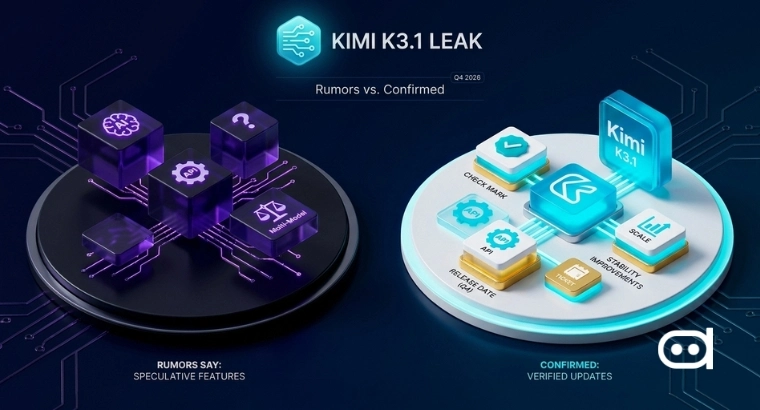
Reports about a possible new AI model from Moonshot AI have started attracting attention after details about Kimi K3.1 appeared online. According to reports, the information comes from a leak and has not been officially confirmed by Moonshot AI. Still, the reported upgrades have started discussions among developers and users who are eager to see what the next version of the Kimi series could offer.
The report outlines several expected improvements, ranging from better performance and faster responses to stronger coding capabilities and improved efficiency for long reasoning tasks. Official details are still awaited to be confirmed by Moonshot AI but the leaks offer an early look at what Kimi K3.1 could bring if the reported information proves to be accurate.
Kimi K3.1 Leaks & Speculations: What We Know So Far
The OrcaRouter report states that Kimi K3 remains the officially released model, and the latest discussion centers around a newer version reportedly called Kimi K3.1. Based on what is being shared online, the upcoming model is expected to introduce several improvements aimed at making it faster, smarter, and more efficient across different types of AI tasks. Some of the key details mentioned in the report include:
- Better overall performance
- Faster inference and lower latency
- Improved token efficiency for long reasoning tasks
- More reliable coding performance along with better support for AI agent workflows
- Fewer unnecessary reasoning steps
- A possible open weight release.
One of the biggest highlights is the focus on overall performance improvements. According to reports, Kimi K3.1 is expected to move closer to some of the strongest proprietary AI models available today, Claude Fable 5. Although the report does not include benchmark scores or technical comparisons, it suggests that the model is being designed to deliver stronger results across a wider range of tasks. The report also mentions improvements in inference speed and latency. Faster inference means the model can generate answers more quickly, while lower latency reduces the waiting time between a user submitting a prompt and receiving a response. These improvements could make everyday conversations with the AI feel smoother, especially for users who depend on quick interactions.
Another reported upgrade is better token efficiency during long reasoning tasks. AI models often need to process large amounts of text when answering detailed questions or completing complex instructions. Kimi K3.1 is expected to handle these longer prompts more efficiently, potentially improving both speed and consistency during extended conversations. Kimi K3.1 could also provide more reliable performance for programming related tasks. This includes generating code, assisting developers, and supporting AI agent workflows that rely on completing multiple connected tasks. Better reliability in these areas could make the model more useful for software development and automation projects.
The leaks also point to changes in the model’s reasoning process. Instead of producing extra reasoning that may not always be necessary, Kimi K3.1 is expected to reduce unnecessary reasoning steps. This could allow the model to generate clearer and more direct responses while also maintaining the quality of its answers. There is also the possibility of another open weight release. Open weight models allow developers and researchers to access model weights for further experimentation and deployment. Kimi K3.1 could continue supporting a wider developer community interested in building AI applications using the model with this approach.
🚨 Kimi K3.1 Leaks
— Adit_Yah ☄️ (@Adidotdev) July 27, 2026
moonshot isn't even letting K3 breathe
– targeting an august launch, weeks after K3 itself
– a researcher inside moonshot is said to have acknowledged it
– expected to close more of the gap with fable 5
– K3's open weights still landing within hours,… pic.twitter.com/xliEs2EBwH
Apart from the reported features, there are currently no published benchmark results, model cards, or release dates connected to Kimi K3.1. As a result, many technical details about the model remain unavailable, including its architecture, training process, supported context length, and hardware requirements. For now, the available information provides an early glimpse into what Kimi K3.1 could offer. The reported improvements in performance, speed, coding ability, reasoning efficiency, and token management suggest that the model is being positioned as a stronger successor to Kimi K3.