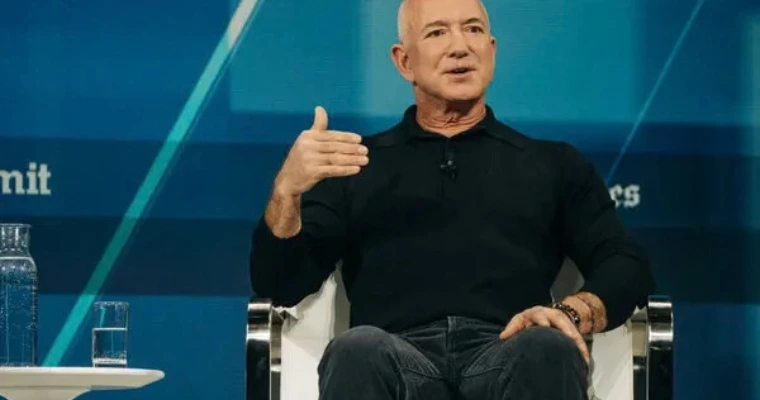
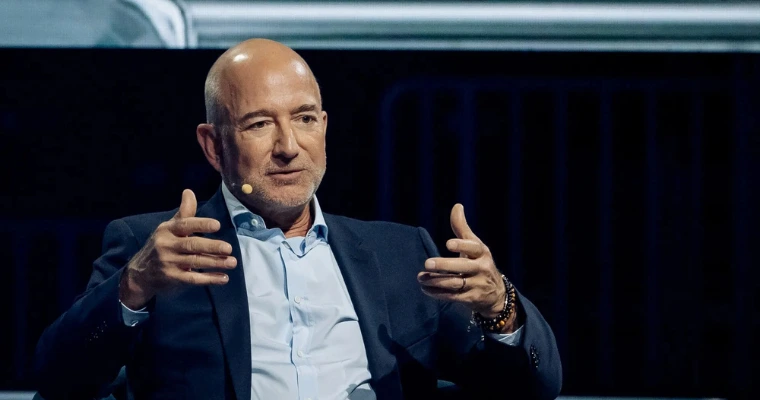
In a statement, Jeff Bezos bespoke, ” Artificial intelligence will lead to labor shortages rather than mass human replacement.” This highlights the growing scrutiny that AI will affect the workforce. The Amazon founder spoke about it while discussing his new artificial intelligence startup, Prometheus, at the VivaTech conference in Paris.
Bezos spoke that artificial intelligence’s profound impact will boost productivity, especially in the physical and industrial realm, rather than eliminating the need for human labor altogether. Prometheus, his novel venture, is focused on using artificial intelligence to accelerate physical manufacturing. This has been an area that has been comparatively slower due to fewer artificial intelligence adopters.
Every time the productivity increases, so does the demand, Jeff Bezos quoted, suggesting that artificial intelligence’s efficiency will lead to faster work. In his opinion, the factor that will be the core will be that not too many workers will change jobs, but a few skilled workers will be able to cope with the scaling industry trends.
How Does AI Multiply Productivity
Jeff Bezos’ statement resonates with the Silicon Valley narrative that witnesses AI as a productivity multiplier. It enhances human capabilities to a larger extent rather than replacing it. Prometheus is placed within this narrative. Instead of targeting the content in knowledge, the startup aims to develop physical manufacturing pipelines for factories and logistics where there are acute labor shortages across Europe, the United States, and parts of Asia.
Bezos also quoted that manufacturing faces challenges such as aging workforces, reduced interest among young workers, and accelerating demand for faster production. An artificial intelligence system that pushes workflows, decreases time, and improves precision allows fewer workers to produce optimally without eliminating human oversight and conception.
Also Read: Satya Nadella Urges Indian Firms to Invest in Sovereign AI Systems
Stark Contrast With Chinese Strategy
Jeff Bezos’s positivity reflects a contrast to China’s policies. China aims for increased AI adoption while planning quiet layoffs. In recent months, multiple Chinese technological and manufacturing firms planned quiet layoffs. Analysts point out that government policies push artificial intelligence efficiency, reduce costs, and promote self-reliance as the core components. Rather than redeploying workers, some organizations use AI as a direct replacement for labor in export-oriented sectors.
This distinction reflects substantial differences in artificial intelligence. In the United States and Europe, artificial intelligence is used to address labor scarcity and demographic changes, whereas in China, it is positioned as a tool for a rising economy, productivity, and geopolitical perseverance. As a result, analysts state that when organizations prioritize federal compliance over workforce transition, workforce reductions are rarely publicized.
What Are the Distinct Outcomes?
Jeff Bezos’ comments emphasize this divide. His statements speak about the fact that flexibility in labor markets, proprietary invention, and the creation of continuous demand. Artificial intelligence in this model expands the economic strata, leading societies to regulate and create more opportunities. China’s approach, by contrast, reflects practicality. They use AI as a leverage to maximize output with fewer people. As they struggle with growth, demographic changes, and increasing competition. While this strategy is highly effective in the short term, it also poses risks of job insecurity and social tension.
Jeff Bezos ignited a debate that goes beyond the launch or sovereignty. It raises a question: Will AI be deployed to augment human potential or replace it? Technology itself does not contain the answer. Regulation policies, corporate benefits, and societal values determine the change. As artificial intelligence systems embed deeper into the physical realm, beyond software and services, the disadvantages will become invincible. Jeff Bezos’ warning is not grim, but conditional. Artificial intelligence can create labour shortages and growth, but only if the economy chooses to build around people and not only efficiency.