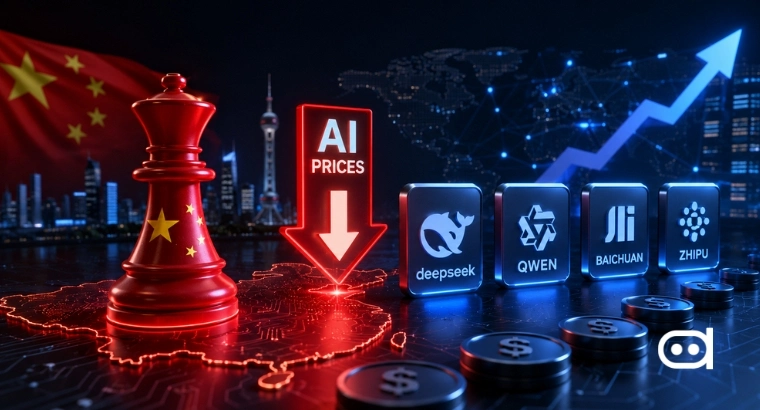
The conversation was fixated on who has efficient models. That is now changing. China’s leading AI labs are no longer just bridging the performance gap with OpenAI, Anthropic and Google, but are making AI facilities cheaper. This nuance turns cost into a competitive advantage that could reshape enterprise adoption worldwide. Moonshot AI’s release of Kimi K3 marked another cornerstone in that shift.
The open source model arrived with benchmark gains approaching Anthropic’s fabled 5, while carrying a significantly lower usage cost. But Kimi is only the newest example. DeepSeek, Z.ai, Tencent, Alibaba, MiniMax and Meituan are all becoming capable models at price that undercut their U.S. rivals, changing how developers and businesses think about adopting AI.
What Is Driving China’s Price Advantage?
Moonshot AI garnered global attention after revealing Kimi K3, positioning it among the strongest open-source models available. Single benchmarks placed the model alongside or even ahead of many leading enterprise systems, challenging the assumption that U.S. AI labs would retain a comfortable lead. The announcement also reinforced a broader trend we see shown in 2025 that frontier-level performance could be achieved using less computing sources through engineering optimizations rather than GPU scale.
Z.ai followed with GLM 5.2, a model that gained traction for coding and creative workflows, while Meituan showed that frontier-scale models could be trained using natively produced Chinese processors. Instead of depending on larger training budgets, Chinese AI have increasingly focused on effectiveness, open-source releases, and feasible pricing strategies. The outcome is a market where multiple Chinese labs now compete at the frontier, instead of a single standout player.
The more noticeable shift is happening in the economy. While Anthropic Fable costs around $50 per million output tokens, Moonshot prices Kimi K3 at $15, Z.ai’s GLM 5.2 around $4, and DeepSeek V4 Pro below $1 for the same output length. Those distinctions become enormous for enterprises processing millions or billions of tokens every month. Lower pricing is already affecting real-world adoption.
Developer marketplace OpenRouter has seen Chinese models cluster usage rankings, with multiple Chinese AI labs occupying the platform’s most-used positions. Companies are increasingly selecting models based on total operating cost rather than brand recognition. Major enterprises are also beginning to bifurcate.
Coinbase has said it reduced AI expenses by shifting workflows toward Chinese models, while DoorDash has started using Kimi for lower-level coding tasks because it delivers similar quality at significantly less cost. Airbnb has previously disclosed use of Alibaba’s Qwen for customer service applications, showing how Chinese models are silently entering production environments. Rather than replacing premium U.S. models everywhere, Chinese AI labs have increasingly becoming the default option for coding, customer support, document processing, and enterprise automation, where cost matters more than squeezing out of benchmark gains.

How Did Export Controls Reshape China’s AI Strategy?
Ironically, U.S. export constraints have pushed this change. Limited access to Nvidia’s most advanced GPU pushed Chinese labs to use software, training methods, inference efficiency, and model architecture, instead of simply scaling compute. That push produced models capable of delivering better performance using less expensive infrastructure. China also benefited from lower electricity costs, expanding domestic data center capacity, and increasing availability of natively developed AI accelerators.
Organizations can now deploy models in Huawei and other domestic hardware while continuing to improve performance. It was also through China’s commitment to open-source AI. Most leading Chinese labs release models under permissive licenses, allowing researchers and developers to download, fine-tune, and adopt them on their own infrastructure without monotonous API costs.
Once adopted locally, organizations primarily pay for hardware and electricity rather than premium inference pricing. That approach resonates with the growing demand for AI sovereignty, giving federal authorities and enterprises greater control over adoption, customization, and data residency.
China’s AI strategy is focused on distribution rather than benchmark gains. By offering frontier AI models at lower prices and prompting open-source releases, Chinese AI companies place themselves as the default for developers seeking a feasible large-scale AI deployment.