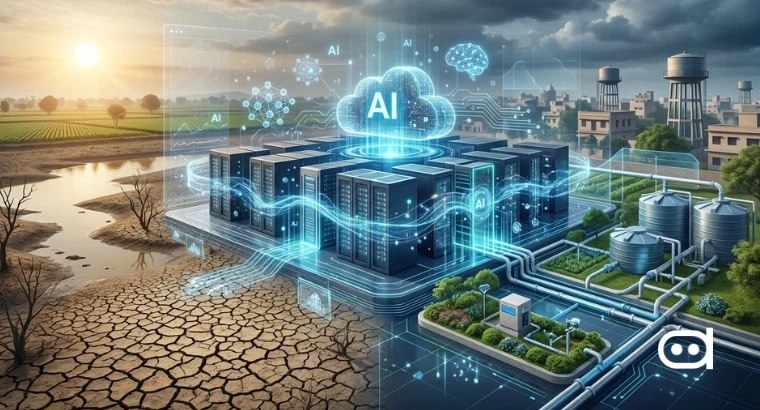
As companies worldwide face immense pressure over sustainability and environmental footprint, Amazon says its Indian operations have taken a new step in sustainability. The US-based firm declared that it has become water positive in India, giving back more water to the local communities than it uses for its facilities. The declaration comes as AI data center expansion boosts across the nation, with growing concerns about water scarcity, energy, and global warming in the most water-stressed regions.
What Does Water Positive Mean for Amazon?
Amazon said its India functioning, inclusive of data centers, corporate offices, and warehouses, have already replenished water usage more than they used. The company achieved this position of decreased water consumption at its operations and invested in community-centric projects such as watershed restoration and better irrigation systems.
As per Amazon, the goal was fulfilled a full year ahead of the plan. The company also stated that it does not use water to cool down its India air data centers, which is a key point, as data center cooling practices are a big issue for activists around the world.
Water deprivation remains a problematic nuance in India, which supports about 18% of the world’s population but has only access to 4% of global freshwater resources. Water shortages are common, particularly during the summer months when rationing becomes widespread. This year, the situation has been particularly difficult due to a strong El Niño, which weakened the monsoon rainfall and aggravated existing stress on water systems.
Some of the hardest-hit states include Karnataka, home to major technology hubs such as Bengaluru, and Maharashtra, and Mumbai is authorities in Mumbai said this week the city had just 40 days of water supply pending, 40 days of water supply, underlining the necessity of conservation efforts.
Also Read: Sundar Pichai to Focus On YouTube as It’s Center of Google’s Upcoming AI Strategy
How Does This Fit in Amazon’s Investment Plans
Amazon is not the only one that is facing such problems. Alongside Microsoft and Google, Amazon has faced scrutiny from shareholders, stakeholders, and environmentalists over the water and power surge for data centre projects. These concerns have grown as conglomerates rush to expand our district’s capabilities, which need significant computing power and additional infrastructure. Previously this year, investor groups raised the question of whether prevailing water and energy systems can keep up with the expansion without affecting residents or ecosystems.

Amazon has promised to be water positive across the world for its data center operations by 2030. India presents a key test case for that vision, given the country’s restrictions on water and its growth in Amazon’s long-term strategy. The organization plans to invest more than $35 billion in India by 2030 to expand base operations, develop AI capabilities, and accelerate exports.
Its cloud arm, Amazon Web Services, is also planning a massive expansion with about $8.2 billion mandated for investmentsAmazon Proves AI Growth can exist with sustainability in Maharashtra, according to India’s Information Technology Ministry. At the same time, the competitors are also investing in the country. Microsoft and Google have also declared large AI data center investments in India over the past year, accelerating the competition and environmental scrutiny in the nation.
Amazon’s declaration that it has become water positive in India emphasizes how sustainable operations are inseparable from the artificial intelligence architecture race. As AI data centers grow and investments boost, companies are under constant pressure to prove that expansion can work together with responsible resource management. In a country already struggling with massive water restrictions, Amazon’s achievements may serve as a benchmark and a test of whether sustainable commitments can be on the same wavelength with the need for an artificial intelligence-driven future.
The declaration also comes as India positions itself as a crucial destination for worldwide cloud and artificial intelligence investment. There is also a spotlight on how global technology firms manage environmental resources. With Amazon, Microsoft, and Google all its plan accelerating their artificial intelligence data centers in the nation, water stewardship is becoming a key measure on how sustainable the growth is.