SpaceX CEO Elon Musk has confirmed the name of the American aerospace manufacturer’s most anticipated project yet. In a recent interaction on X, Musk locked in Starmind as the official name for SpaceX’s upcoming plan to orbit up to a million AI-enabled satellites. The name was first teased through xAI trademark filings and backed by a January 2026 FCC application for non-geostationary orbital data centers.
Here’s a brief on what the Starmind project is, how Musk plans to tackle power and water limitations, challenges, timeline and more details on the project.
Yes
— Elon Musk (@elonmusk) June 23, 2026
What Project Starmind Actually Is
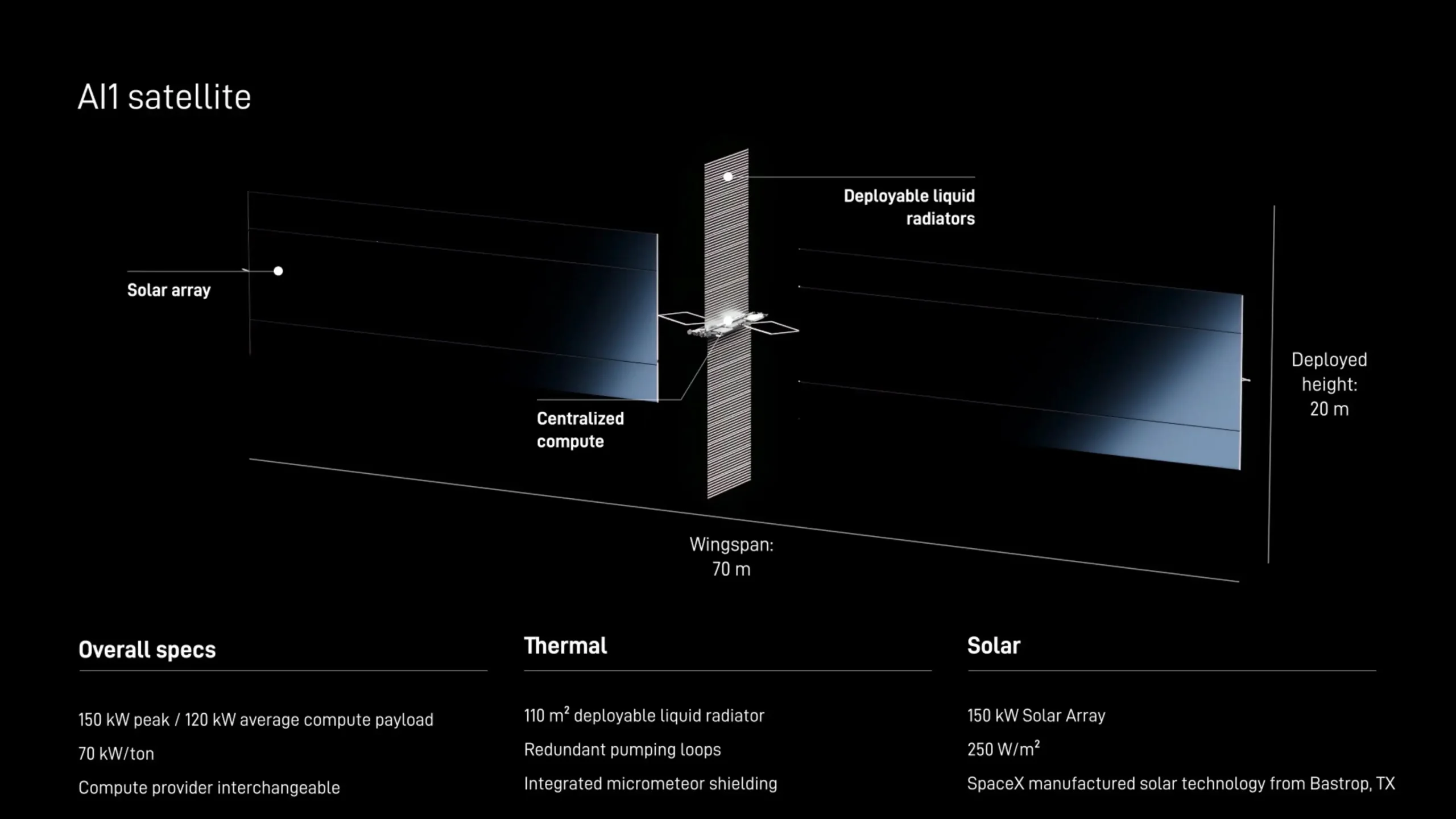
Starmind isn’t a satellite that launched this week, but rather the constellation name. The satellite itself however, is called AI1, sometimes referred to as “AI Sat Mini.” Earlier this year, Space X filed an application with the FCC in late January for a constellation of up to one million satellites that would be used as an orbital data center for AI applications. Each satellite is dominated by large solar arrays and would generate up to 150kW of power at peak and up to 120kW consistently.
Unlike Musk’s Starlink, which was used to provides high-speed, low-latency broadband internet, Starmind satellites would perform on-orbit inference and other AI workloads using onboard processors and large solar arrays. Then, it would transmit these results to Earth, routing AI queries without dependency on terrestrial data centres. In simpler terms, the AI processing is done in space, and the results are sent to your device.
In regards to the timeline, nothing from the project is in the orbit as of yet. However, two AI1 satellites are scheduled to launch in early 2027, with volume production targeted by the end of 2027.
Why Musk’s Space Orbital AI Data Center Makes Sense
One of the main problems currently faced in the AI industry is availability of physical space to host large data centers, as well as concerns in regards to significant power and water usage. For perspective one can consider how Meta has planned Hyperion data center in Lousiana, which is expected to scale to 5GW and house around 2 million GPUs, while xAI’s Colossus 2 facility in Memphis has expanded to nearly 2GW with approximately 555,000 GPUs. Both these facilities require enormous power and water from local grids an reservoirs.
With Starmind, Musk puts an argument that the orbit would remove all of these limitations, and reiterates that data centers in space will be more cost-effective than terrestrial data centers in as little as two to three years, citing abundant solar power and a lack of real estate contraints. He stated, “Increasing power on Earth becomes harder over time and more expensive over time, but in space it becomes actually cheaper and easier over time.”
Watch @ElonMusk provide a technical update on SpaceX’s capability to manufacture, launch, and operate AI satellites at scale → https://t.co/PSCyWrNsOg pic.twitter.com/vhtr46uax7
— SpaceX (@SpaceX) June 8, 2026
The most debated concern in regards to AI footprint is the water consumption. Ground-based date centers consume large volumes of water for cooling, and that draw has become a flashpoint in permitting fights across the US. However, Musk’s Starmind sidesteps this challenge entirely by design. Space offers abundant solar power, natural vaccum cooling, and no zoning boards. Therefore, in theory, an orbital data center simply removes water from the AI compute equation. But there’s more to it than just the concept.
Space is cold but it is also a vacuum, which means heat would not simply dissipate. When a satellite gets hot, there’s no easy way to get rid of that heat and it just builds up. However, SpaceX plans to tackle this with deployable liquid radiators, with redundant pumping loops and integrated micrometeoroid shielding. Whether that will hold at the scale of a million satellites is yet to be proven.
You can also read: Elon Musk loses legal battle against OpenAI and Sam Altman