The NSA authority is facing a massive roadblock, denied access to one of the most essential artificial intelligence tools within government systems. The issue arose after the Trump government exercised export controls on Anthropic, which is an American artificial intelligence startup. This also led to slandering the National Security Agency’s (NSA) access to AI models, which help to detect software vulnerabilities. The shift depicts a differentiation in the U.S. policy for frontier artificial intelligence dependence. This issue escalates amidst a political rift with the companies building those systems.
What Triggered the Cutoff for NSA?
The National Security Agency (NSA) dealt with a profound impact where the cybersecurity researchers were running controlled tests on Anthropic’s new models. The organization, which facilitates digital espionage against foreign adversaries and safeguards U.S. networks, was evaluating how efficiently these tools identify and address these issues.
According to U.S. officials, researchers were appalled and in disbelief by how swiftly the model surfaced flaws during checks. When Anthropic retreated access to its advanced systems, those checks were suddenly stopped.
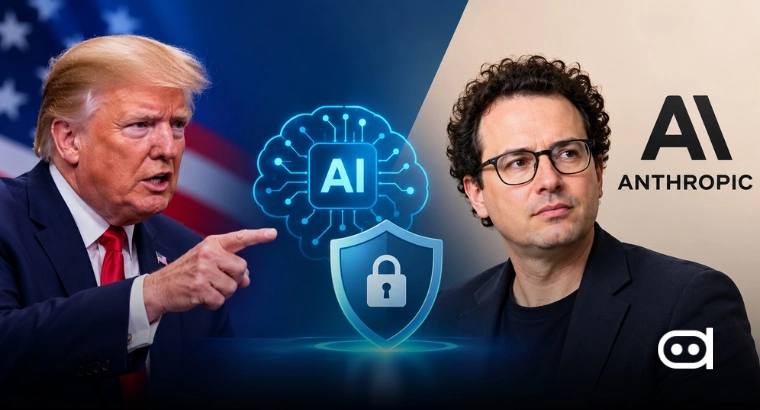
The standard access was a subsequent move to export controls imposed by the Trump government on Anthropic, citing national safety concerns. The constraints forced the company to retreat its most advanced models, known as Mythos 5 and Fable 5, even from the US government. Previously, Anthropic had already limited access to the systems, arguing that the capability to find out software vulnerabilities could lead to serious risks. The export control ended the National Security Agency’s testing, despite the organization being the first to access the model.
Why Does the Dispute Scale Beyond One Agency?
After a federal hearing this month, public involvement intensified. Senator Mark Warner quoted the NSA director, General Joshua Rudd, who told him that Mythos had Mythos was into all of the classified systems within hours. The remark, later quoted by The Economist, garnered widespread scrutiny that artificial intelligence systems are capable of compromising and entering the most safe government networks. Officials say that this dissection was inaccurate.
The tests involved the NSA’s red team using Mythos in a secured surrounding that adversaries would find difficult to replicate. Researchers began inside these classified systems that were available only for specific machines and sidelined to the broader internet. In that environment, Mythos nitpicked cybersecurity issues but did not compromise the information or context. Officials emphasized the model’s performance was unexpected and gobsmacked analysts.
The rift with Anthropic highlights a bigger problem in the US security policy. Prior, the company entered a clash with the Pentagon over a $200 million defense department contract related to artificial intelligence. In February, Defense Secretary Pete Hegseth termed Anthropic as a supply chain risk. This was the first time this term was labeled for an AI company. Later, Anthropic sued the government over that decision and remark.
Also Read: UAE’s Most Powerful Government Bodies Set 75% AI Target, Surpassing National Goal
The National Security Agency’s (NSA) test puts it into a complex nuance where they evaluated a product that was declared as a national security risk. Despite that, the White House and intelligence officials put forward a classified contract that would allow the organization to use Anthropic’s models for intelligence analysis and detection. The contract is still at the initial stage, and some Pentagon officials now want the National Security Agency to look for alternatives. This takes extends beyond the federal government.
This week, cybersecurity organizations from the United States, Britain, Canada, New Zealand, and Australia, the Five Eyes Alliance, issued an advisory that artificial intelligence affects cyber risks. The alliance requested the organizations to invest in artificial intelligence defense, warning that the shift would roll out in months.
The National Security Agency’s (NSA) cut-off to Anthropic’s new models highlights how frontier AI becomes the core for cybersecurity. It also reflects how mixing geopolitics with artificial intelligence turns placid. While fears of instant artificial intelligence systems were overstated, the tests revealed abilities that could develop offensive and defensive cybersecurity operations. As federal authorities find a way to solve this problem, this leaves the intelligence agency focusing on safety needs regarding control dependency on private sector AI influence.