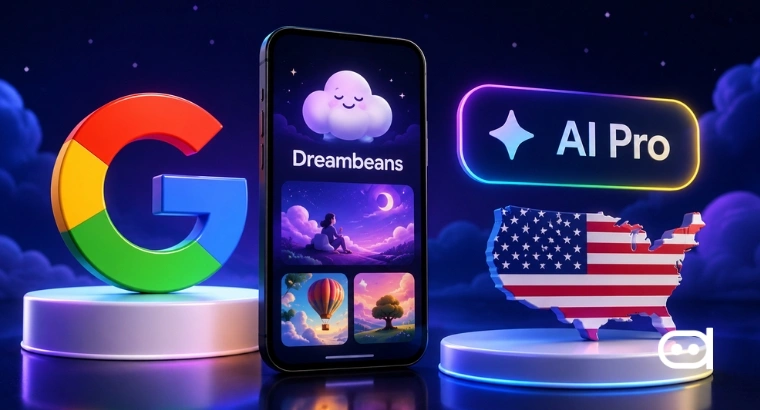
Google Labs has opened Dreambeans, its experimental mobile app, to Google AI Pro subscribers in the United States. The app launched on June 3 for AI Ultra subscribers only. It pulls from a user’s Google services to assemble a daily set of personalised stories. According to Google’s developers, the current update aims to expand the active testing pool within the company’s premium subscription tiers.
Dreambeans is still at an early-stage prototype, with its current access limited to specific geography, subscription plans, and age requirements. The app hints at how Google’s aims to push toward proactive AI that draws on personal data across products rather than waiting for a query or prompt.
How Dreambeans Uses Personal Intelligence
Dreambeans runs on Personal Intelligence, the same system behind personalised features in the Gemini apps and AI Mode in Search, alongside the Nano Banana 2 image model. When authorised by the user, Dreambeans can connect to their personal account including services such as Gmail, Google Calendar, Google Photos, YouTube, and Search history. The app processes those sources overnight and delivers a finite collection of stories each morning. Google says the name reflects that structure, with the app dreaming overnight and brewing a fresh set of beans by morning.
Each entry takes the form of a short story with AI-generated artwork. Product lead Gozde Oznur has described the output as lifestyle prompts covering places to visit, topics to explore, and upcoming trips. Google’s own example involved a Gmail delivery confirmation for puppy treats producing training tips, and a calendar reminder about a visiting friend producing dog-friendly restaurant recommendations. The aim is to surface these without having the user search for them.
Time to spill the (Dream)beans.
— Google Labs (@GoogleLabs) August 5, 2026
Dreambeans is expanding! Joining our US-based AI Ultra users, AI Pro subscribers in the US can now also get in on the action.
Get ready for your fresh, daily collection of personalized stories. We’re surfacing the deep dives and hidden gems you… https://t.co/CBvENYNe90
Google positions the app against endless feeds by capping the daily output at a finite set rather than an infinite scroll. To distinguish itself from traditional social media feeds or endless news aggregators, the system enforces a strict volume constraint. It restricts the delivery to approximately 10 to 14 distinct entries per day. According to Google this format is deliberate and intentional, designed specifically to let users finish and put the app down. Where a story involves the user or people close to them, Dreambeans can use Google Photos and Nano Banana 2 to paint their likeness into the scene rather than using stock imagery. That requires Google Photos face grouping to be enabled.
Who Can Use Dreambeans and What Google Says About Privacy
Participation in the pilot phase is governed by specific account criteria and privacy configurations. In order to use Dreambeans, interested users must be 18 or older, hold an active premium subscription, and be located in the US. For those who do not have the required Google AI subscription, can join Google Labs waitlist using a personal Google Account. The app will be available on both Android and iOS operating systems.
During setup, users choose which of the Google services they want to connect. A minimum of one connected service is necessary for core functionality, but users can modify these permissions at any time. Google claims that the choices made inside Dreambeans do not affect Personal Intelligence settings in other products such as the Gemini apps or AI Mode. Furthermore, users have the option to change the app permissions any time as well as permanently delete the app history through its settings.
Google has not committed to long-term availability, wider release, or integrating the features into its main products. The open question is how many people will grant a single app access to their inbox, calendar, and photo library in exchange for a daily digest.