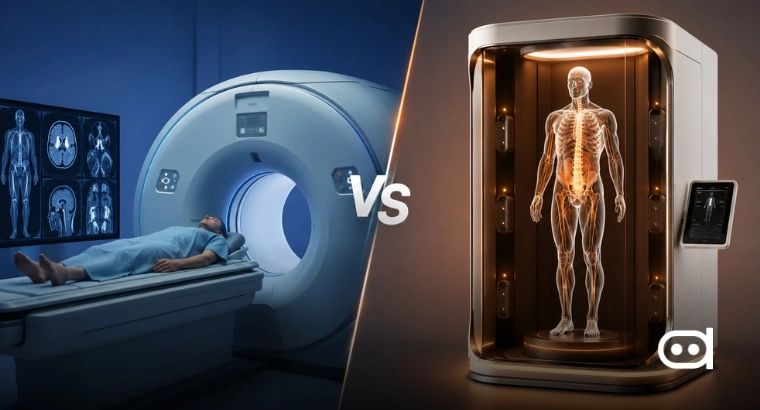
Midjourney, the company most people know for its AI image generation software, is reaching for something much bigger: a full body scanner that, according to the company, could eventually offer a faster, safer, and easier alternative to MRI. The device uses ultrasound to capture detailed images of the human body, potentially letting people check up on their muscles, fat, bones, and organs in just seconds.
People are talking, not just about the tech, but also about how bold these claims are. MRI is trusted everywhere. So, when Midjourney suggests it can make something better, people expect a lot. The idea is definitely interesting, but the real test will be whether Midjourney can actually prove it with solid clinical data.
Midjourney’s Claims about the Full Body Scanner
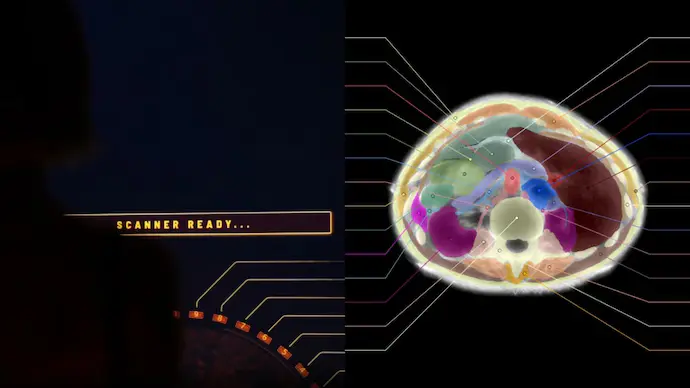
Image Credits: Midjourney
Midjourney says its scanner uses a ring of ultrasound sensors to build a 3D image of the body. The claim is that body imaging gets easier, quicker, and more accessible than today’s MRI machines. David Holz has called MRI “complicated” and “old,” and he thinks that ultrasound technology is ready for a big leap forward.
One of the most striking promises from Midjourney is pure speed. The company claims their scanner can do a full body scan in 60 seconds. It sounds almost like a routine check; imaging that is way more convenient than what hospitals offer now. They are not just thinking about sick people, either; their vision includes healthy folks scanning themselves regularly, tracking how their bodies change over time.
And Midjourney’s even talking about opening centers that mix body scanning with things like gyms, saunas, recovery lounges, etc. Imaging would not just be something you do at the hospital anymore. It would be a part of everyday health, like monitoring your steps or calories.
A technical dive inside our new "Midjourney Scanner" pic.twitter.com/wJBHz2O7ro
— Midjourney (@midjourney) June 18, 2026
Big Claims, Limited Evidence
As exciting as all this sounds, it raises a lot of big questions. MRI is trusted because it has been through decades of research, testing, and everyday use. We rely on it for a reason: the images are incredibly detailed and help doctors figure out what’s wrong in a huge range of cases. There is a lot of evidence showing that it works.
That is what Midjourney has to beat. So far, the company hasn’t released any clinical trial data that proves its scanner can match MRI’s accuracy. Without that, it is impossible to say if the new tech can really deliver. Sure, a faster scan is convenient but in medical imaging, accuracy is what counts.
There are also questions about detail and reliability. Can an ultrasound based scanner really show everything MRI can? Will it spot problems in all the same places: muscles, bones, organs? Those answers only show up after serious testing and clinical validation.
And let’s talk about trust. Hospitals, doctors, regulators, they won’t just quit their jobs because a company makes big promises. Medical tools usually face years of reviews and tests, especially if they are going to replace something as established as MRI.
None of this means Midjourney’s project lacks potential, but, history has shown that transforming healthcare requires more than a compelling vision, it requires proof.
Also read: Midjourney Unveils Smarter AI Image Generator: Meet Model V7
Midjourney’s full body scanner is an ambitious bet on the future of medical imaging. Faster, safer, easier, if it lives up to those claims, both the tech world and the healthcare industry will definitely take notice, especially since people care more and more about preventive health.
But for now, it is just an idea waiting for clinical validation. MRI’s place in medicine is built on evidence, long term use, and the trust of doctors everywhere. Midjourney is asking the industry to imagine a different future, but with the scanner not launching until late 2027 and without clinical results yet, many of the most important questions remain unanswered.