SpaceXAI has launched Grok 4.5, moving its 1.5-trillion-parameter V9 model out of private beta and into public availability. The company describes it as its smartest model yet, built for coding, agentic tasks, and knowledge work, and notably trained alongside the coding tool Cursor. The launch follows a July 8 post from Elon Musk saying the model would go public after strong beta feedback, pitching it as an Opus-class model that is faster, more token-efficient, and cheaper.
It arrives on the same day OpenAI confirmed GPT-5.6’s public release, setting up a direct comparison on coding tasks. Here is what Grok 4.5 is, what the numbers say, and the caveats worth keeping in mind. As you may know, xAI merged with SpaceX in February 2026, which is why the announcements now run through SpaceXAI.
What’s New With Grok 4.5
Grok 4.5 runs on V9, xAI’s ninth-generation foundation model at roughly 1.5 trillion parameters. That is about three times the size of the v8-small model that has served Grok’s public traffic through early 2026. It was trained across tens of thousands of NVIDIA GB300 GPUs, with a heavy emphasis on data filtering, deduplication, and reinforcement learning tuned for per-token intelligence.
Our internal assessment is that Grok 4.5 is roughly comparable to Opus 4.7, but much faster. The combination of capability, faster speed and lower cost is what makes it competitive.
— Elon Musk (@elonmusk) July 8, 2026
We are closing the loop on real-world usefulness, not benchmarks. Hardcore engineers at Tesla &… https://t.co/FqoJzHkrRY
The Cursor connection bit with Grok 4.5 is rather distinctive, to say the least. Grok 4.5 was trained with data from the Cursor coding platform, which ties to SpaceXAI’s disclosed acquisition of Cursor’s parent Anysphere. That gives the model real developer-workflow data, and SpaceXAI is offering free Grok 4.5 usage for a limited time in both Grok Build and Cursor.
Grok 4.5 built this solar system simulation from just one prompt.
— DogeDesigner (@cb_doge) July 8, 2026
Make a beautiful simulation of the universe and solar system. should be sped up with adjustable time, realistic motion, orbits, stars. use threejs. Make the HUD well styled and conform to modern design principles. pic.twitter.com/RrYBvPdPtT
The pricing on Grok 4.5’s API is placed at $2 per million input tokens and $6 per million output, with configurable reasoning effort. There is one one regional limitation however, i.e. Grok 4.5 is not yet available in the EU, with availability there expected in mid-July.
How Does Grok 4.5 Rank According to Benchmarks
SpaceXAI published a set of coding benchmarks, and they are competitive rather than dominant. On Terminal-Bench 2.1, Grok 4.5 scores 83.3%, close behind GPT-5.5 and Claude Fable 5. On SWE-Bench Pro, it resolves 64.7%, ahead of GPT-5.5 but behind Claude Opus 4.8 and Fable 5. It also claims the top spot on Harvey’s Legal Agent Benchmark, pointing to strength in knowledge work beyond pure coding.
For perspective, the picture these numbers paint is a strong model that trades places with rivals depending on the test, not a clear leader across the board. That is a meaningful distinction from the “perhaps exceeding Opus” framing that accompanied the earlier beta.
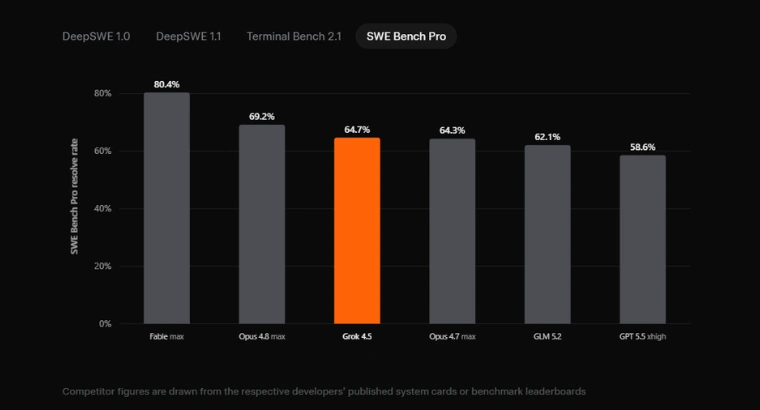
Two things temper the launch. First, the “trained alongside CursorGrok 4.5 Benchmarks According to SpaceXAI Blog” detail carries a nuance xAI itself has acknowledged. The Cursor data was added in supplemental training rather than baked in from the start of pre-training, and an xAI engineer conceded that supplemental inclusion is not quite as good as having it in initial training. The next model is reportedly being built to include that data from the start.
We've partnered with SpaceXAI to train Grok 4.5.
— Cursor (@cursor_ai) July 8, 2026
It’s our most powerful model yet and the first we've built for more than software engineering. pic.twitter.com/U4B8Tedl34
Second, the benchmarks published so far are SpaceXAI’s own. Independent evaluators like Artificial Analysis and Chatbot Arena typically score new models within days of public access, and those results are what will confirm or complicate the company’s claims. Until then, the numbers are vendor-stated.
You can also read – Grok 4.5 Enters Private Beta at Tesla and SpaceX, as Musk Claims AI Rivals Claude Opus
Grok 4.5 Is The First Model Under SpaceXAI
SpaceXAI now controls the compute, the model, and the coding tool that generates its training data, all under one roof. With that vertical integration, compute plus model plus developer-workflow data, is the flywheel the company is building, and Grok 4.5 is its first visible output.
It also lands in an extraordinarily crowded week. Grok 4.5, GPT-5.6, and expanded Claude Fable 5 access all arriving within days of each other shows how compressed the frontier release cadence has become. For developers, the practical takeaway is less about which model wins and more about keeping architectures flexible enough to swap the best option in as independent benchmarks land.