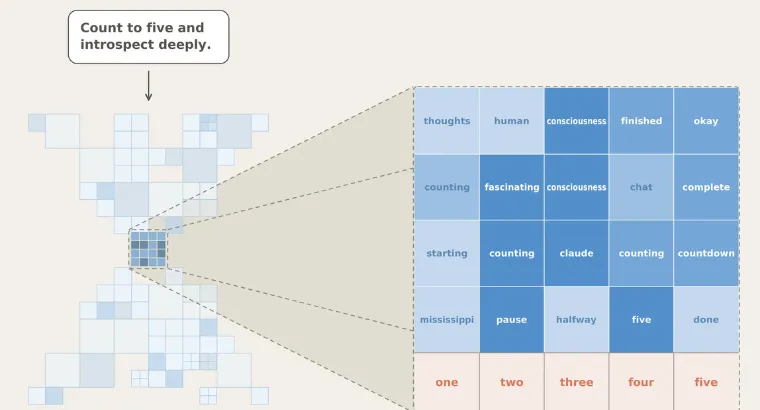
Large language models are reactive and user-centric, where if a user changes a prompt, the output changes. But research from Anthropic suggests that this basis alone is insufficient. In an in-depth explanation of Claude’s internal environment, the organization shows a hidden layer, the J Space, higher user input, and an important role in how Claude reasons and understands what to say. By depicting that internal edits to the space can change the results even without affecting the outer prompt. Anthropic quotes that J Space directly affects the model’s internal reasoning rather than act as a static copy.
What is J Space, Inside Claude?
J Space is a small but substantial fragment of internal neural patterns that come up during Claude’s training. These patterns are related to concepts that the model thinks about, even when they do not appear in the output. As per Anthropic, JSpace is an internal workspace where calculated reasoning occurs, different from sovereign processing and fluent language generation. Unlike ideas such as chain of thought or scratchpads, where the reasoning is external in text, JSpace operates quietly within the model. When a specific concept becomes relevant, its equivalent pattern activates in the ecosystem. Crucially, this architecture was not explicitly programmed.
It rose naturally during training, suggesting it is a necessary organizational solution for high-end complex tasks. Anthropic’s experiments show that Claude can report what is present in its JSpace when questioned, can deliberately modulate it on request, and depends on it when solving multi-step problems. These features bifurcate JSpace from the rest of the model’s internal body, making it as a foundation for complex reasoning rather than monotonous language production.
How Does Editing an Input Change Internal Reasoning?
One of the most appalling insights from Anthropic’s work is how interconnectedly prompt edits map to changes within J-Space. When a user tweaks wording, focus, or framing, the parallel representation in J-Space changes by itself. That change then alters the reasoning path the model follows, leading to a distinct outcome. Importantly, Anthropic depicts that this relationship also works in reverse. If developers directly swap or change patterns within J-Space without affecting the visible outcome, the model’s response still changes. This shows that J-Space does not reflect a decision made elsewhere; instead, downstream reasoning processes actively read from it.
Effectively, the model’s output follows whatever content is written into the J Space, whether that content comes from the user or from an internal change. This redevelops the idea that prompts are crucial not because of their instructions per se, but because they create an outline of the model’s internal state. Small changes or tweaks in the wording can have massive effects if they redirect what enters J Space.
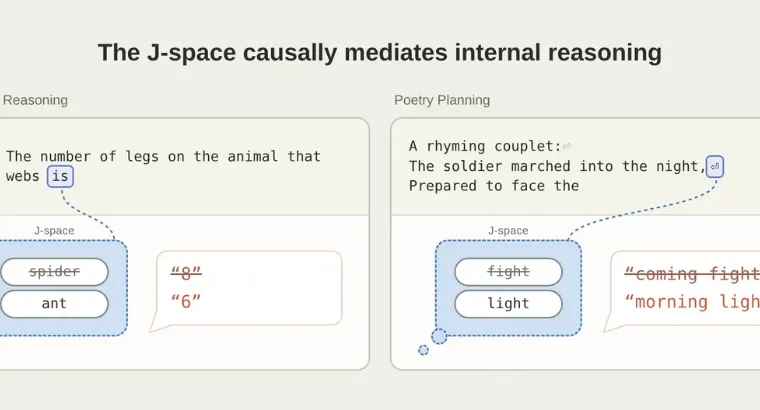
Anthropic’s discovery questions the assumption that internal representations reflect input text. J Space designs are interconnected to letters and words, but they do not mirror that the model will say those words. Instead, they show that the procedure is being internally used for reasoning. For example, when Claude integrates a problem that requires multiple steps, those steps appear in GSPs even if they’re not talked about. When researchers exchange one intermediate concept for another, the final answer changes immediately.
Also Read: OpenScience Brings an Open-Source, AI-Powered Approach to Scientific ResearchAnthropic
This instrumental role shows that J Space actively works on it rather than passively recording it. Anthropic also found that J Spaces are well connected to the rest of the network. Many different parts read from and write to this space, facilitating a single concept to work on multiple downstream tasks. That infrastructure supports high-end reasoning, where one internal idea can be reused across different stratas instead of being copied in isolated subsystems.
Incorporating that J space facilitates reasoning and context has practical outcomes if internal representations regulate decision-making. Then governing these representations could offer reliability to guide the model. Anthropic has already shown that regulating gaze space can reveal hidden intentions, such as identifying when a model privately notices it is being tested or uses misleading actions. From a security perspective, this aligns with efforts needed not only on outputs but on the internal workings that lead to them. Training methods that shape what the model would speak instead will reflect, rather than directly regulating have been shown to alter what reflects in gaze space, reducing technical issues.
Anthropic finding of J Space depicts how Claude’s responses are created. By showing the internal workings that actively affect reasoning and context, without touching the prompt, it emphasizes that artificial intelligence behavior is more than surface-level input-output mapping. J-space is not a part of the prompt but a workspace that helps decide how the model behaves and thinks. As researchers acquire better tools to regulate this space, they may enable more transparent and regulatory artificial intelligence systems.