Key Takeaways
- Michael Smith received 18 months in prison after pleading guilty to music streaming fraud involving AI-generated songs.
- Prosecutors said Smith used up to 10,000 bot accounts to generate billions of artificial streams.
- The scheme generated more than $8 million in royalties before streaming platforms detected the manipulation.
- The case highlights how AI-generated music can be combined with automated accounts to manipulate streaming systems.
A North Carolina man has been sentenced to 18 months in prison after using thousands of automated accounts and hundreds of thousands of AI-generated songs to manipulate music streams and collect royalties. Michael Smith, 54, pleaded guilty in March to conspiracy to commit wire fraud after prosecutors said his scheme ran from 2017 through 2024.
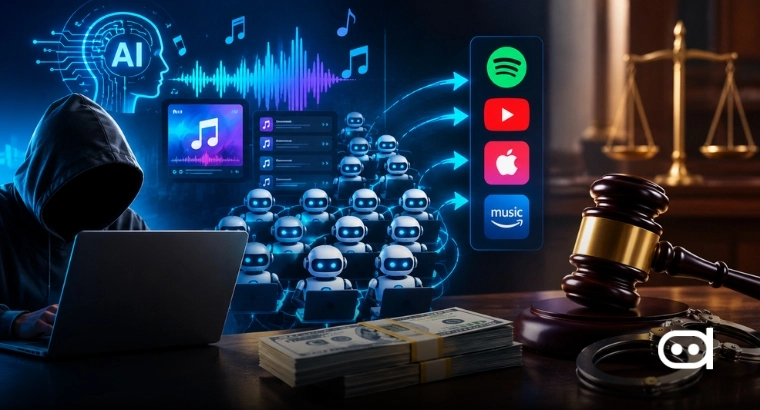
The U.S. Department of Justice said Smith used as many as 10,000 bot accounts at once across services including Spotify, Apple Music, Amazon Music and YouTube Music. His accounts generated billions of artificial streams, allowing him to receive more than $8 million in royalties. Smith was also ordered to forfeit $8,091,843.64 and serve two years of supervised release. Prosecutors described the case as the first U.S. criminal prosecution involving AI-assisted music streaming fraud.
How Michael Smith Used AI Songs And Bots To Generate Fake Streams
The scheme centered on artificially increasing the number of streams attributed to music Smith controlled. According to the U.S. Department of Justice, Smith created large numbers of accounts using fake email addresses and fraudulently obtained debit cards, then used software to make those accounts repeatedly play his songs. Smith eventually used as many as 10,000 bot accounts at once. Rather than concentrating the activity on a small number of tracks, prosecutors said he distributed the streams across thousands of songs to make individual tracks less likely to trigger anti-fraud systems.
The operation also relied on a large supply of music. The DOJ’s earlier account of the case said Smith used artificial intelligence to produce hundreds of thousands of songs that his bot accounts could upload and repeatedly stream. The scale of the activity became particularly clear in April 2023. Smith’s bots generated 80.9 million YouTube Music streams through family plans that month. For comparison, Taylor Swift’s entire catalog generated 9.3 million family-plan streams on the same service during that period.
The artificial streams resulted in more than $8 million in royalties being paid to Smith, according to prosecutors. The judge ordered him to forfeit $8,091,843.64 as part of his sentence. It is also important to separate the use of AI music from the fraud itself. Smith was not sentenced simply for creating AI-generated songs. The criminal case focused on using automated accounts and manipulated streams to obtain royalty payments.
The Case Shows Why AI Music And Streaming Fraud Are Now Connected
The Smith case comes as streaming services deal with a growing volume of AI-generated music. Deezer reported in July that it was receiving nearly 90,000 fully AI-generated tracks per day, with such material accounting for more than half of its new uploads on some days. The company has also said that a large proportion of streams on fully AI-generated tracks it identifies are fraudulent. Deezer’s figures show why platforms are paying closer attention to both how much AI music is uploaded and streamed. The distinction between AI-generated music and fraudulent streaming has also appeared in online discussions about Smith’s case. In the Reddit post, some commenters pointed out that the fake plays, rather than the use of AI to create songs, were the central issue. Others discussed how artificially generated streams can affect the royalty pool available to legitimate artists.
The case also comes as platforms continue developing systems to identify artificial activity. Deezer has introduced technology to detect fully AI-generated music and remove fraudulent streams from royalty calculations.
Smith’s sentence therefore focuses on a specific form of financial fraud rather than establishing a general legal ban on AI-generated music. His 18-month prison term, two years of supervised release and more than $8 million forfeiture mark the outcome of a case in which AI-generated content was combined with automated streaming to manipulate royalty payments. The case leaves streaming platforms with a continuing challenge: distinguishing legitimate uses of AI-generated music from activity designed primarily to manufacture streams and collect royalties that would otherwise be distributed across the wider pool of rights holders.