For the past few years, artificial intelligence has been defined by GPU access. Companies and governments compete to secure Nvidia accelerators because they power frontier AI models. That is about to change. According to SK Group Chairman Chey Tae-won, the next bottleneck is not the processors, but the memory chips that let those processors work. Speaking this week, Chey warned that demand for AI memory is growing so fast it could pull governments in, turning what was once a supply-chain issue into a question of economic security. As nations race to build their own AI capabilities, securing memory is becoming as critical as securing the processors themselves.
Why AI Memory Matters as Much as AI Chips
When people picture AI hardware, Nvidia GPUs dominate the conversation. But GPUs do not work alone. Modern AI systems rely on high-bandwidth memory, or HBM, a high-end form of stacked DRAM placed close to the processor. The GPU does the bulk of the calculation. HBM feeds it data fast enough to keep up. Without enough memory bandwidth, even the most powerful AI accelerator sits waiting for information instead of processing it. That is why HBM has become essential for training and running frontier models from OpenAI, Anthropic, Google, and Meta.
Buying more GPUs without enough memory is like buying a car with an empty tank. The engine is there, but it cannot run. Chey said customers are requesting between 60% and 100% more AI memory for next year compared to current demand, with overall semiconductor demand also climbing sharply. The problem is that new manufacturing capacity comes online slowly. Unlike ordinary memory chips, HBM is hard to make. Production takes years of investment, specialized stacking technology, and fabrication plants only a few companies can operate. Today, SK Hynix leads the market with roughly 58% of global HBM revenue, ahead of Samsung and Micron.
Because supply cannot keep pace with demand, governments are starting to treat memory access as a competitiveness issue. Chey said global investment has already begun locking up supply for domestic industries, and he cautioned that governments may soon start pressuring one another over chipmakers. That is the real shift. Instead of companies competing for parts, countries are beginning to compete for them.
Why Nations Cannot Just Build Their Own AI Memory
The obvious question is why governments do not simply build the chips themselves. The answer is the sheer complexity of semiconductor production. A high-end memory fabrication plant costs tens of billions of dollars and takes years to build before it produces anything. Even once complete, a plant needs highly specialized engineers, advanced equipment from suppliers like ASML, stable power, ultra-pure water systems, and years of experience to reach acceptable yields.
The difficulty extends beyond the factory. Modern AI memory depends on advanced packaging that stacks memory tightly while managing heat and maximizing bandwidth. Only a handful of companies worldwide have that expertise at scale. As a result, countries cannot simply announce domestic production and expect shortages to ease within a few years. An exception to this is Musk’s attempt to use Starmind to escape the scarcity challenge altogether, which we covered in detail.
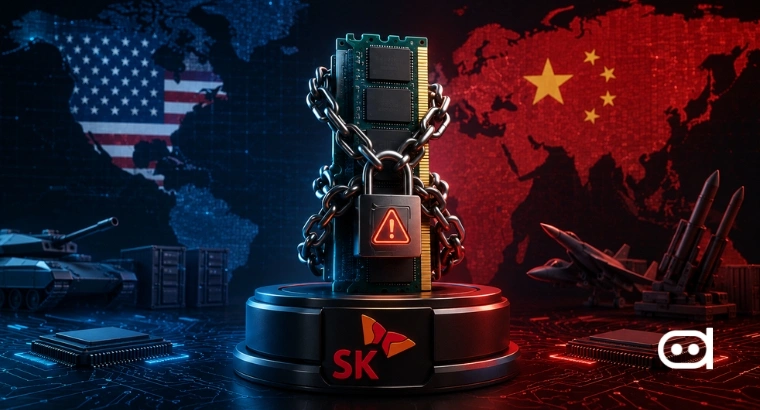
The warning lands as AI hardware becomes increasingly geopolitical. The United States has restricted China’s access to high-end Nvidia chips, while China has poured investment into domestic semiconductors. Now memory is emerging as another strategic layer. If AI memory stays scarce through 2027, governments may compete not just over processors, but over the memory needed to run them. That competition could shape where new plants are built, how subsidies flow, and which countries get priority during a shortage. It is part of why SK Hynix is expanding both at home in South Korea and abroad, including an advanced packaging facility in Indiana.
Why the AI Race Is Now About Hardware, Not Just Models
The AI contest is moving beyond who can build the most capable system. Increasingly, it is about who can secure the hardware to run one, the processors, the memory, the advanced packaging, the power, and the manufacturing capacity behind all of it. One such example is of Kimi K3, wherein Moonshot had to pull the plug to subscription for new users. On similar lines, Chey’s warning suggests AI memory may become one of the defining pressure points. If demand keeps outrunning supply, governments are unlikely to treat memory as just another component. It could instead become a resource that nations negotiate over and build industrial policy around. This boom is not only creating a AI memory shortage, but also creating a geopolitical contest over the hardware that makes AI possible.
You can also read – Apple Intelligence Is Cleared for China, Powered by Alibaba’s Qwen