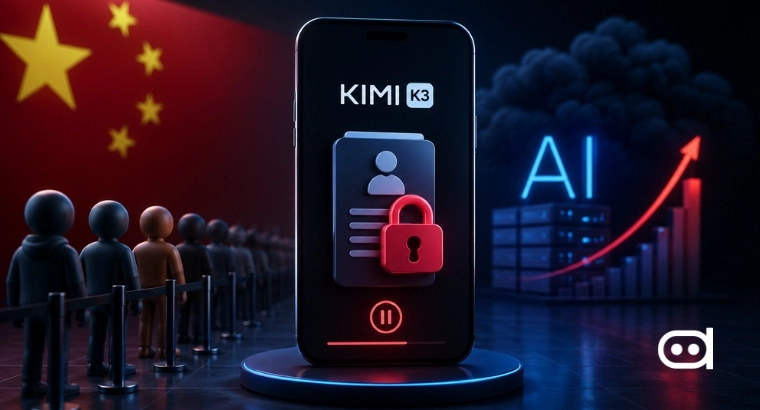
Moonshot AI’s new venture has created a problem for consumers. Just days after revealing Kimi K3, the Chinese startup halted new paid subscriptions after demand surpassed supply. Existing subscribers keep uninterrupted access, but anyone hoping to buy a membership is now turned away until more capacity becomes available. The move highlights an emerging reality in AI. Companies are no longer competing only to build capable models. They also have to scale up the computing power to keep those models running. When that infrastructure falls short, it is users, not companies, who lose out.
What Does the Kimi K3 Pause Mean for Users?
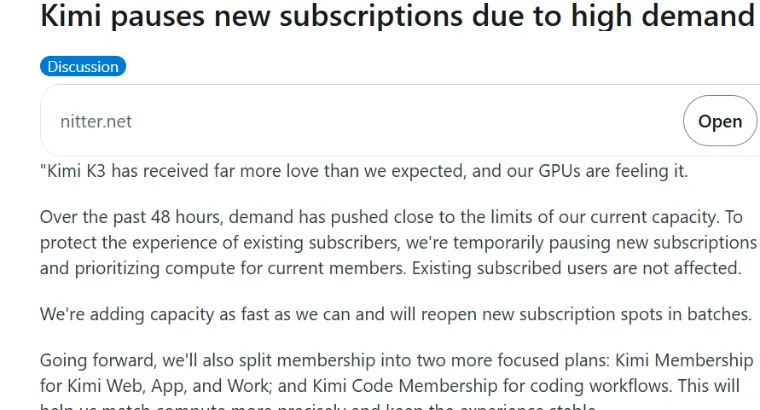
For general users, Kimi K3’s rollout has become a waiting list. Moonshot says that the demand surpassed its supplies within 48 hours, forcing it to halt new subscriptions while preserving service quality for existing paying customers. The declaration led to a discussion where researchers and AI enthusiasts discussed the sudden pause, while several users looked upon the move as proof that Kimi K3 had become one of the nation’s most sought after AI models.
Kimi pauses new subscriptions due to high demand
by u/anarchist1312161 in kimi
Others pointed to a harder truth. Even frontier AI systems cannot escape the compute bottleneck. The discussion mixed enthusiasm for the model’s abilities with frustration that new users could not access it despite being willing to pay. Unlike conventional cloud software, where companies can simply add servers, frontier AI models depend on large inference clusters that cannot be expanded overnight.
The result is a strange situation. The more successful an AI rollout becomes, the more likely users are to lose access to it. Moonshot also said future subscriptions will be split into different plans, including one dedicated to coding workflows. The move is meant to allocate computing resources more efficiently, since coding agents and long AI workflows consume more capacity than daily conversations.
Why Compute Is the Real Bottleneck for Kimi K3
The subscription frenzy is an outcome of a bigger challenge, which is compute scarcity. Kimi K3 was introduced as a 2.8 trillion parameter open source model, making it one of the globe’s largest available AI systems. Beyond ordinary conversation, it is designed for coding, context, and agentic workflows that need repeated model calls and greater GPU resources than ordinary chat applications. That makes operating the model at a magnitude extremely expensive. Although Kimi K3 is an open source, meaning developers can theoretically download and tailor the model themselves, very few proprietary bodies possess the hardware needed to run a system of this size sovereignly.
Most users still depend on Moonshot’s cloud infrastructure, which makes the company’s GPU capacity a direct factor in who gets access. The irony is clear. Open-weight models promise greater accessibility, yet infrastructure limits can still lock users out. Moonshot’s situation shows how AI competition is evolving beyond benchmark gains. Chinese firms including DeepSeek, MiniMax, Z.ai, and Moonshot are narrowing the gap with leading American labs by building capable models at lower cost. Their launches have challenged the assumption that Chinese frontier AI trails its U.S. rivals. But every gain in capability also raises the infrastructure needed to serve millions of users.
Training a frontier model is costly. Keeping it online constantly needs huge GPU clusters, strong inference infrastructure, and billions in funding. As models grow more advanced, serving them may become a bigger challenge than building them. The problem is made harder by U.S. export controls that restrict China’s access to Nvidia’s AI chips, forcing Chinese firms to squeeze maximum output from limited compute while staying competitive.
How the Pause Affects Moonshot’s $30B IPO
The timing matters because Moonshot is preparing for a potential Hong Kong IPO while seeking investment that could value it at around $30 billion. On one side, the subscription freeze strengthens Moonshot’s funding story. Demand for Kimi K3 has beaten expectations, reinforcing its position among China’s leading AI startups.
But the freeze also underlines the capital required to sustain that demand. Investors are no longer assessing AI companies on efficiency or benchmarks alone. They are asking whether these companies can fund enough computing infrastructure to meet demand without repeatedly limiting access. In today’s AI market, GPUs and inference clusters matter as much as the algorithms.
You may also like to read – AI Model Evolution: The Complete Timeline of Every Major AI FamilyMoonshot
Why AI Access Now Matters as Much as Capability
Moonshot’s subscription halt reflects a broader shift across the industry. As models grow, user experience is increasingly judged by availability. People expect AI assistants to be there whenever they need them. Yet frontier systems demand massive compute, which makes constant availability hard to guarantee. Kimi K3 shows that infrastructure has become part of the product.
A powerful model means little if users cannot access it. For China’s AI industry, the message is clear. Building high-end models is no longer enough. The next phase will depend on who can supply the computing capacity to keep those models available to millions. The AI race is no longer only about capability. It is about access.