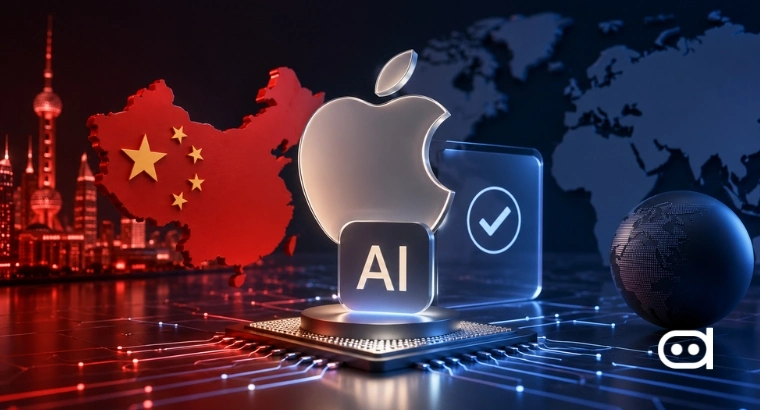
Apple has procured approval to launch Apple Intelligence in China, clearing one of the massive roadblocks to bringing its AI features to the biggest smartphone market. The Cyberspace Administration of China (CAC) approved Apple generative AI services on July 15, letting the company to embed Alibaba’s Qwen AI across iPhones, iPads, and Macs sold in the nation. While this seems to be a normal product launch, the approval reflects something much bigger. Apple’s AI strategy in China is not about inventiveness; it is about adjusting to geopolitical situations, governance demands, and competitiveness from domestic technology companies.
Why Apple Needed Alibaba’s “Help”
Apple’s approval emphasizes how foreign AI companies cannot adopt global AI products within China without adjusting to native regulations. Instead of depending on its own AI stack, Apple has forged an alliance with Alibaba to power its Intelligence features for Chinese users. Alibaba confirmed that its Qwen large language model will help abilities, including text generation and image recognition, across iOS, iPadOS, and macOS. The alliance depicts China’s governance approach towards generative AI, where services need federal authorities’ approval before public adoption.
For the company, localization becomes the only essential path to embed its Intelligence into one of its most important markets. The approval also ends a long-standing delay that began after Apple first introduced Apple Intelligence in 2024. During that time, the organization substantially rebuilt its AI platform, shifting from the perennial foundation models to Google’s Gemini globally while working with Alibaba to satiate China’s AI requirements.
AI Is Now More of a Geopolitical Product Than Tech Innovation
China launch depicts how artificial intelligence is massively affected by geopolitics rather than technology. The United States continues to impose restrictions on advanced AI chips and frontier technologies, while, on the other hand, Beijing has boosted oversight of foreign AI services entering its own market. As an outcome, multinational technology companies are increasingly creating a distinction between AI strategies for several regions. This broader AI landscape reflects the same distinction. Recent tension between Anthropic and China over Cloud Code depicted how frontier AI tools are becoming a part of the national security debate.

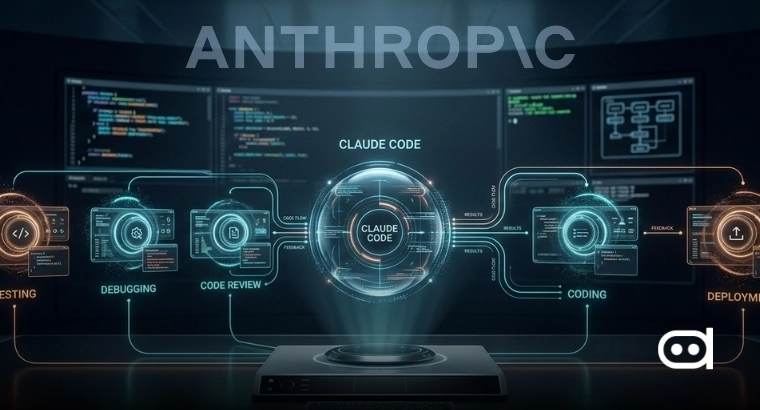
Chinese authorities warned about feasible security risks associated with Claude CodeApple, while Anthropic previously accused Alibaba of attempting to extract its AI capabilities. Although both sides have different opinions, the episode underlines how artificial intelligence companies are affected within the geopolitical boundaries rather than one market. Against this issue, Apple decided to forge an alliance with Alibaba, which seems like a complex strategic requirement.
What It Means for Apple’s Position in China
China is one of Apple’s most quintessential smartphone markets and the most competitive as well. Native manufacturers, including Huawei, Xiaomi, and other Chinese smartphone makers, are integrating generative AI into the devices, giving them a native advantage. Apple, meanwhile, was asked to wait for government approval before introducing the same capabilities. The approval may help Apple somewhat bridge the gap by finally allowing users in China to access its Intelligence. Crucially, it also gives the company a better position in a market where AI is increasingly becoming a deciding factor for smartphones.
Similarly, the company still faces the issue of convincing consumers that its AI experience offers benefits over a well-established domestic environment built around companies like Alibaba and Huawei. Apple’s experience demonstrates a comprehensive shift in the niche. Technology companies can no longer assume that one single product can be adopted worldwide without modification.
Instead, AI models, cloud architecture compliance requirements, and even strategic partnerships are governed by native regulations and geopolitics. For Apple, embedding Alibaba’s Qwen is not simply about improving product performance. It represents an understanding that succeeding in China now requires work with the native ecosystem rather than attempting to serve it. As federal authorities treat advanced AI systems as strategic mediums, localization is becoming less of a preference and more of a requirement.
Apple’s long-standing AI rollout in China is crucial not because it introduces new features, but it demonstrates how global companies are shifting towards a segmented technology landscape. By forging an alliance with Alibaba, it has gained access to China’s market while still figuring out geopolitical pressures that reshape the global technology niche. The launch shows that in today’s AI race, success does not depend only on building powerful models, but also to navigate across political ecosystems.