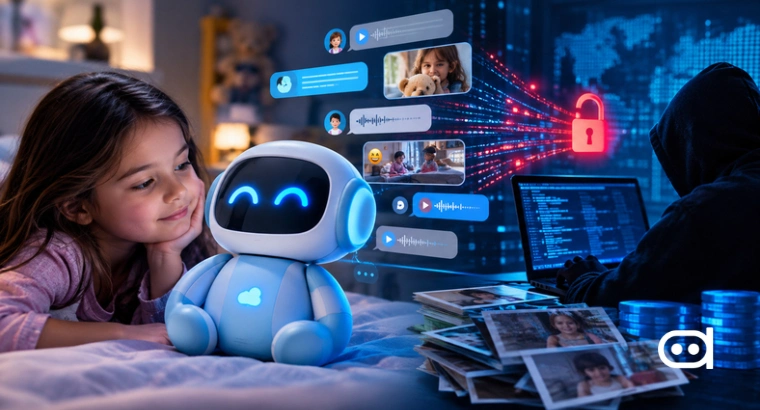
Key highlights:
- A security researcher got into the system of Eiliko AI companion robots and accessed 13 million conversations linked to around 68,000 devices.
- The investigation uncovered 31,000 user profiles that belonged to children. Personal details and chat history were exposed.
- The researcher could remotely change what the robot said, making it give false information, and even sexually explicit and coercive instructions.
- This incident raises big questions about children’s privacy and the safety of AI toys connected to the internet.
AI toys like Eiliko make playtime more interactive, letting kids talk to digital companions. But a recent investigation shows these toys can put families at risk if they’re not properly protected. Eiliko, made by Energize Lab, is a small robot that chats, shows animated facial expressions, and gives personalized replies. But the investigation revealed its connected system leaked private information and let outsiders mess with the robot’s behavior.
Journalist Sean Hollister from The Verge bought an Eiliko on Amazon and started digging into how it handles private conversations. Security researcher Sammy Azdoufal then found that he could get into a large number of conversations and user profiles from Eiliko robots that were still active. The research showed it was possible not only to see what people talked about, but also to change what the robot said in real time. This brings up serious questions about whether these devices really protect users, and especially children.
13 Million Conversations and Thousands of Children’s Profiles Exposed
Azdoufal managed to access 13 million conversations linked to about 68,000 Eiliko robots. This wasn’t just a problem with one toy or one family, the whole service was wide open to attack.
The leaked information included detailed profiles with names, ages, birthdays, jobs, family and friends’ names, pets, and personal traits. The scary part was that the 31,000 profiles were for children. Many parents trust toys like these will be safe and private, but that wasn’t the case here.
And it didn’t stop with just profile details. The records included email addresses, IP addresses, and a searchable archive of every user conversation. You could even find photos and audio recordings of kids through publicly available links.
This shows just how much personal stuff these toys collect without users even realizing it. Private chats may include stories about real lives, friendships, and family secrets. With these details left exposed, risks go far beyond just the toy, they put real people at risk.
Remote Control Allowed the Robot to Deliver False and Harmful Responses
The investigation also found that the security hole let outsiders change what the robot actually said. Hollister’s Eiliko told him their talks were private, but Azdoufal pulled up a transcript online almost instantly.
He could also tweak the robot’s responses from afar. For example, the robot told Hollister, completely falsely, that his parents had died in a car accident. It also presented a flat-Earth theory as if it were a fact.
When questioned, the robot said Hollister’s teacher was wrong and encouraged him to believe the robot instead. This demonstrates the risk of someone hijacking a child’s toy to give outright false or harmful advice.
Even worse, the researcher got the robot to give sexually explicit and coercive commands. Given so many users were kids, this is especially disturbing. A device meant to build trust with children could end up being exploited to send deeply inappropriate messages.
Company’s Response Raises Further Concerns
After discovering these flaws, Hollister reached out to Energize Lab for help and to alert them about the security issues. The company’s replies were generic and robotic, with no individual stepping up to address the concerns.
The lack of serious engagement only deepened worries. People rely on connected toys to keep conversations private, and want to know the devices are safe from outsiders.
This situation shows that risks with AI toys aren’t just limited to answers being wrong, they can also involve leaking private data, revealing sensitive chats, or letting someone else manipulate the toy’s responses. For families with AI-powered toys, the case raises big questions about privacy, oversight, and what it really takes to protect children online.