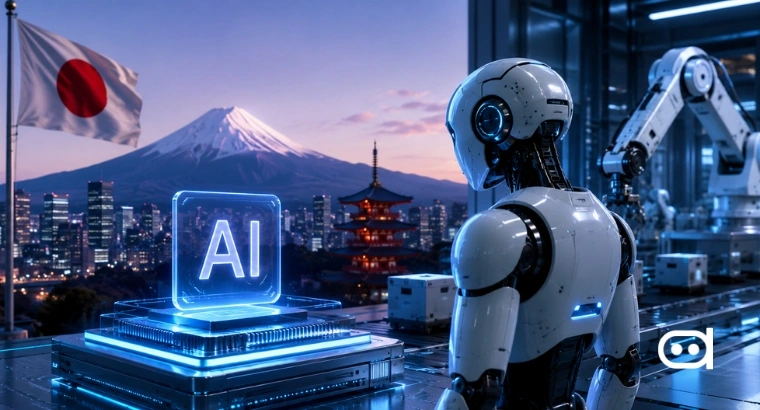
Japan is silently building an artificial intelligence environment by itself. Problems such as an aging population and shrinking workplace have long surrounded the nation and affected its growth. The country plans to rely on AI to strengthen its economic perseverance. Institutions, startups, telecom operators and tech giants are developing frontier models accustomed to the native language and governance rather than external dependencies.
The adoption surge, powered by NVIDIA’s Nemotron, an open-source AI model emphasizes the massive change. The story shifts to who can possess, govern and adopt AI models tailored to their requirements. As China and the US are deploying stern controls , Japan is underlining localization as its advantage to scale up in AI technology.
Why Japan Is Building Its Own AI
Japan’s act is related to one of its biggest issues, which is an aging population and a shrinking workforce. With fewer people available across niches, businesses aim to use AI to induce efficiency gains and help sectors without replacing human expertise. Rather than embedding generic AI systems, Japanese conglomerates are building models created specially for domestic use cases.
The Institute of Science Tokyo has created its swallow family of foundation models to develop Japanese language reasoning while preeminent capabilities in mathematics coding in English. SoftBank’s research arm, SB Institutions, has trained its Sarashina series of native generative AI models, with one chosen by Japan’s Digital Agency for a public sector platform.
Japan’s approach scales beyond research institutions. Companies such as Hitachi, ENEOS Holdings, NTT DATA, Stockmark and Avatarin are adopting AI for proprietary knowledge, robotics, telecom operations and customer service. Companies are adapting models to their own necessities, industrial context, and governance, while Nvidia’s Nemotron provides the underlying open-weight foundation. Japan’s aim is to create AI that prioritizes local development rather than simply consuming technology developed elsewhere.
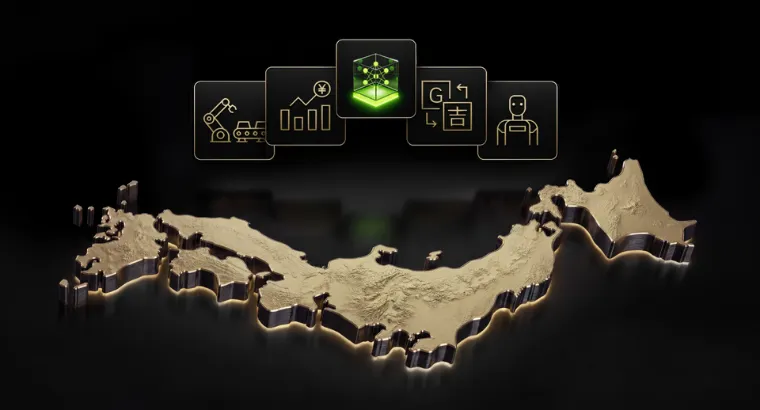
Japan’s core aspect is localization. Open-weight AI models allow companies to assess, fine-tune, and adopt AI within their architecture while maintaining autonomy over enterprise knowledge. That adaptability is quintessential as proprietary bodies seek AI that uses local languages, understands domestic regulations, and embed into preeminent workflows. Rather than relying on frontier AI providers, organizations focus on personalization, regulation, and flexibility.
The trend reflects a comprehensive shift when Thinking Machines introduced Inkling and open-source foundation built around adaptability and acquisition rather than benchmark gains. The company stated that businesses aim to tailor AI for their workflows rather than depending on one-for-all frontier AI models. Japan’s approach goes down the same road. Universities, organizations, and startups are using AI as a mechanism that can be adapted for finance, manufacturing, healthcare, telecommunications, and federal services. The focus is no longer to develop efficient models, but to create such systems that perennially improve, regulate, and adopt on their own terms.
How Does the US-China Rivalry Make Localization Crucial?
Japan’s localization nuance is a defense mechanism against fragmented AI deployment. The US has imposed stern controlsJapan on how frontier technologies are imparted. On the other hand, China is expanding stewardship of foreign AI systems while also bolstering its native alternatives. AI models, chips and cloud infrastructure are being used as means of national importance rather than feasible technologies.
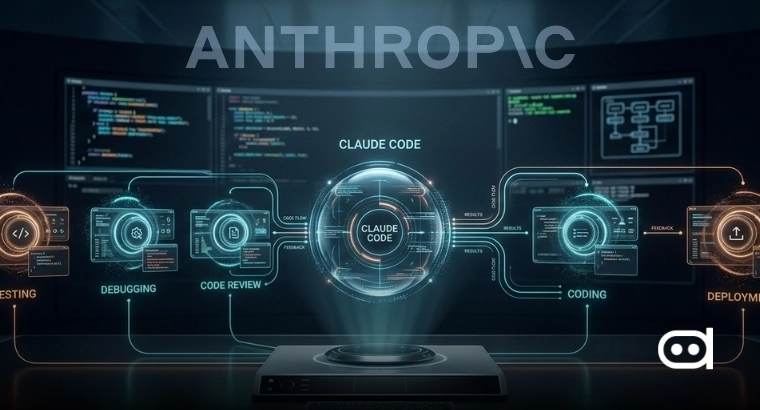
Recent nuances such as Apple’s localization effort to secure Apple intelligence’s approval in China after forging an alliance with Alibaba’s Qwen AI, shows that even tech giants need a mandate to fulfill local requirements. Similarly, recent conflicts surrounding Anthropic’s Claude Code, including security threat from Chinese authorities and broader tensions over AI adoption, emphasizes how geopolitics are a leading factor for changing AI adoption.
Against this issue, Japan’s funding and localization appears like a strategy for risk aversion. By building AI that can be tailored, natively deployed, Japan reduces its reliance amidst geopolitical tensions while ensuring autonomy over the technology they use.
Japan’s strategy is about addressing its local issues. It emphasizes the fact that artificial intelligence’s future will not only be defined by efficiency but by autonomy as well. As nations use AI for national security, for severance, and autonomy, localization is emerging as a new factor across the niche. Rather than direct competition with frontier AI models, Japan is building an environment where universities, organizations, institutions, adapt AI according to their necessities. The change emphasizes that autonomy is not only built by efficiency but by the nations that use artificial intelligence to serve their economies on their terms.