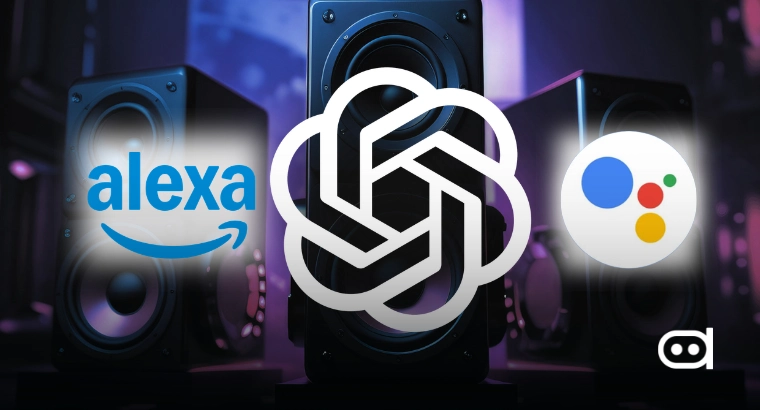
OpenAI is reportedly preparing to build a smart speaker powered by ChatGPT. Most people know Sam Altman led AI giant for ChatGPT, but now the company seems ready to bring its conversational AI straight into people’s homes with a dedicated device. The OpenAI smart speaker is expected to do more than just respond to simple voice commands. It could support natural conversations, understand what is happening around it using cameras and other sensors, and assist users with everyday tasks such as answering questions, playing music, sending messages, and controlling smart home devices.
Although the reported OpenAI smart speaker is yet to be announced officially, the reported features have gained interest because they hint at a more conversational AI experience than what most smart speakers currently offer. If the reports prove accurate, OpenAI will be entering a market dominated by Amazon’s Alexa and Google Assistant. The main question is whether the company is introducing something genuinely new or simply building another smart speaker with ChatGPT at its core.
What We Know About the OpenAI’s Smart Speaker
The smart speaker appears to be a part of OpenAI’s broader push into consumer hardware. The company has already been expanding its hardware efforts by hiring Apple’s smart glasses chief Paul Meade and continuing to roll out products such as Codex Micro for developers. These developments suggest that OpenAI wants to make sure AI is not limited to chatbots by extending it to dedicated devices and tools.
A Bloomberg report suggests that this OpenAI smart speaker will be a portable, screen free smart speaker powered by ChatGPT. Unlike traditional voice assistants that mainly respond to short commands, the device is expected to focus on holding more natural conversations to make interactions feel less robotic and more like speaking to another person.
The reported features include:
- Natural conversations: Designed for free flowing, two way conversations instead of single voice commands.
- Context awareness: Expected to use cameras and other sensors to figure out its surroundings so responses are more relevant.
- Everyday assistance: Can reportedly answer questions, play music, send and receive messages, and manage reminders.
- Smart home controls: Expected to control compatible smart home devices such as lights, appliances, and other connected gadgets.
- Personalised experience: May learn user preferences over time to deliver more tailored responses and recommendations.
- Screen free design: Reports indicate the device will not include a display, relying entirely on voice interactions.
But, it is important to remember that OpenAI has not officially confirmed the device, its specifications, pricing, or launch timeline. All these details come from people who say they are familiar with the project, so things might end up looking different when the product finally launches.
JUST IN: OpenAI’s first device will reportedly be a screenless smart speaker designed as a humanlike AI companion.
— Polymarket (@Polymarket) July 14, 2026
Can OpenAI’s Smart Speaker Compete With Alexa and Google?
OpenAI’s smart speaker sounds a lot like current smart speakers from Amazon and Google. These existing devices can already answer questions, play music, control smart home devices, manage calendars, set reminders, etc. The reported difference is expected to be the quality of conversations. ChatGPT has already shown that it can generate more detailed and context aware responses than traditional voice assistants. If those conversational capabilities are successfully integrated into dedicated hardware, users may find interactions to be more natural and less dependent on fixed commands.
Here is a quick comparison:
| Feature | OpenAI’s reported smart speaker | Amazon Alexa | Google Assistant |
| Conversational AI | Expected to support natural, back and forth conversations | Mostly command based, with improving AI capabilities | Mostly command based, with conversational features |
| Context awareness | Reportedly uses cameras and sensors | Limited contextual understanding | Limited contextual understanding |
| Smart home controls | Yes (reported) | Yes | Yes |
| Music playback | Yes (reported) | Yes | Yes |
| Messaging | Yes (reported) | Yes | Yes |
| Personalisation | Expected to learn user preferences over time | Supports routines and personalised settings | Personalised recommendations and routines |
| Hardware availability | Reported, not officially announced | Widely available | Available through Nest devices |
One of the biggest complaints about voice assistants is that they often struggle with follow up questions or lose context during longer conversations. ChatGPT’s ability to maintain the flow of a discussion could make interactions more intuitive and reduce the need to repeat information.
At the same time, Amazon and Google have spent years building extensive ecosystems around their voice assistants, supporting thousands of third party smart home products, music streaming platforms, shopping services, routines, and automation features. Even if OpenAI builds a smarter assistant, catching up with those ecosystems would not be easy.
Privacy is another big deal. Reports suggest the speaker may include cameras and other sensors to better understand its surroundings. While these could improve contextual awareness, they are also very likely to raise questions about how user data is collected, stored, and processed inside the home. Transparency around privacy and security will be just as important as the AI capabilities themselves.
Also read: Anthropic Says Claude for Teachers Should ‘Assist,’ Not Replace Them
For now, the device remains unannounced, and the reported specifications are yet to be officially confirmed by OpenAI. Whether it becomes a true competitor to Amazon and Google will depend not only on its conversational AI but also on pricing, ecosystem support, privacy safeguards, and real world performance. If the reports are accurate, OpenAI might not be inventing the smart speaker, but it could change how people talk to them by making the whole thing feel more like talking to a real person and less like giving orders to a robot.