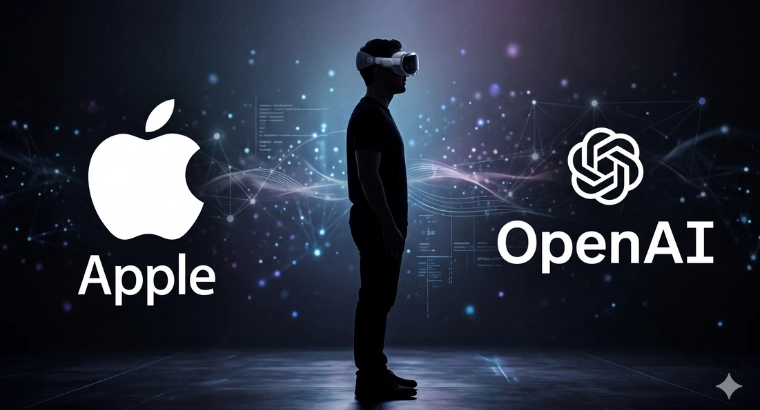
In yet another talent coup, Apple is losing the executive who ran its most ambitious hardware bet. Paul Meade, the vice president in charge of the Vision Pro headset and Apple’s smart glasses efforts, is leaving for OpenAI, continuing a streak of high-profile defections to rivals in the AI and hardware sectors. He is set to leave Apple by next week and will then start at OpenAI’s hardware unit, working on the company’s upcoming family of AI-powered devices.
As of yet, neither of the companies, nor Meade has commented publicly. But the move itself says something specific about where both companies are headed, and which one is going all out to win the talent that matters for the next computing platform.
Who Paul Meade Is & Why Is He Leaving Apple?
Meade is not a mid-level manager. He is one of the architects of Apple’s wearable future. He has been at Apple since 2010 and working in the Vision Products Group since 2017, and before the headset he was on the iPad and iPhone teams.
His latest responsibilities covered Apple’s entire spatial and wearable roadmap. He led hardware engineering for the Vision Pro for seven years, was responsible for the display-free smart glasses meant to compete with Meta next year, and his team also handles future augmented reality glasses planned for the end of the decade along with other AI wearables. In short, Meade was a vital person in turning Apple’s wearable ambitions into real hardware products.
His departure leaves a real gap, given that now most of his responsibilities are being assumed by Fletcher Rothkopf, his longtime deputy in charge of the product design function for the Vision Pro and smart glasses. Although this is not a simple case of a bigger paycheck, there may be more to it. The trigger is a reorganisation at the top of Apple. Meade’s exit is part of the fallout from John Ternus, the longtime head of all Apple hardware engineering and Meade’s former boss, stepping up to replace Tim Cook as CEO on September 1.
That promotion alone is likely to set off a chain reaction. Apple chips boss Johny Srouji became chief hardware officer and initiated a controversial shake-up of the hardware engineering unit, leaving several vice presidents in new roles and some executives feeling they had been demoted. And of course, Meade was among them. With Srouji taking over all hardware, Meade and several other hardware leaders now report to Tom Marieb, the new vice president of hardware engineering, rather than directly to Srouji, effectively pushing them down a level.
For an executive who reported near the top for years, being pushed a layer down is a clear signal. The OpenAI offer arrived at exactly the right moment.
You may also like to read – Monako Glass Introduces Custom Linux Computer Glasses
Why This Matters for OpenAI
OpenAI has been trying to build hardware for over a year, with little to show for it publicly. This hire changes the depth of that effort.
The hardware push began with a high-profile acquisition. Last year OpenAI joined forces with Jony Ive and several LoveFrom designers to form io, a subsidiary meant to release AI-first hardware. Since then, the company has steadily pulled talent from Apple. It kept poaching current and former Apple designers and engineers, including longtime Ive collaborators Evans Hankey, who led Apple’s design for three years after Ive left, and Tang Tan.
Comment
by u/iMacmatician from discussion
in apple
For OpenAI, Meade is a different kind of hire, given all of their earlier defections were largely designers. Meade is an engineering leader who has actually shipped and managed complex hardware at scale. He is described as an architect of Apple’s future-generation wearables, having led Vision Pro hardware engineering for seven years while steering the display-free smart glasses meant to rival Meta. For a company that has promised AI devices but not delivered them, hiring the person who ran Apple’s headset engineering could prove to be a meaningful step towards a ‘ready to launch’ product.
Apple Departure Patterns, & The Vision Pro Logic Behind It
While poaching isn’t rare, Meade’s subtle exit is. It is unusual for an Apple vice president to leave for a competitor, aside from the designers who joined OpenAI, with another exception being Alan Dye, who ran Apple’s human interface group before joining Meta in December.
OpenAI has also been working the lower levels of Apple’s org chart. It has separately pillaged Apple’s hardware engineering department for rank-and-file talent. The combination of senior and junior departures points to a sustained recruiting campaign, not a one-off. For Apple, losing both a hardware VP and a steady flow of engineers to the same rival is a pattern worth taking seriously.
Comment
by u/WinResponsible9977 from discussion
in VisionPro
The context behind all this is that Apple’s headset bet has not paid off commercially. With the Vision Pro a sales flop, Apple has refocused its roadmap to heavily de-prioritise enclosed headsets and instead focus on glasses. The retreat has been messy. The company has started and cancelled several headset ideas over the past couple of years, including a cheaper, lighter Vision headset planned for 2027, and now does not expect to ship a new enclosed headset before 2028 or 2029.
For an executive who spent seven years building toward a platform that has been quietly shelved, the appeal of a fresh start at a company betting heavily on hardware is easy to understand.
What It Means Going Forward
For users and the industry, this hire raises the odds that OpenAI’s long-promised AI hardware actually ships. A company can buy designers and still struggle to manufacture a product. Adding an engineering leader who has done it before narrows the gap between vision and reality.
For perspective, the AI wearables race is already crowded. Meta leads with its Ray-Ban glasses. Google is building toward Gemini-powered devices. Apple is regrouping around glasses after the headset stumble. OpenAI entering that race with both Jony Ive’s design pedigree and Meade’s engineering experience makes it a more credible hardware contender than it was a week ago.
APPLE’S VISION PRO AND SMART GLASSES CHIEF TO LEAVE FOR OPENAI
— zerohedge (@zerohedge) June 26, 2026
But why? They just hiked the price of Vision Pro to $4k because nobody bought a single one in the past two years.
The open question is whether assembling ex-Apple talent is enough to produce a device people actually want. OpenAI now has the people. What it does not yet have is a shipped product. Whether Meade helps change that is the thing worth watching over the next two years.