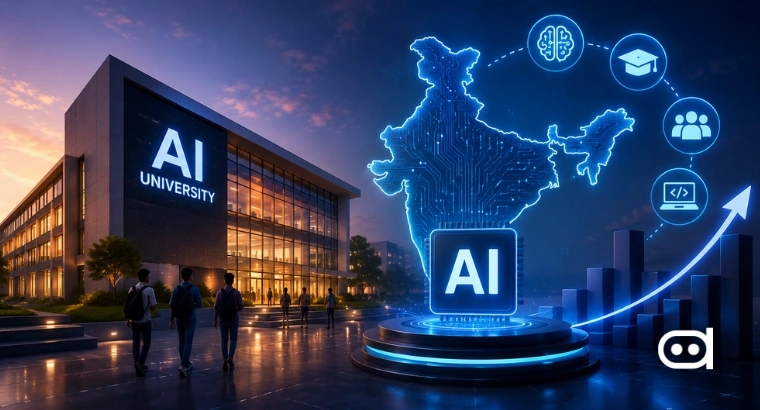
Karnataka plans to build India’s first government-centric AI university and an AI hub, in response to a growing mismatch in the country’s talent. India creates a large number of engineers, but industry and policy analysts say that the country is under a serious AI-specific skills gap, especially in applied machine learning, adoption, data engineering, and AI operations. Karnataka’s new institute is meant to bridge that gap by blending education, analysis, research, incubation, and industry collaboration under one place.
The state declared the plan after the inauguration of Google I/O Connect India 2026 in Bengaluru. Chief Minister D.K. Shivakumar said that the alleged university would help create world-class artificial intelligence talent and boost ties between academics, industry, and the federal authorities. Karnataka wants to implement more than teach artificial intelligence theory. It wants to create an ecosystem that can help students support startups and help skilled workers move into the wider AI spectrum.
Why Does the Gap Matter?
India’s disadvantage is not being devoid of engineers, but a shortage of people who can create and run artificial intelligence systems in real time. The India AI platform has said that the nation, despite one of the largest talent pools, faces a substantial backdrop. That gap is witnessable in the labour market too, with reports noting that employers are unable to find AI-ready workers even as demand surges. That is why a legit AI university may matter more than an ordinary institution. A specialized model can implement practical levels of AI work that organizations need the most.
This includes model adoption, data pipelines, regulation, cloud integration, and responsible governance. Those are the skills that decide whether a pilot project becomes a feasible product. Karnataka is already moving in that direction with new initiatives. The state has launched 50 AI labs in government colleges, lesser the AI education in schools, and revealed AI-related skills and startup programs. The novel university hub appears to be the next building block in that broader environment.
The artificial intelligence hub is essential because it connects the industry to the AI niche. Rather than keeping research within classrooms, the hub acts as an incubation centre for startups, organisations, and academic teams. That matters because many artificial intelligence innovations do not lack ideas but fail because the gap between research and deployment is massive. Karnataka has already been pushing to make Bengaluru, the wider state, a deep tech and AI centre.

The federal authority has declared large startup and deep tech funding programs, inclusive of programs aimed at AI, quantum, and new technologies. The AI university will be seen as a mechanism bolstering talent while the hub becomes the monetary engine. This would help the state generate opportunities beyond the city.
Recent policy moves have highlighted AI labs and innovation centres in tier-2 and tier-3 cities, which indicates that the federal authority wants AI growth to be more balanced within the nation. That works for Karnataka to help create more AI-element jobs and a broader startup base, not just on an academic basis.
Also Read: India Must Build Resilient AI Systems for Cybersecurity, Says MeitYKarnataka
Why Is Karnataka Betting on This Initiative?
Karnataka plans to place itself as a dominating body in India’s AI transition. This is about timing as well. Federal authorities across the globe are using artificial intelligence and relevant architecture as strategic assets, and states want to attract startups, funding, and research before the market dies down. By building a dedicated university and hub, Karnataka indicates that it wants to revamp the AI workforce rather than simply react to it.
There is also a policy logic. Reports on Karnataka’s education and AI environment have argued that classrooms do not resonate with the state’s technology vision. A focused AI university could help bridge that gap by resonating the curriculum with industry requirements, and by training teachers, researchers, and students at one place. The question put forward is whether a government-backed university can scale fast enough. AI changes quickly, so a successful institution will need more than classrooms and branding. It will need industry alliances, real project experience, better facilities, and a curriculum that adapts as the technology develops.
If Karnataka hits the nail on the head, the university could become a model for how India trains AI talent. If not, it becomes another declaration that sounds ambitious but fails to mend the gap between education and employment. For now, the plan is essential because it understands the real problem, which is that India may produce engineers, but it still needs a stronger pipeline of AI specialists who can create, adopt, and regulate the systems to power the next wave of AI growth.