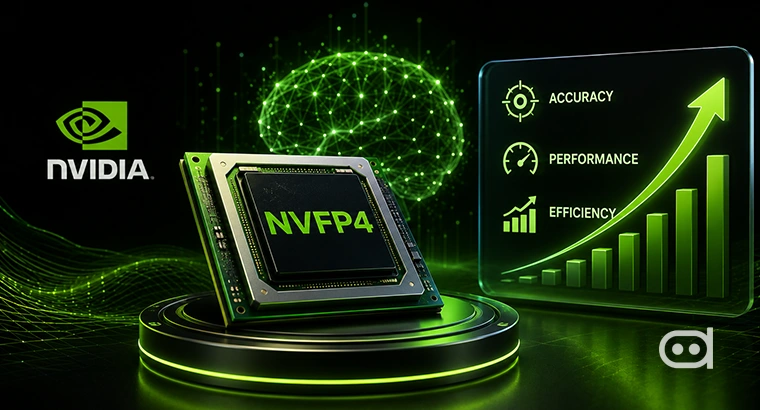
NVIDIA is clear that artificial intelligence performance is not about the algorithm nor big model. In a new deep dive on NVFP4 quantization, the company states that strategy, hardware, and pattern are one. The outcome is clear that a model is needed that understands decision laws and executes math. and information flows, and the model uses billions of parameters, the blend of software and hardware is a core aspect, not efficiency. NVIDIA introduces quantization to reduce the weight into bit-sized pieces for better memory and efficiency. It also has Nemotron 3 Ultra NVFP4, which runs on both of NVIDIA’s GPUs smoothly, despite their differences.
What Does NVIDIA Change About Large Models?
NVIDIA focuses on quantization, which is a method that reduces model weight into small formats, to reduce memory and speed up the process. The focus is NVFP4, a four-bit floating point format, which is embedded with the Blackwell infrastructure. NVFP4 decreases model size for accurate results, making it feasible to run large models with efficiency. The Nemotron3 Ultra NVFP4 depicts this approach in real-time.
Rather than embedding every layer in the same format, NVIDIA applies different precisions across the models based on the layer’s sensitivity. After quantization, the checkpoint decreases from over a terabyte in BF16 to one-third of its size. This cuts the footprint while also aiming for accuracy across the benchmarks. The outcome shows that compression alone is not the innovation, but layer awareness is.
Shifting to FP4 presents a new issue. There are only certain representable values for each bit block. How these values are embedded determines whether the information is preserved or lost. NVIDIA explains why max scaling, where the largest value in a block sets the scale, does not work. A single outlier forces the values to shift towards zero and degrades the quality.
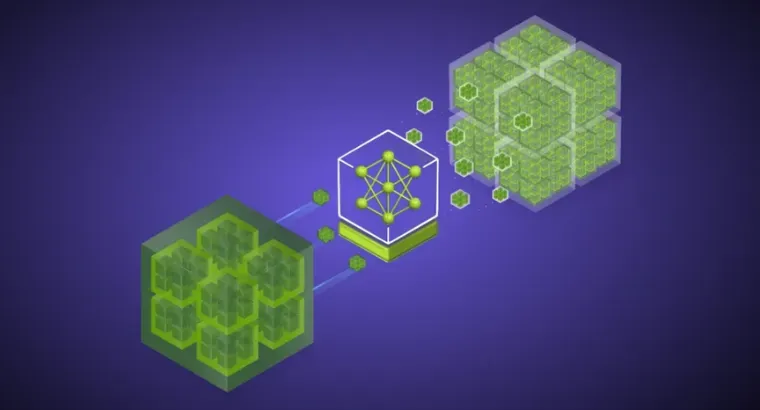
To resolve this problem, Nvidia looks out for new strategies, including mean squared error scaling and newer techniques. The key highlight for Nemotron 3 Ultra is four-over-six scaling. Instead of always scaling weights to the FP4 value, each block chooses whether to scale to 4 or 6, two of the available FP grid points, which reduces reconstruction error. This process targets the largest gap in the P4 grid and decreases quantization across several layers. The comprehensive message is that precision loss is not evenly bifurcated. Effective scale strategies must understand where the error stems from in the numeric representation, not just minimize errors.
Also Read: How NVIDIA’s BEVPoolV3 Software Address Latency in GPU-Based Self Driving VehiclesNVIDIA
Why Does the Hardware Design Matter?
A key aspect of NVIDIA is hardware knowledge. The Nemotron 3 Ultra NVFP4 can smoothly run on both Hopper and Blackwell GPUs, despite their distinct capabilities. On Blackwell, the model NVFP4 uses FP4 tensor cores. On Hopper, which does not have FP4 support, the framework shifts to a mixed format suitable for the hardware, avoiding performance penalties. This adaptation shows how checkpoints are not static.
They are highly dynamic, shifting on the basis of GPU math and memory restrictions. NVIDIA explains that a higher precision format can be highly productive if it prevents critical features such as multi-token prediction. In some situations, lower-bit formats blend with hardware capabilities to perform better than traditional choices because they have space for advanced model behaviors.
NVIDIA redeveloped the idea of a suitable model checkpoint. Accuracy, reliability, memory footprint, throughput, and hardware optimization must strike a balance. Tools like NVIDIA Model Optimizer automate part of this procedure by assessing layer sensitivity and assigning formats to meet a target, rather than coaxing developers to fine-tune every configuration.
This method understands that not all layers are equally robust to quantization. Some are high in precision, while others can work on aggressive compression. The best checkpoint, then, is not the one with the lowest bitwidth or the highest benchmark score, but one that resonates with scaling strategies, GPU execution in one system.
NVIDIA’s NVFP4 depicts a comprehensive change in artificial intelligence infrastructure. As models expand and inference becomes a necessity, performance gains stem from the interaction between the model and the hardware’s native math. Quantization formats, scaling strategies, and GPU patterns are one, handled by different teams. In this opinion, the future of artificial intelligence does not lie in universal checkpoints but in the awareness of the model and the hardware they run.