ON Semiconductor will acquire Synaptics in a $7 billion all-stock transaction, which will be its largest investment. The funding comes as semiconductor and proprietary technology shift towards acquisitions to bolster their artificial intelligence abilities. Unlike other artificial intelligence deals that involved monetary exchanges, ON Semiconductor plans to fund the takeover through share issuance. This portrays that it could be a strategic alternative to preserve cash assets while extending its exposure to connected compute and tangible artificial intelligence technologies.
What is the ON Semiconductor- Synaptics Deal?
Under the alliance, Synaptics stakeholders will receive 1.350 shares of ON Semiconductor for each Synaptics share they possess. The monetary value of Synaptics is close to $7 million, and is structured as an all-stock alliance rather than cash funding. ON Semiconductor said that the takeover would accelerate its total market by $30 million, taking it to an estimated $243 million by 2030.
The company also said that the alliance would bolster its intelligence system portfolio by adding new computing capabilities and software expansion. The monetary exchange will also result in ON Semiconductor adding one Synaptics board member after completion.
Using shares instead of cash is a distinct approach. Tech giants are carefully adopting capital amid struggling market conditions. By issuing shares, On Semiconductor refuses to use cash reserves or take extra debt, while still focusing on expansion. All-stock deals also transfer a certain amount of risk to stakeholders of both companies, tying the success of the business to On Semiconductor’s upcoming stock performance. The market reaction showed mixed reactions, where On Semiconductor shares fell about 6% and Synaptics shares rose about 14% after the declaration.
Analysts state that all stock transactions can affect existing stakeholders, especially if the market crumbles before deal closure.
Also Read: How NVIDIA’s BEVPoolV3 Software Address Latency in GPU-Based Self Driving VehiclesON semiconductor
How Does the Takeover Match ON Semiconductor’s Strategy
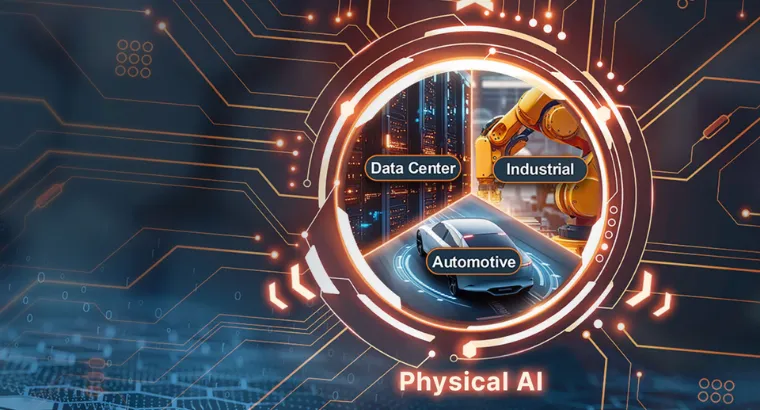
ON Semiconductor outsources major power-intensive technologies with a strong hold in automotives and electric vehicle markets, including silicon carbide production. The organization said the procurement of Synaptics will support these advantages by embedding connected compute capabilities relevant for physical and digital systems. According to ON Semiconductor CEO Hassane El Khoury, consumers look for intelligent systems that blend connectivity hardware and software. The organization states that Synaptics’ portfolio would support that demand as AI workloads expand beyond data centers into industrial mechanisms.
The organization said that the acquisition will be facilitated in the middle of 2027, with compliance and customary closing conditions. Until then, both companies will operate on their own. The long coast depicts the deal size and the compliance often associated with top semiconductor mergers, especially those that are a part of worldwide supply chains. Regulatory speculation can give rise to the growing strategic importance of artificial intelligence semiconductors set worldwide.
The ON Semiconductor-Synaptics alliance arises amid other procurements by companies to boost their artificial intelligence stacks. Earlier this week, Qualcomm took over infrastructure startup Modular to boost its software, while Salesforce announced to buy artificial intelligence customer service platform Fin for about $3.6 billion.
Contrary to ON Semiconductor’s stock-based idea, those alliances were placed as crucial purchases to boost software and AI product development. The difference emphasizes diverse strategies, where some organizations use money and others use equity to acquire AI-native platforms. ON Semiconductor chose the equity-based transaction without depending entirely on cash reserves. Execution is also a challenge as embedding hardware-centric and software-based product portfolios altogether is complex.
ON Semiconductor’s plan to procure Synaptics through an all-stock agreement highlights how semiconductor organizations redevelop their development strategies to an increasing role of AI in physical systems. By using shares rather than money, the organization aims to balance tangible flexibility with long-term portfolio expansion. As the funding moves towards 2027, its outcome will rely on integration, execution, the market, and whether the integrated capabilities bring sustained demand across industrial, automotive, and connected device markets.