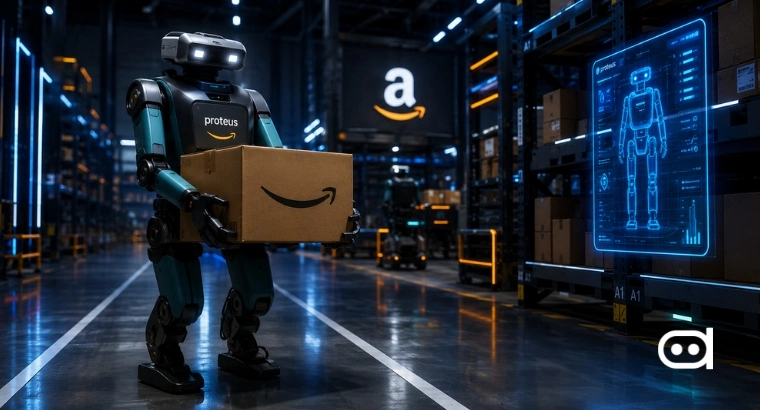
- Amazon just revealed a next-gen version of its autonomous warehouse robot, Proteus, at the “Delivering the Future” event in London. They’re planning to roll it out across Europe in the first half of 2027.
- Unlike older warehouse robots, the new Proteus takes instructions in simple language. Employees can just tell it what needs to be done and the robot figures out how to get it done.
- This launch is part of Amazon’s bigger push into AI and robotics. It’s not just Proteus, they’re also rolling out robots called Vulcan and STARK, and they’ve pledged $1 billion to upskill their global workforce by 2030.
Amazon is pitching this as a major leap in warehouse automation, but the bigger story is about how machines and people interact. At the London event, Amazon introduced a smarter Proteus that shuttles goods around warehouses but also actually understands what people tell it using regular language, not some complicated programming.
Tech companies are mixing AI with machines more and more these days. Warehouses have had autonomous robots for a while but Proteus marks a shift from robots that just follow rigid instructions to those that read your intent. Amazon is changing not just logistics but the whole idea of how people and robots could work together.
What is Amazon’s New Proteus Robot?
The newest Proteus operates across Amazon’s fulfillment centers, more independently than ever before. Employees can talk to it using everyday words instead of struggling with software or manual input.
That matters because warehouse workers have always adjusted to whatever tech demanded: learning processes, software, scanners. Now, with Proteus, the tech adapts to people.
Proteus understands tasks, figures out the fastest way to finish them, and moves around the warehouse on its own. Amazon is planning to start using it in Europe from 2027, which shows they believe conversational AI is ready for real-world logistics.
This reflects a wider trend, that is, businesses want to connect smart, language-based systems with physical machinery. Proteus is one of the clearest examples of how that’s happening.
TODAY: Amazon just announced a multi-year plan to invest over €10 billion to expand and modernize its European fulfillment centers, including hiring 25,000 new employees. The investment will include the launch of a next-generation autonomous robot and the expansion of systems… https://t.co/wn3yw5tfVo
— Amazon (@amazon) June 4, 2026
How Amazon’s Proteus Robot is Basically an Echo Dot on Wheels
So, while everyone’s talking about its mobility, the standout feature is the interface. Amazon built one of the world’s most recognizable voice platforms through Echo and Alexa. Millions of people started talking to devices instead of clicking buttons or memorizing commands. This shift made people used to the idea of conversation as tech’s operating system.
Proteus brings that same principle to the warehouse. Instead of saying “Alexa, play music”, workers just tell Proteus what needs to be done. The robot processes the request, plans it out, and handles the job. In both cases, conversation becomes the operating system.
Proteus isn’t your typical warehouse robot, it’s a physical AI assistant. The wheels, sensors, and navigation tech matter, but they’re not the primary story anymore. The real innovation is Amazon’s push to make machines understand people, instead of forcing everyone to learn how machines work. In a way, Amazon’s just putting its Echo philosophy on wheels and sending it to work in warehouses.
How does Proteus Reveal Amazon’s Bigger AI and Automation Strategy?
Proteus wasn’t the only new thing Amazon showed off in London. They also introduced Vulcan, which can “feel” and handle items, and STARK, a collaborative robot that deals with storage totes and is expected to expand to 15 European sites by 2027.
On top of these robotics upgrades, Amazon announced a $1 billion commitment to workforce training through 2030 so employees can keep up with skills in cybersecurity, software, logistics, renewable energy, and mechatronics.
It’s clear Amazon sees a future that’s less about pure automation and more about people and AI-powered machines working side-by-side. Employees will be directing robotic systems that are smart enough to understand what needs to be done rather than performing repetitive manual tasks.
Also read: Amazon’s Alexa can now generate full AI podcast episodes on demand
Proteus’s ability to take natural-language instructions puts it at the crossroads between AI and robotics which are two fields that are moving closer together fast. The robot’s hardware is an upgrade, but the real game-changer is that conversational layer on top. By bringing lessons from Alexa and Echo to the industrial space, Amazon is pushing toward a future where talking to a robot feels just like talking to another person.