OpenAI has introduced a restricted preview of its GPT-5.6 model, launching a three-tier approach. It covers aspects such as cost, speed, and capability. The model launch includes Sol, the strong flagship model; Terra for daily life work, and Luna, a quick and low-cost option. Beyond efficiency and cost, the launch depicts a shift in how frontier artificial intelligence systems are launched. The preview is restricted, coordinated with the U.S. government, and followed by what OpenAI describes as its most complex safety step to date. Altogether, the models and their launch depict a more amalgamated, risk-aware phase in the artificial intelligence spectrum.
How Are GPT 5.6 Sol, Terra, and Luna Distinct?
GPT-5.6 hasn’t launched a sole model, but a comprehensive stack of three models. At its best, Sol is designed for contextual tasks across coding, biology, and security. Terra is placed as a model with competitive performance, and half the cost of GPT-5.5. Luna succumbs to be a pocket-friendly and slim option with latency-sensitive use cases. The difference stems from cost and performance.
Sol has the highest per token cost, depicting its high-end modes and capabilities. Terra lowers the cost slightly while maintaining strong performance, and Luna further lowers it, trading speed for cost. A decrease in cost leads to an increase in speed, which seems to be the core aspect of GPT-5.6. The architecture allows users, developers, and organizations to consider aspects such as context, effectiveness, and price, rather than a model that claims it all.
GPT-5.6 Sol seems to be OpenAI’s most efficient model yet, particularly in long-standing and multi-step tasks. A novel “max reasoning effort” option lets the model take more time for in-depth reasoning, while an Ultra mode uses sub-agents for complex workflows. These mechanisms are made for tasks that require organizing iteration loops and tool use. In coding, Sol sets a new state-of-the-art on Terminal Bench 2.1, which focuses on command-line workflows.
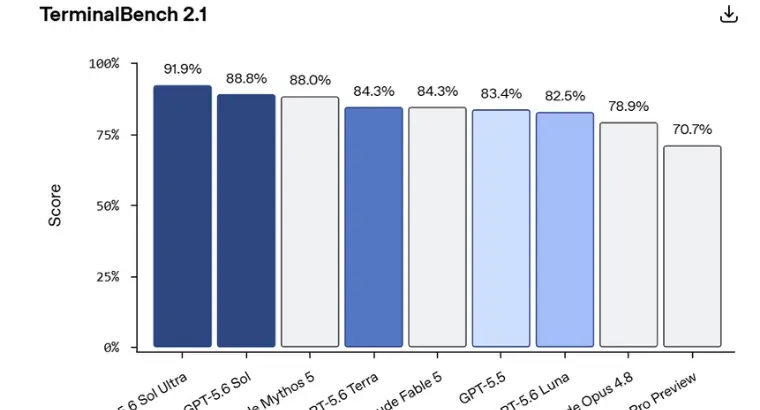
In biology, it shows better results on GeneBench V1 while using fewer tokens than GPT-5.5, suggesting greater efficiency with output. In cybersecurity, Sol transfers what OpenAI calls the performance efficiency frontier, showcasing competitive results on exploitation-focused benchmarks with fewer token usage. Terra and Luna also contain improvements, though at different capability levels resonating with their tiers.
Also Read: Claude Sonnet 5 Leaks: What Users Can Expect & Other DetailsGPT-5.6 Launch
Why is the Launch Tied to Government Oversight?
Despite aiming for comprehensive access, OpenAI chose to start GPT-5.6 with a restricted preview for a small group of vetted partners. These individuals have been shared with the U.S. government, and the preview includes an advanced briefing on the model’s abilities. As per OpenAI, this method is a short-term step taken at the federal authorities’ request, intended to facilitate cooperation on cyber safety risks and surging compliance. The organization is explicit that it does not view this process as a long-term mechanism.
It states that withholding restricted access would keep necessary tools away from organization cyber defenders, partners, and developers who aim to acquire them. However, given the abilities, particularly in domains like cybersecurity, OpenAI depicts the release as the fastest path to comprehensive access while resonating with the cyber executive order.
Security is a central aspect of GPT-5.6, especially for its sole. OpenAI describes a guardrails, safety guardrail stack that is inclusive of model-level refusals, real-time classifiers, account-level monitoring, differentiated access, and monotonous testing. These mechanisms are created to make offensive activity strenuous and detectable while safeguarding legitimate users, such as vulnerability research, patch development, and defence testing. GPT-5.6 Sol is known for helping users find vulnerabilities rather than at carrying out end-to-end attacks.
In internal checks, it recognizes bugs and exploitation primitives, but did not sovereignly produce full-chain exploits or exploit conditions. OpenAI also works on automated red teaming, dedicating over 700,000 A100-equivalent GPU hours for universal jailbreaks, supplemented by human oversight. The preview is intended to test the guardrails and capabilities, so as to make them better, so that the further release is not blocked.
The GPT-5.6 launch is more than an update. With Sol, Terra, and Luna, OpenAI has formulated a three-level marketplace that resonates with certain aspects. Similarly, the limited government-coordinated preview highlights how frontier AI releases are related to security and speculation. If the preview succeeds, GPT-5.6 could set a tone for future releases with strong guardrails and accessibility.