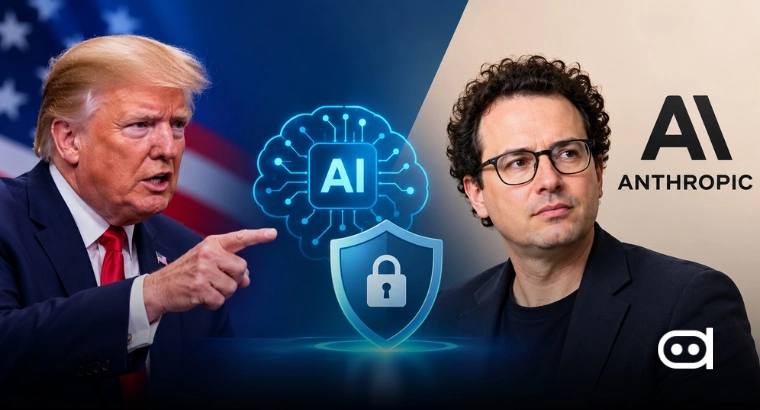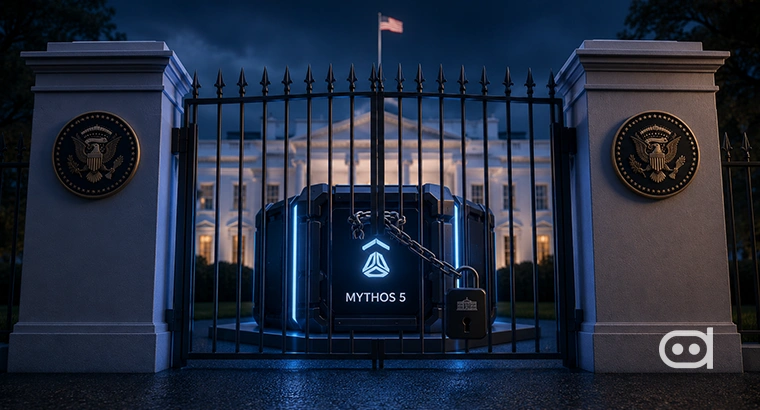
The US government’s latest decision on Anthropic’s Claude Mythos 5 has started off another round of debate over who controls access to the world’s most advanced AI models. The Trump administration, after briefly restricting the model’s deployment because of national security concerns, just gave Anthropic the green light to restore access but only for around 100 selected and trusted US organizations. The restrictions stay the same for everyone else.
The White House says it’s limiting access to Mythos to keep the AI out of the wrong hands but critics aren’t buying it. The core question is pretty simple: Should it really be up to the federal government to decide which companies are trusted enough to use frontier AI?
Why is the White House Gatekeeping Mythos and Fable 5?
The government’s decisions come from concerns that today’s frontier AI models are way past just boosting productivity. Earlier this month, the government asked Anthropic to suspend access to both Claude Mythos and Fable 5 models after officials raised concerns that their cybersecurity capabilities could potentially be exploited by cybercriminals.
After a lot of discussions, the administration partially reversed its decision and allowed Anthropic to restore Mythos 5 to more than 100 trusted organizations. According to Reuters, the list includes Fortune 500 companies and critical infrastructure operators already involved with Project Glasswing, and Anthropic’s cybersecurity program. The government believes these groups to be trustworthy because they help run and defend core US infrastructure.
Since June 12, we’ve been working closely with the US government to restore access to Claude Mythos 5 and Fable 5. Today, the government notified us that Mythos 5, our strongest cybersecurity model, can be redeployed to a set of US organizations that operate and defend critical…
— Anthropic (@AnthropicAI) June 27, 2026
But Fable 5 restrictions are still in place which means the model still cannot be used broadly. Officials still think Fable 5’s protections against generating dangerous cybersecurity content might break if someone bypasses jailbreaking techniques. Until those concerns are addressed, the administration has decided to keep the restrictions in place.
The decision also signals that instead of just leaving deployment decisions entirely to the companies building these systems, the government is taking a more direct role in determining when and how advanced models can be released. For AI companies, government approval is becoming a more important part of the launching process.
The US Government Releases Mythos AI to ‘Trusted’ US Organizations: Who Gets Access and How is the Government Deciding?
The White House named over 100 organizations that can use Mythos 5 but hasn’t said much about how they selected them. Companies participating in Project Glasswing, Fortune 500 companies, and critical infrastructure operators were among those approved. There is no publicly available guide explaining how eligibility works. We don’t know if companies can even apply themselves, or which security standards are required, or who reviews applications, or how future decisions will be handled.
US allows Anthropic to release Mythos AI to 'trusted' US organizations https://t.co/RaqiYWebch https://t.co/RaqiYWebch
— Reuters (@Reuters) June 27, 2026
US Commerce Secretary Howard Lutnick apparently told Anthropic that it had made “significant progress” on the model’s safety, but neither the Commerce Department nor the White House has disclosed what changed or what safety steps convinced officials to authorize the limited rollout. And this lack of transparency has become the biggest reason for criticism.
John Coleman, legislative counsel at FIRE, summed up the criticism as “No one knows how these companies are picked and why everyone else is excluded”. He warned, “This is putting too much power in the hands of the government. There’s little transparency and it raises questions about the rule of law”.
OpenAI CEO, Sam Altman said, “Extensive safety testing is not a bad idea. I just don’t like the idea of the government picking the customers”.
Kate Koren of the Center for Strategic and International Studies called the rollout “A practical interim step, but leaves unresolved the larger issue of how companies can widely release updated models”. She also warned that dragging out restrictions could hurt US businesses, adding, “The longer there isn’t a system in place that will allow US companies to widely release new models, the more likely it is that China will be able to catch up”.
Together, these reactions highlight that while stronger safeguards for powerful AI models may be necessary, the rules governing that access need to be far more transparent.