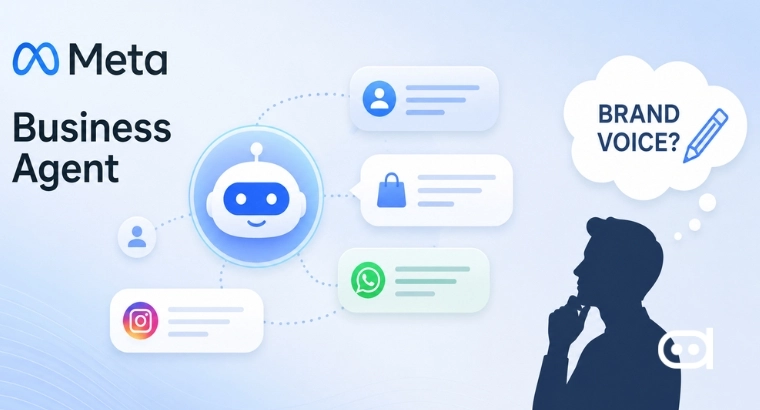
- Meta has launched Meta Business Agent, an AI-powered assistant built to help businesses manage customer conversations, qualify leads, suggest products, book appointments, and even close sales across WhatsApp, Messenger, and Instagram.
- Meta announced this tool at the Conversations event in London on June 3, 2026.
- After earlier versions saw over 1 million businesses use it on WhatsApp and Messenger, Meta is rolling it out to companies worldwide.
Meta wants people to see its Business Agent as more than just a customer support chatbot. They picture it as an AI-powered business assistant that can manage sales conversations, give operational insights, and help companies boost customer engagement without having to hire more staff. By integrating directly into Meta’s messaging ecosystem, the tool aims to make AI assistance accessible to all types of businesses.
What is Meta Business Agent?
Meta Business Agent is Meta’s latest move into enterprise AI. The company says you can set up the assistant in minutes and it lets businesses respond to customers 24/7 across WhatsApp, Messenger, and Instagram. It can answer tailored business questions, suggest products, book appointments, qualify leads, close deals, etc. Already, over 1 million businesses used earlier versions before this wider launch, and now Meta’s expanding access globally. Paid subscriptions are also coming soon.
But Meta’s not just stopping at customer service. The Business Agent will eventually handle morning briefings, summarize conversations, run market research, surface product insights, provide competitive intelligence, and work with systems like Shopify, Zendesk, and Shopee. Meta says automation could boost business output by 10 or even 100 times.
Brand voice remains a big selling point. Meta says the assistant can respond in customers’ native languages while using the specific tone of each business. That feature could be key in making AI feel like part of the team, not just another generic chatbot.
Introducing Meta Business Agent: AI that lets businesses show up for their customers as if they had an infinite team behind them answering questions, making product recommendations, booking appointments, closing sales, and more.https://t.co/wCFU7OWXQv
— Meta Newsroom (@MetaNewsroom) June 3, 2026
Meta’s Attempts to Capture Business’ Tone
With Meta Business Agent, the company wants its AI to act more like a digital team member by handling customers, supporting sales, and pitching in with operations. The real question for marketers isn’t if this technology works, but if it can actually sound like their brand.
That issue matters more as companies look to automate customer conversations without losing that personal, authentic touch. Meta claims its assistant can deliver responses in a business’s unique tone, but early demos show the real value may hinge as much on human oversight as on how smart the AI is.
How Meta Business Agent Imitates Brand Touch
A recent demo of Meta’s AI Business Assistant by Ben Heath, shows that in Ads Manager both the upside and some limitations in using AI for marketing support. In the video, the assistant checks live campaign data, spots performance trends, and gives tips to boost results. Marketers can talk to the AI in simple language and get insights that would normally take much longer to find manually. The demo calls out plenty of helpful features, but you can see where people still need to step in to double-check the AI’s recommendations.
In one example, Meta Business Agent looked at an ad campaign that had high click-through rates but wasn’t converting into sales. It picked up on a disconnect between the ad and the landing page, suggesting tweaks like problem-solution image ads and carousel ads with social proof which is real marketing advice, not just generic tips.
For another campaign, the assistant noticed performance differences by age group, showing that people 18 to 24 were generating leads way more efficiently than those aged 55 to 64. It suggested creating ads that speak more directly to older customers. The AI also pointed out standout ads, one had a cost per result of £3.79, while another cost over £30.
It also benchmarked performance. In one case, it said a campaign’s cost per lead was 154% above the industry average, but noted the results had improved by 52% recently. In another example, after analyzing more than 700 purchases, it suggested ways to improve ad spend returns using value-based optimization.
The AI sometimes recommended turning on settings that were already active, and it often pushed for higher budgets which is an advice marketers don’t always trust. The creator testing the tool kept emphasizing that advertisers still need to know their basics before following the AI’s suggestions.
That’s a key point. The assistant can spot trends in no time, but it still depends on humans to decide if those recommendations actually fit business goals, customer expectations, and brand identity.
Also read: Meta is quietly testing premium subscription plans for its AI chatbot
Meta Business Agent marks a big step in how businesses could use AI. It can already handle customer conversations, deliver performance insights, and provide smart marketing suggestions. But sounding like a true brand is more than giving quick answers, it’s about grasping context, tone, and what customers really expect.
For now, Meta’s AI works best as a smart assistant, not a total replacement for human decision-making. Businesses that use it as a partner can boost efficiency.