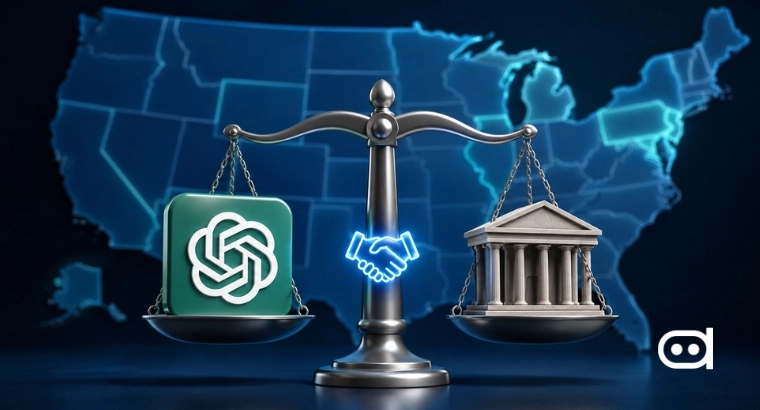
OpenAI’s latest proposal on AI regulation has reignited the debate over who should set the rules for artificial intelligence in the United States. The company says that, until Congress passes a federal AI law, individual states can help by introducing similar AI safety regulations. At first, the proposal appears to give states a leading role in shaping AI governance. However, the emphasis on similar laws has led to a different interpretation. If states adopt nearly identical regulations, they could effectively create a national standard without Congress passing a single federal law. In that sense, the discussion is not only about states regulating AI but also about how regulatory uniformity could emerge.
Why “Similar” State Laws Matter
In its policy proposal, OpenAI argues that AI developers should not have to navigate dozens of different regulatory systems across the country. Instead, the company says states can play a temporary role by adopting comparable safety rules until a federal framework is established. This approach would mean that although laws are passed at the state level, they would largely follow the same rules. And in practice, this could function as a de facto national rulebook even without Congress passing a single law.
For OpenAI, having a consistent set of rules just makes things easier for companies working across multiple states. Plus, it means advanced AI systems would have to meet the same safety standards everywhere. Others view the proposal differently. They argue that asking states to adopt similar laws is less about encouraging independent state policymaking and more about creating regulatory uniformity through state legislatures. So, the debate is not only about whether we regulate AI. It is also about how a national standard could take shape before Congress finally reaches an agreement.
States Have Already Begun Building Their Own AI Frameworks
The discussion comes as several states have already moved ahead with AI related regulations instead of waiting for federal action. California has introduced laws addressing different uses of artificial intelligence, while Colorado has passed legislation focused on high risk AI systems. New York City has also implemented rules governing the use of automated employment decision tools in hiring. In short, the state level patchwork has already started. That growing mix of laws has also appeared in legal disputes. For example, lawsuits over layoffs at Meta brought AI employment practices and state AI regulations into the spotlight, making it clear that state laws are beginning to change how companies operate.
So, OpenAI’s proposal is not just about getting states to regulate AI. It looks like an effort to bring some order to a regulatory scene that is getting more confusing by the day. With different states rolling out their own rules, OpenAI’s call for similar regulations sounds more like a push towards consistency instead of letting every state do its own thing. The conversation also reflects OpenAI’s broader approach to government oversight. The company has previously cooperated with the federal government’s voluntary pre release safety review process for advanced AI models while also raising concerns about making such arrangements permanent regulatory requirements. That position reflects OpenAI’s support for AI safety oversight alongside its preference for regulatory consistency.
Also read: White House Restricts OpenAI’s GPT 5.6 Release Amid Security Concerns
The debate over OpenAI’s proposal extends beyond whether states should regulate AI. It also raises questions about what the company means when it asks states to adopt similar rules. Some see it as OpenAI offering states a temporary role until Congress acts. Others think that the proposal seeks to create a uniform national framework through matching state laws while federal legislation remains pending. With California, Colorado and New York City already enforcing AI related regulations, the United States is no longer starting from zero. Whether future state laws become more aligned or continue to evolve independently will play a key role in shaping how AI is governed before a federal framework is eventually established.