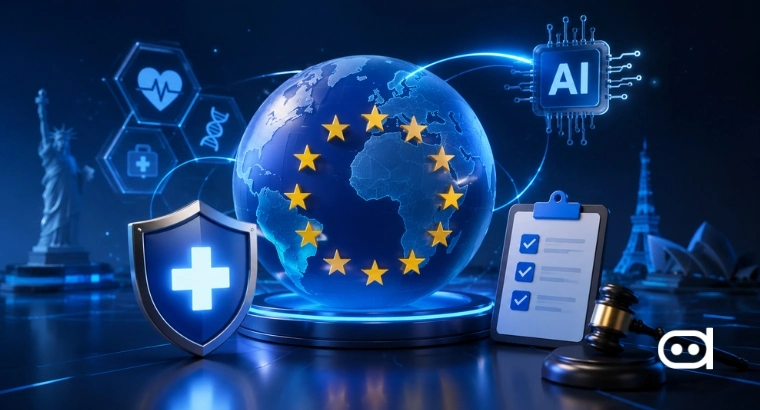
Artificial intelligence is embedding itself into healthcare, helping doctors assess scans, support diagnosis, and ease hospital workloads. But as deployment increases, regulators face a new issue. The issue is that AI systems are crossing borders while oversight remains native. Portugal’s decision to become the first European Union member to join HealthAI’s Global Regulatory Network,( GRN), hints that Europe is moving towards global cooperation on AI regulation, even before the EU’s landmark AI Act is implemented. The shift reflects a necessity that monitoring AI in healthcare needs expertise, security, governance, rather than working in isolation.
How is HealthAI Affecting AI Governance in Healthcare?
Portugal’s healthcare regulator, Infarmed, has been added by the Geneva-based non-profit HealthAI’s Global Regulatory Network, giving the nation access to a regulator review directory of AI healthcare tools and systems that let members to report and share AI-related incidents. The shift comes as the European Union slowly launches out its AI Act, the world’s most broad framework for governing artificial intelligence. Instead of pausing for the legislation to approve, Portugal is bolstering its oversight by joining a global network that already includes countries such as the UK, India, Brazil, Singapore, Indonesia, Vietnam, Zambia, Peru, and the Philippines.
The timeline is crucial because AI-powered healthcare applications are quicker than conventional processes. Clinical tools developed in one nation may find new consumers elsewhere, making oversight difficult and insufficient. The need for manual intervention is increasing as AI-powered healthcare tools become a norm, with platforms such as Philips Alturion already helping clinicians analyze ultrasound scans and develop diagnostic workflows. Portugal’s decision suggests that Europe sees global cooperation as a crucial complement to native regulation.
Health AI was created to generate regulation standards and frameworks for artificial intelligence in the healthcare niche. Rather than replacing native regulators, the ecosystem enables them to share information, assess AI tools, and answer quicker when safety concerns arise through HealthAI. One of its key aspects is a shared warning system through which regulators can inform each other about harmful incidents regarding AI-enabled healthcare products.

That means watchdogs no longer have to check every issue independently. Instead, changes in one country can help the others. This shows a crucial shift in AI regulation. Conventionally, healthcare governance has been native, with each country assessing medical technologies on its own. AI changes that process because software develops rapidly, updates, and operates across multiple nations.
Why Is Global AI Oversight Necessary?
HealthAI is crucial for native watchdogs to manage on their own. Unlike conventional devices, AI systems rapidly develop through software and can be adopted across multiple healthcare environments within a short span of time. That makes global coordination necessary. If an AI diagnostic tool produces unprecedented outcomes, a greater elsewhere can be alerted before similar problems arise in their healthcare systems. Shared regulation also decreases regulatory work while pushing more safety standards.
HealthAI chief executive Baptista Leite said that the organization is in conversation with other EU member states, stating that Europe’s regulatory choices will have worldwide consequences. As more countries adopt artificial intelligence in the niche, Europe’s decisions will affect how ombudsmen worldwide approach security, reliability, and accountability.
Portugal’s act may start a comprehensive shift in how healthcare governance develops across the EU. Rather than depending solely on the AI Act, the ombudsman appears to be facilitating global coordination alongside the legislature. That approach could become necessary as artificial intelligence companies release healthcare products across several regions.
Cooperative oversight offers arbiters faster access to evidence, knowledge, context and real-time safety information that would be strenuous to gather alone. The move also reinforces a trend where governments are regulating under AI models, arguing common standards or monitoring healthcare applications. AI is rapidly growing and operating on a worldwide scale is equivalently necessary.
Portugal’s arrival into HealthAI’s global regulatory network is about the global healthcare system. It shows that Europe is starting to regulate AI through international coordination rather than acting alone. As healthcare AI becomes more widespread, ombudsmen are recognizing that effective regulatory regulation depends not only on native rules but international coordination. The future of AI governance may therefore be defined as much by shared global networks as by native legislation.