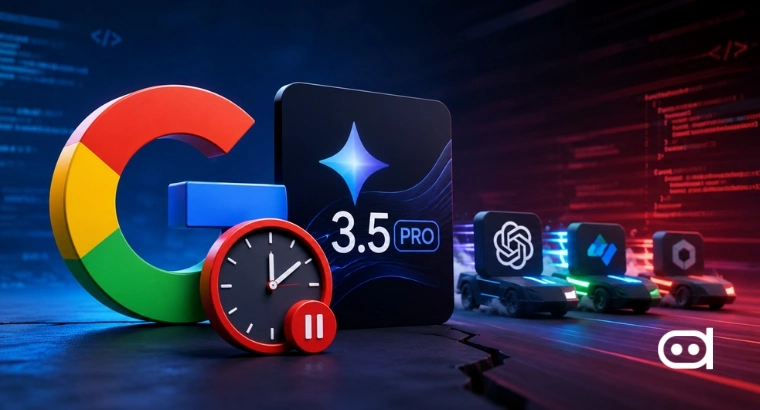
Google’s plan to halt the public release of Gemini 3.5 Pro emphasizes how arduous the artificial intelligence race is. The model was first revealed at Google I/O in May, with better reasoning, multimodal abilities, and industrial leading context length, and was expected to launch in June. Instead, a new report suggests that Google is stopping its flagship AI because its coding capabilities did not meet internal checks. The delay comes at a time when competitors including OpenAI, Meta, Anthropic, and xAI are readying new coding-focused AI models, making development one of the most important breakthroughs in the AI niche.
Why Has Google Delayed Gemini 3.5 Pro?
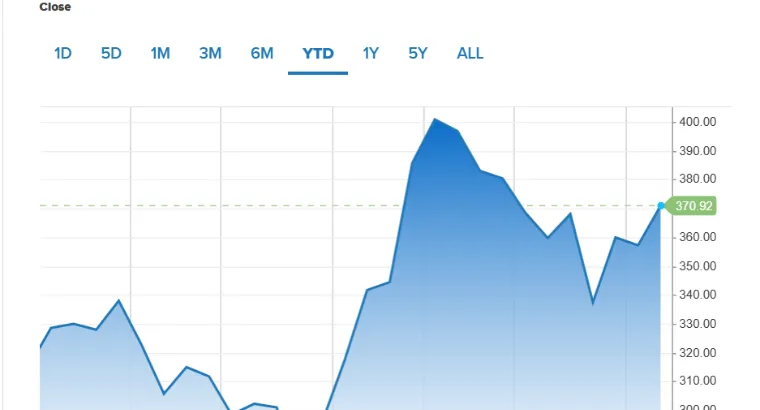
As per CNBC, Alphabet has delayed the launch of Gemini 3.5 Pro by several months as the developers continue to improve the model’s performance. The biggest issue reportedly lies in its coding abilities, which are way behind Google’s internal expectations. The report hit investor sentiment immediately, with Alphabet shares falling about 4% after the news rolled out. The delay is particularly notable because Google had previously declared Gemini 3.5 during Google I/O 2026 and said that the model was used for internal work before public release.
Google has not confirmed a new release date. Instead, the organization said it is continuing to test Gemini 3.5 Pro, an upgraded flash model, and other artificial intelligence systems with their partners while highlighting that it remains focused on providing cost-efficient models for consumers. Before the delay, Google has already outlined a vision for Gemini 3.5 Pro positioning it as the most advanced AI model.
What Was Gemini 3.5 Pro Supposed to Deliver?
One of its appealing features is the 2 million token context windowCNBC, allowing the model to process huge documents, extensive code repositories, long-standing conversations, and complex resource models without losing context. Google also launched DeepThink, a reasoning mode created to spend more time solving complex problems before answering. The company said this would better perform across mathematics, science, research, coding, and other multi-step reasoning tasks.
Gemini 3.5 Pro is also expected to boost multimodal capabilities by managing text, infographics, image, audio, and video naturally while helping long-running agent workflows that can create and complete complex work tasks with less manual intervention. For developers, Google promised substantial code generation, debugging, and large software project capabilities that now appear to be the core aspect behind the late launch.
Read More: Gemini AI Timeline from 2024 to 2026
How Gemini 3.5 Pro’s Delay Reflects the AI Coding Race
The reported delay comes as AI companies compete on coding abilities rather than standalone chatbots. OpenAI recently introduced GPT-5.6 Sol, emphasizing major improvements in frontier coding efficiency. Meta arrived with Muse Spark 1.1, describing it as the organization’s strongest model for coding and autonomous AI agents. Anthropic has continued expanding its Claude family with models such as Fable, while xAI steadily enhanced Grok as the competitiveness increases. All together, these rollouts show that the research focus has shifted beyond benchmark gains of conversational abilities.
AI companies aim to build systems capable of production, productivity, writing quality software, understanding massive codebases, developer workflows, and managing complex reasoning tasks. This change also explains why Google is hesitant to release Gemini 3.5 Pro until it can compete better in software development, one of the fastest-growing proprietary applications of frontier AI.
The suspension highlights the growing pressure faced by the largest AI companies. Just months ago, Google placed Gemini 3.5 Pro as a big step with longer context windows, better reasoning, developed multimodal understanding, and developer tools. Those declarations created expectations that Google was preparing to bridge the gap with its rivals. Since then, Google has failed to live up to those expectations while competitors continue releasing new models.
That raises the competitive bar even further by the time Google eventually rolls out its flagship model. Similarly, delaying a release beats shipping a model that fails internal standards.. As artificial intelligence becomes integrated in proprietary software development, stakeholders prioritize reliability and coding accuracy over who arrives first.
Google’s alleged Gemini 3.5 Pro defer highlights how quickly the environment is changing. The race is not only about conversational intelligence but is also based on sovereign agents, coding, and reasoning. While the delay may temporarily leave Google trailing competitors that have already launched novel models, it also reflects a comprehensive reality which is that flagship AI systems are now judged by consistency and real-time performance.