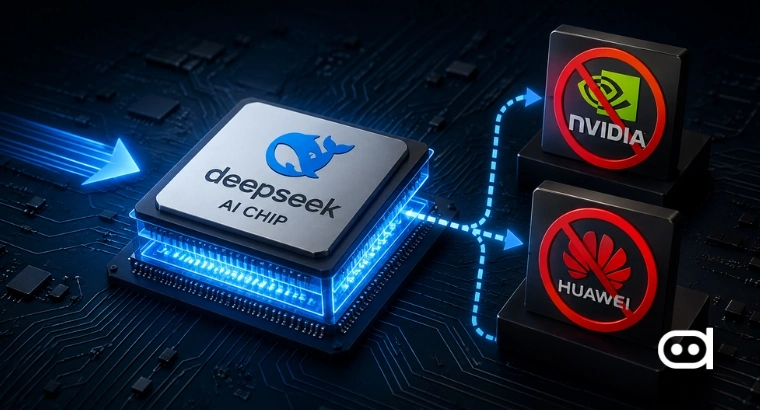
Chinese AI startup DeepSeek plans to develop its own artificial intelligence inference chip, demonstrating a substantial shift. This will transform DeepSeek from an AI model developer to owning its own hardware stack. According to sources, the company has silently extended its chip design efforts over the previous years. It has also simultaneously accelerated the recruitment of semiconductor engineers. The shift depicts a comprehensive strategy to reduce reliance on external suppliers such as Nvidia and Huawei, as China aims for greater self-dependence in artificial intelligence architecture amid the continued U.S. export ban.
What Is DeepSeek Developing?
DeepSeek is acquiring its own artificial intelligence chip, particularly for inference. Inference refers to the stage where artificial intelligence models develop responses to users. Unlike training chips, which are designed to improve AI models, inference chips are created to efficiently run adopted models. It is becoming increasingly crucial as artificial intelligence applications move into the corporeal niche. If it thrives, the project would depict a crucial strategic expansion for DeepSeek, which has built its fame on developing highly efficient artificial intelligence models rather than monetizing semiconductor technology.
By stepping in on chip development, the organization aims for greater control over the hardware that supports its AI services while decreasing dependence on third-party supplies. The effort remains at an early stage, with DeepSeek holding talks with chip-designing organizations, foundries, and suppliers as it explores the technical and manufacturing needs to bring its chip to market.
DeepSeek is about to become an active part of artificial intelligence companies seeking to build enterprise hardware instead of depending on Nvidia’s GPUs. Previously, OpenAI introduced Jalapeno, its first tailored inference chip developed in alliance with Broadcom. On the other hand, Anthropic has also been reported to be evaluating the development of its own artificial chips. For DeepSeel, the motivation extends beyond efficiency and reducing costs.
Building domestic artificial intelligence hardware also answers geopolitical restrictions, making semiconductor development a national necessity alongside a crucial investment. To accelerate this effort, the Hangzhou-based company increased the semiconductor team, privately recruiting chip-designing engineers without public hiring or advertisements.
How Does the Chip Fit Into China’s Self-Reliance Plan?
DeepSeek’s semiconductor vision resonates with China’s comprehensive project of building a self-reliant artificial intelligence ecosystem. U.S. export restrictions continue to restrict Chinese organizations from buying Nvidia’s most advanced AI chip. This has caused domestic AI developers to depend on distinct hardware or create their own solutions. DeepSeek has relied on both Nvidia and Huawei processors perennially. The organization previously said that the base model behind its R1 reasoning model was trained using Nvidia H800 chips, which were later constrained under U.S. export rules.

Recently, DeepSeek has deployed Huawei hardware, releasing its V4 model, a joint effort with Huawei’s Ascend chips, and confirming that Huawei processors were used for a segment of the training of V4 Flash. Creating its own inference chip would decrease reliance on both suppliers, while giving DeepSeek an edge over its AI architecture. The shift also depicts Beijing’s continued efforts to push domestic technology to create essential artificial intelligence capabilities within the country.
Inference is one of the quickest-growing parts of artificial intelligence computing as enterprises adopt AI applications. In contrast to training workloads, which need gigantic resources , inference focuses on user efficiency after model training. Specialized inference chips can provide lower power consumption and decreased costs with general-purpose GPU’s. It makes them appealing as AI deployment extends.
Despite the advantage, DeepSeek also faces certain issues. Creating a competitive artificial intelligence chip needs years of engineering, substantial funding, and access to advanced manufacturing capabilities. U.S. constraints on high-end foundries and high-bandwidth memories remain key roadblocks for Chinese chip developers, meaning there is no guarantee the project will succeed. Similarly, DeepSeek is adopting external capital for the first time. According to Reuters, the company is seeking to raise $7 billion in its first funding round, valuing the startup between $52 billion and $59 billion, providing extra resources to boost its growing AI hardware vision.
DeepSeek’s entry into AI chip development hints at a comprehensive evolution to become a full-stack infrastructure company. By funding tailored inference hardware, the Chinese company aims to reduce its dependence on Nvidia and Huawei, while resonating with China’s long-term strategies. Although the project remains in its initial stages and faces massive challenges, it depicts a broader trend where AI developers aim to acquire control over software and hardware.