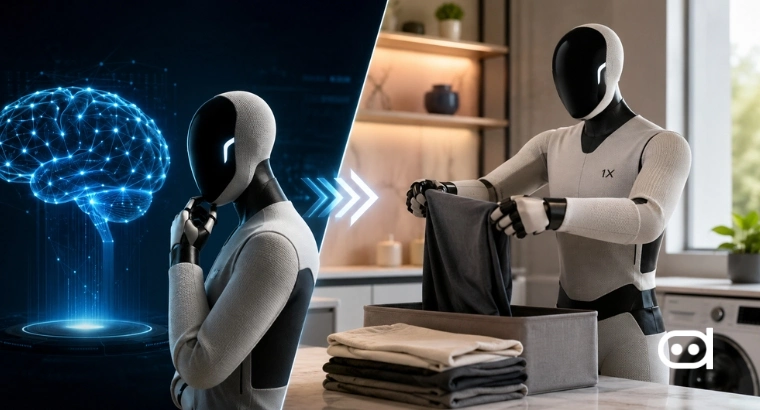
Artificial intelligence has rapidly evolved from answering questions and generating content to handling complicated problems with real skill. Large language models have shown that AI can understand instructions, engage in conversations and assist users across a wide range of digital tasks. However, the next phase of innovation is shifting beyond software and into the physical world. That shift is reflected in 1X’s vision, which is developing humanoid robots capable of performing everyday household tasks.
Rather than limiting AI to a screen, the company is combining intelligence with mobility, perception and sharp hands to create a robot designed to help inside the home. The goal is to bridge the gap between digital intelligence and real world action by letting AI physically complete routine chores. But are consumers ready to welcome an AI powered robot into their daily lives?
What 1X NEO Can Do
According to 1X, its humanoid robot NEO is designed to tackle repetitive and boring household work so people can spend more time on activities they actually like. Instead of serving a single function, the robot is intended to assist with a variety of domestic tasks through a combination of robotics and artificial intelligence.
The company says users can create a list of chores, schedule them and return to a cleaner home. NEO is also designed to respond to natural voice commands while carrying out routine activities around the house.
Some of the capabilities highlighted by 1X include walking to a person when called, putting away dishes, completing scheduled household chores, understanding and responding through natural conversations, and learning new household skills over time. But how much autonomy are users willing to hand over to a robot inside the privacy of their homes?
A notable feature is Expert Mode, which allows a 1X expert to remotely guide the robot when it encounters a task it has not yet learned. According to the company, this process also helps the robot improve its capabilities over time.
🤖WILD: ROBOTS JUST GOT HANDS BETTER THAN YOURS
— Coin Bureau (@coinbureau) July 10, 2026
1X Technologies unveils NEO hands with 25 degrees of freedom and tendon-driven fingers that match human dexterity at 0.2mm precision.
They can plug in cables, stack LEGO bricks, lift 20 kilos, and take a hammer strike without… pic.twitter.com/txIxE2dgnT
The software powering NEO combines multiple AI systems. At the center is Redwood AI, which is its Generalist AI model for learning and repeating household tasks. The robot also incorporates a built in large language model that enables it to understand instructions, reason through requests and hold conversations with users. Alongside conversational AI, the robot also includes memory capabilities, audio intelligence, visual intelligence, and autonomous navigation. All this tech helps NEO understand its surroundings while interacting naturally with people inside a home.
1X NEO’s Hardware and Specs
The software enables NEO to understand instructions and learn new tasks, but the hardware decides whether it can safely operate in real homes. Can a humanoid robot be both capable enough to help and safe enough to coexist with people in everyday environments? That is one of the key challenges companies in this field are trying to address and overcome.
The robot features a custom 3D lattice polymer soft body and uses tendon driven actuation for slow, gentle movements. To improve safety more, the joints are covered to eliminate pinch points, and its suit and shoes are made from machine washable nylon for easy upkeep.
The published specifications include:
| Height | 5’6” |
| Weight | 66 lbs |
| Maximum lifting capacity | 154 lbs |
| Carrying capacity | 55 lbs |
| Payload per arm | 18 lbs |
| Hands | 22×2 |
| Arms | 7×2 |
| Neck | 3 |
| Spine | 2 |
| Legs | 6×2 |
| Maximum running speed | 6.2 m/s |
| Walking speed | 1.4 m/s |
| Hand speed | 8.0 m/s |
Power is supplied by an 842 Wh battery that provides 4 hours of runtime. According to 1X, the robot supports quick charging at 6 minutes per hour runtime and is designed to plug itself in whenever charging is required. The onboard computing platform is the 1X NEO Cortex (Nvidia Jetson Thor), delivering up to 2070 FP4 TFLOPS of AI compute.
For sensing and communication, NEO includes:
- 4 beamforming microphones.
- Dual 8.85MP 90Hz stereo fisheye cameras.
- Wi Fi connectivity.
- Bluetooth.
- 5G support.
Users can interact with the robot through voice commands, a mobile application or remotely run it using both the mobile app and a VR device.
Neo Robot’s Privacy Concerns
The launch has also raised privacy concerns among some users, particularly around the amount of data a home robot could collect. In a discussion on Reddit’s community, users questioned the implications of having a robot with cameras and microphones operating inside private homes. Some are concerned that footage recorded to improve the robot’s performance or enable remote assistance could, under certain legal circumstances such as a valid warrant, become accessible to law enforcement. Others also raised questions about whether users would be comfortable with a device capable of moving itself throughout their homes.
The Neo Robot from 1X might be the biggest privacy nightmare yet.
by u/GrandyRetroCandy in privacy
Artificial intelligence has already shown that machines can understand language, reason through requests and assist users digitally. The next stage of innovation focuses on extending those capabilities into the physical world through humanoid robots that can perform everyday household tasks.
1X’s NEO represents that direction by combining conversational AI, autonomous navigation, household task learning and hardware designed for safe interaction inside homes. Rather than treating intelligence as a purely digital capability, the company’s approach aims to give AI the ability to move, interact and complete physical chores.
Also read: What is UBTECH? Inside its New UWORLD Brand and U1 Humanoid Robot