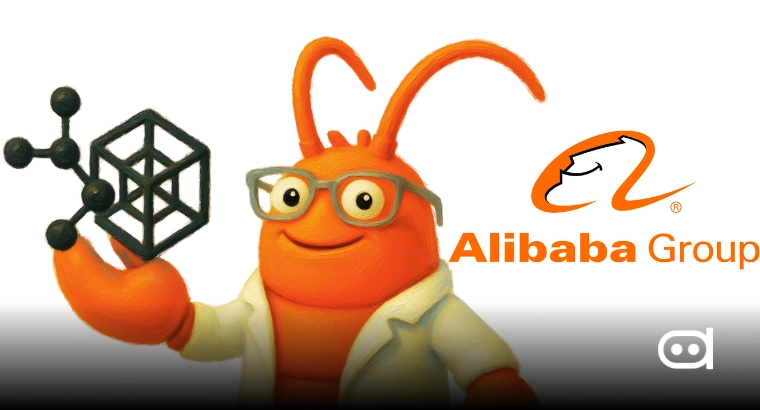
Artificial intelligence keeps pushing scientific research forward, moving beyond automating routine tasks to making meaningful contributions to complex discoveries. Take Alibaba’s DAMO Academy, for example. They have rolled out an AI powered materials discovery agent called Elements Claw, and the research team says this system found four completely new superconducting materials. Scientists then went ahead, synthesized them, and confirmed the results in the lab.
This achievement sends a clear signal on how artificial intelligence is starting to reshape materials science, which is notorious for being tough and time consuming. Instead of replacing lab work, systems like Elements Claw significantly reduce the time needed to identify promising candidates for testing. The AI scans millions of possible combinations fast so researchers can focus on compounds most likely to have superconducting properties. None of these materials are room temperature superconductors yet, but it is a solid sign that artificial intelligence is speeding up scientific innovation.
How Elements Claw Accelerated the Search for New Superconductors
Discovering superconductors has traditionally been a slow and resource intensive process. Researchers often rely on theoretical models, computer simulations, and years of experimental work before identifying materials capable of conducting electricity without resistance below a specific critical temperature.
Elements Claw tackled this problem differently. It scanned an impressive 2.4 million crystal structure in search of superconducting materials. From this massive dataset, it narrowed the field to approximately 68,000 promising candidates while requiring only 28 GPU hours of computing time.
This dramatic reduction in computational effort demonstrates how artificial intelligence can really streamline the hardest parts of material research. Now, instead of slowly and manually evaluating endless crystal options, scientists get a prioritized list of them because of AI predictions.
But researchers still need to synthesize the materials and check their properties in the lab. That human validation is a must, every artificial intelligence discovery faces real experimental scrutiny before it counts as a breakthrough. The successful collaboration between AI driven prediction and laboratory experimentation illustrates a model that could become increasingly common across scientific disciplines in the coming years.
Four New Superconductors and their Scientific Significance
According to reports, the researchers found these four new superconducting compounds among the experimentally confirmed discoveries:
- HfZrRe₄
- Hf₂₁Re₂₅
- Zr₄VRe₇
- Zr₃ScRe₈
🇨🇳 Alibaba unveils Al agent that discovered four new superconductors
— StarBoySAR 🇭🇰 🇨🇳 🥭 (@StarboySAR) July 4, 2026
Elements Claw screened 2.4 million crystal structures and identified four novel compounds later verified in lab experiments.
Alibaba DAMO Academy launched Elements Claw on Thursday, calling it the first AI… pic.twitter.com/yNz1aP0mcu
According to the researchers, HfZrRe₄ was designed entirely from scratch by the AI system, highlighting the technology’s potential not only to identify existing candidates but also to propose entirely new material compositions.
The highest superconducting transition temperature among these is about 6.5 K. No, that is not close to room temperature, but the achievement is not primarily about setting new performance records. What matters is the proof that artificial intelligence can find new kinds of superconductors that can genuinely withstand experimental scrutiny.
This goes way beyond superconductors. Materials discovery drives progress in clean energy, electronics, aerospace, and quantum computing. With artificial intelligence speeding up the identification of promising compounds, development cycles for things like solid state batteries, advanced catalysts, thermoelectric materials, and next gen semiconductors are bound to get shorter.
Also read: Alibaba to Ban Claude Code at Workplace Over Alleged Security Concerns
Traditionally, discovering materials meant slow, incremental experimentation. Now, artificial intelligence lets scientists consider far more candidates in less time. And the goal is not to replace researchers, systems like Elements Claw are collaborators, helping scientists focus on the most promising paths for exploration.
Big tech is seeing the value; as AI heats up, companies invest more and more in scientific projects, not just consumer products. Alibaba’s breakthrough reflects this broader shift. As artificial intelligence discovery tools get sharper, they will help unlock the next wave of advanced materials across industries, pushing the pace of innovation in science and engineering.