Anthropic’s Claude models will now be present in Microsoft Foundry, hosted on Microsoft Azure and boosted by Nvidia GB300 Blackwell Ultra GPUs. The access depicts a change in how proprietary AI is being embedded and sold. Instead of providing a standalone model, Microsoft, Nvidia, and Anthropic put forward a clustered stack that combines model access, architecture, regulation, and adoption. For Azure-focused organizations building sovereign and domain-specific agents, the focus is no longer model quality but efficiency, control, and capability to operationalize agentic systems at scale. The availability flowd in Microsoft Foundry shows the growth and acceleration of proprietary AI from isolated performance to full-stack delivery.
What Claude in Foundry Actually Offers
LLM models are fully embedded within Microsoft Foundry, working on Azure architecture and supplemented by an NVIDIA GB300 NVL72 system with an NVIDIA Quantum X-800 InfiniBand ecosystem. This infrastructure is created to help agentic artificial intelligence workloads that require high inference efficiency and outcomes. By using inference at the foundation level, organizations can cut down costs of ownership while running sovereign agents. The Foundry ecosystem allows enterprises to create and adopt LLM-powered agents that do not limit themselves to a single task. Instead, they can succumb to sovereign and specialized sub-agents that work across multiple niches, handling advanced workloads that would require human oversight.
The target audience is Azure-centric organizations that will step into production-grade agentic artificial intelligence. As artificial intelligence systems become sovereign, organizations need suitable access to computing power, substantial performance, and regulation. This is for those companies that want to adopt artificial intelligence agents entirely into their operations rather than treat them as isolated tools. For these companies, inference effectiveness matters as much as ability. Quicker, more efficient inference affects operating costs and results, especially as agents run back and forth and at scale.
Also Read: HP’s Collaborates with OpenAI For Frontier AI’s Cybersecurity Mechanism
What NVIDIA Adds to Claude – Hardware & Agent Skills
NVIDIA is in alliance with Anthropic to embed NVIDIA’s tool into the Claude stack. This collaboration allows organizations to give Claude agents domain-centric abilities using NVIDIA-verified agent skills. These skills, pushed by NVIDIA accelerated computing, help agents to be tailored for particular organization functions and adopted as a core operational layer within the company. Rather than creating every capability from scratch, organizations can use these verified skills to boost deployment and ensure their agents can securely interact with information, data, context, and workflows.
A salient aspect of the launch is the capability to run Claude agents using the NVIDIA Secure Agent Workspaces reference design on Azure. This helps to create a blueprint for adopting sovereign agents in a regulated environment, wherein network credentials and runtime policies are within their own infrastructure level. This procedure answers a growing organization concern that as agents become more sovereign, regulation cannot be bolted on after adoption. By reinforcing controls at the foundation layer, companies can make sure that agents function within defined boundaries while still benefiting from efficiency and autonomy.
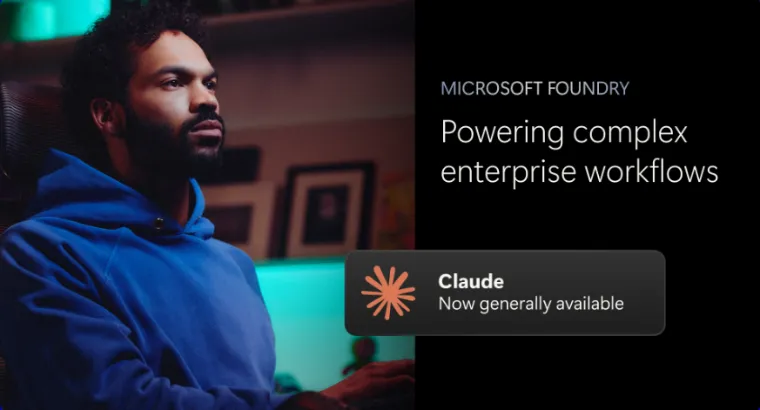
Claude’s presence in Microsoft Foundry builds on the strategic alliance declared by Microsoft, Nvidia, and Anthropic to extend proprietary access to Claude on Nvidia-accelerated computing. What makes this effort distinct is the entirety of the package. Where many nemeses focus on selling individual model access, this trinity is offering an embedded proprietary artificial intelligence stack. Claude provides the model layer, Nvidia provides optimized hardware-enabled tooling, and Microsoft Foundry Azure delivers the adoption, regulation, and operational ecosystem. Altogether, they offer a coherent system designed for real-time organizational workloads.
The presence of Florida Microsoft Foundry depicts acceleration of proprietary artificial intelligence. The focus shifts from isolated model efficiency to full-stack delivery, where model, infrastructure, regulation, and adoption come together to create a stack. By blending Anthropic’s modelsMicrosoft, NVIDIA and Anthropics Alliance NVIDIA’s accelerated computing, and agent tooling in Microsoft’s Azure-centric platform, this alliance positions agentic artificial intelligence as an operational ecosystem organizations can trust, access, and regulate as a soaring capability.