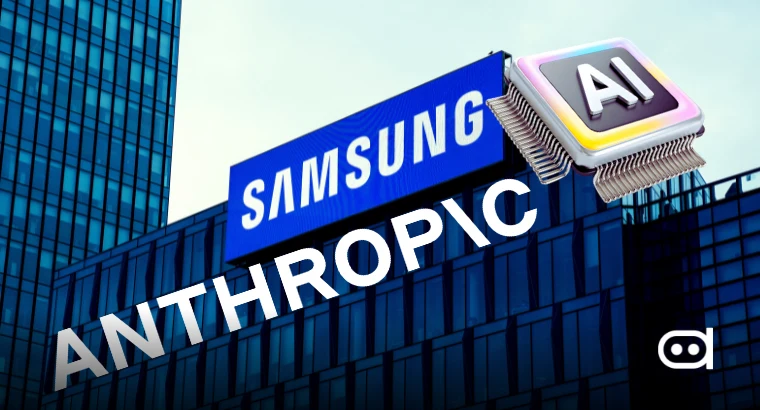
The race to build stronger artificial intelligence is not just about better large language models anymore. Now, the top AI companies are focusing on the hardware driving these systems. Take Anthropic, for example, they are reportedly in talks with Samsung Electronics to create custom AI chips.
These talks point to a bigger industry shift. Artificial intelligence firms want more control over their computing power and do not want to rely so heavily on Nvidia, whose GPUs are still the industry standard for training and running advanced AI models. If Anthropic and Samsung end up working together, this could boost efficiency, cut costs, and lock in reliable computing resources for the future.
Anthropic Explores Samsung Partnership for Custom AI Chips
According to reports, Anthropic just started early conversations with Samsung Electronics to produce a custom AI chip using Samsung’s 2nm semiconductor process. There is no decision yet on the chip’s architecture, production timeline, or exactly what AI tasks it will tackle yet.
Samsung’s 2nm process and chip packaging skills are the limelight as it tries to win over major AI firms as their clients. If this collaboration moves forward, it sets Samsung up even better in the fast growing AI chip industry, and it would give Anthropic more ways to control its own tech.
But do not expect Anthropic to suddenly ditch its current hardware partners. They will keep using the accelerators and GPUs they already buy as they figure out whether a custom chip makes sense for future training and inference needs. The move reflects an industry wide effort to optimize performance while managing the increasing cost of AI computing.
This comes while Nvidia still leads the AI chip industry, but as demand grows, major artificial intelligence firms want to diversify their hardware strategies so they are not stuck with a single supplier.
How Anthropic’s Strategy Compares with OpenAI’s Custom Chip Push
Anthropic’s reported approach looks a lot like what OpenAI is already doing. Even though Anthropic is still weighing its options, OpenAI recently launched its first custom AI chip, Jalapeño, built with Broadcom and manufactured by TSMC. That chip is aimed specifically at AI inference, the process that lets models like ChatGPT generate answers faster and more efficiently.
Jalapeño is already up and running in their infrastructure, and, according to Reuters, it is just the start of OpenAI’s bigger plan to make more of their own chips and reduce dependence on the Nvidia GPUs. They want better performance and lower operating costs.
| Feature | Anthropic | OpenAI |
| Current status | Early stage discussions | Custom chip unveiled |
| Manufacturing partner | Samsung (under discussion) | Broadcom (design), TSMC (manufacturing) |
| Chip focus | Yet to be disclosed | AI inference |
| Objective | Greater infrastructure control and reduced GPU dependence | Lower infrastructure costs and reduced Nvidia dependence |
The comparison illustrates how the competitive landscape is evolving. Leading AI companies are not just trying to beat each other with smarter models, they are focusing on owning their own hardware. When they design their own silicon, they can optimize chips to fit their workloads, reduce exposure to GPU shortages, and potentially achieve better performance per dollar than general purpose accelerators.
Anthropic 🤝 Samsung
— 🚨 AI News | TestingCatalog (@testingcatalog) July 2, 2026
Anthropic may develop its own AI chip with Samsung, according to The Information.
> OpenAI recently announced their own AI chip developed in a partnership with Broadcom.
Everyone is going full stack 👀 pic.twitter.com/JNIebUARkQ
For Samsung, landing Anthropic as a customer would also represent a strategic win against rivals in advanced semiconductor manufacturing. For Anthropic, it is an opportunity to make hardware that matches exactly what their next generation AI systems will demand.
Also read: Anthropic To Join the Race to Build its own Custom AI Chips
Anthropic’s reported discussions with Samsung underscore how the AI industry’s competitive battleground is expanding beyond model development. Although the partnership remains at an early stage, it signals the company’s intention to build greater control over the infrastructure that powers its AI systems.