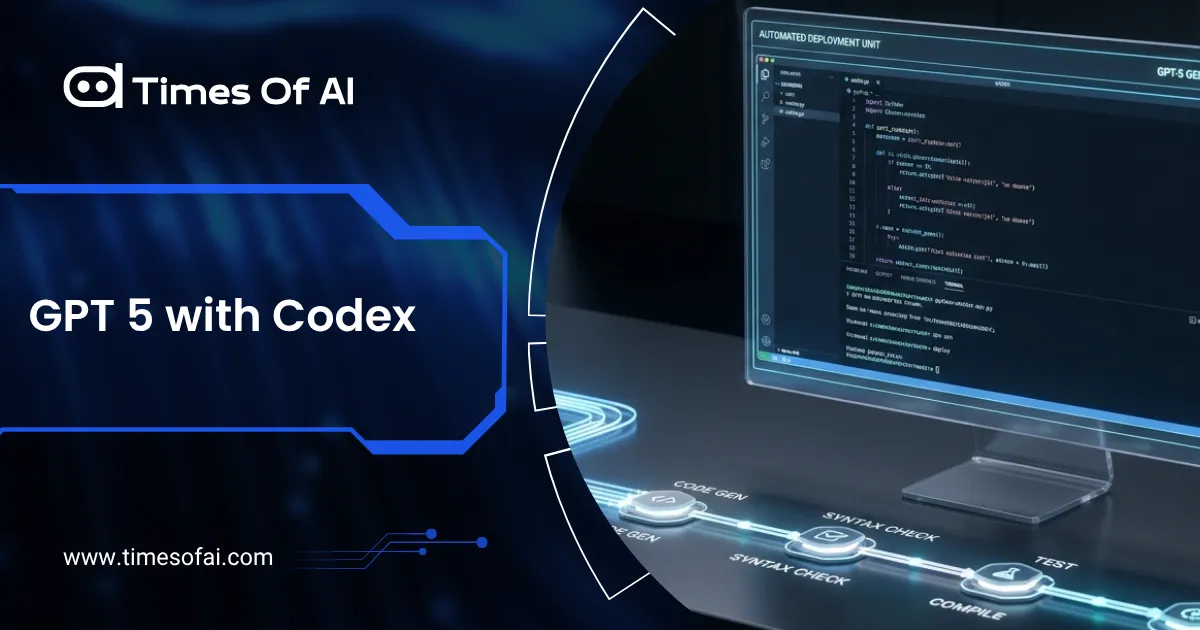
Thanks to coding with GPT-5 Codex, AI-assisted workflows are rapidly evolving, moving from assisting in work performance to executing the work. Organizations have access to a next-generation productivity engine that combines all of these tools into an automated workflow across departmental lines.
This marks the transition from traditional working tools to intelligent and autonomous systems powered by the latest versions of GPT-5.
Businesses can now use fully automated systems instead of manually executing processes with the more recent versions of GPT, including GPT Codex 5.5 with improved reasoning capabilities, and integrated platforms such as Codex-CLI and APIs.
The new features of GPT-5 are designed to do more than just have conversations. It bridges the gap between what humans want to do and how the machines execute it.
Coding with GPT-5 will redefine enterprise digital transformation by making ChatGPT Codex a core component of modernizing enterprise operations. It aims to transform how teams function to develop computer code, use real-time data for decision-making, generate images using GPT, and allow enterprises to execute simultaneous processes in an automated fashion
By transforming how teams function, GPT-5 coding will redefine enterprise digital transformation by making ChatGPT Codex a core feature of this evolution.
AI Tool Evolves into Enterprise Workflow Engine
Before GPT-5 was released, there were different versions of AI from OpenAI, such as GPT-4, that have primarily emphasized on content creation and user support. However, unlike prior versions, the GPT-5 AI model provides much deeper reasoning, greater context handling, and native capabilities for interacting with external systems. In combination with the existing Codex software infrastructure, GPT-5 Codex can:
- Understand natural language instructions
- Translate those instructions into executable code
- Interact with different technologies such as API’s, databases, and SaaS applications
- Execute highly automated workflows with little to no human intervention
As a result, AI coding with GPT-5 Codex differs from previous versions because it now takes control of actions rather than just suggesting.
Automation of Daily Repetitive Tasks
Automating daily repetitive tasks is one of the best examples of how to benefit from GPT-5.5.
- Automating Email and Communication
In addition to drafting, summarizing, and responding to emails, GPT-5 helps users with:
- Organizing messages based on priority
- Triggering workflows based on incoming requests
- Taking customer support requests and interpreting them
- Generating context-based responses
- Reporting and Handling Data
Using either the Codex CLI or built-in APIs, GPT-5 allows users to:
- Extract data from your CRM/ERP/analytics systems
- Generate real-time reports
- Convert raw data into useful information and insight
This can reduce the time taken to create reports by simply allowing teams to ask, “Generate last month’s sales data along with any key performance indicators?”
- Managing Schedules and Operations
An AI agent can:
- Coordinate meetings
- Synchronize calendars across various teams
- Optimize scheduling based on priority
These functions allow GPT Codex 5.5 to serve as a virtual operations assistant.
Agent-Based Automated Workflows
The real innovation comes in the form of agent-based automation. The following GPT-5 prompting guide highlights how GPT-5 Codex can function as an orchestrator of multi-step workflows. Let’s consider the following example –
Input: “Launch new product marketing campaign.”
Output from GPT-5 + Codex
- Research target demographics
- Create promotional content for your campaign
- Produce visual assets using Chat GPT-5 image generator
- Post schedule with marketing tools
- Track engagement metrics through marketing platforms
- Create performance reports
These tasks can be completed through linked systems by the directions given in natural language.
This is where integrations between Codex GitHub and Codex-CLI allow AI to communicate directly with code repositories, automation pipelines, and deployment systems.
GPT-5 Capabilities For Automating Your Business
The strength of GPT Codex 5.5 is derived from multiple features combined, including:
- Natural Language to Code
With the introduction of GPT-5, businesses will no longer have to write scripts manually. Now it will be able to:
- Create production-ready code.
- Debug errors within the written code.
- Enhance existing workflows.
This GPT-5 capability makes it much easier for teams using Codex AI coding environments to generate code.
- Ability To Integrate With Other Systems
The ability of GPT-5 to connect with other applications and systems (Salesforce and HubSpot), and tools (Jira and Notion), in Cloud environments (AWS and Azure) will provide perpetual automation as a service.
- Contextual Reasoning For Business Tasks
The previous generation of GPT-3 could only maintain short-term contexts in conversations. However, with GPT-5, it will:
- Have a long-term conversation context.
- Understand the business context associated with certain types of decisions.
- Make decisions based on the desired outcome.
- Intelligent Image Generation
With the introduction of the new ChatGPT image generator in GPT-5, creative teams can:
- Create marketing graphics.
- Develop examples of products.
- Design assets for social media.
This capability eliminates reliance on manually developed graphics through the design process.
How to Use GPT-5 with Codex?
An implementation and prompting guide for GPT-5’s automation of workflows is broken down into five major steps:
- Define Objective – It should be specific with clear, well-written prompts.
- Break Tasks Into Steps – While GPT-5 decomposes tasks automatically, having defined tasks can improve results.
- Connect Tools – Connect tools using APIs, Codex CLI, or with a third-party integration tool.
- Create Agents – Deploy agents with persistence:
- A waiting agent to check for an event to trigger
- An agent to carry out the work associated with that event
- A reporting agent to log what happened while executing the task
- Iteration – Prompts and workflows should be continuously improved through iteration.
GPT Codex Pricing
Although the exact GPT Codex pricing is unclear, it is possible to identify general structures typically used. The following list provides some examples:
- API keys (Codex Key, pay-per-token)
- Subscription tiers for advanced functionality
- Enterprise licensing for larger-scale systems
FAQ
What is Codex software?
The Codex software developed by OpenAI is an AI system that converts written instructions into computer programming language and can be used to create software, automate processes, and integrate various systems within organizations.
How to use OpenAI Codex?
OpenAI Codex can be accessed through various APIs, development tools, and other software development tools, such as Codex-CLI, which use natural language to provide instructions that result in functioning code or automations.
How can GPT with Codex benefit developers?
Developers can:
- Automate repetitive coding tasks
- Debug code faster
- Create complete applications
- Integrate disparate systems with relative ease
This will allow for a considerable increase in development speed, and a reduction in the amount of manual work required.
In which industries can GPT with Codex be applied?
The Codex developed by OpenAI can be used in many industries, including:
Healthcare, Finance, Marketing, E-commerce, and Software as a Service (SaaS) and Technology. Any industry that has standard repetitive workflows can benefit from this technology.
Is GPT Plus Free with Codex?
No, GPT Plus is typically a subscription service that allows users access to a more advanced version of the GPT text-based AI models. However, Codex access using APIs or any alternative will generally incur an additional cost.
Which GPT model does Codex use?
Codex is based on the most recent version (GPT-5 series) of the advanced GPT framework but is explicitly tuned for building computer programming languages and automating process activities.
Can I run GPT Codex locally?
Typically, Codex runs using cloud-based hosting. So, there are limitations about running the service locally, outside of specialized enterprise configurations. Generally speaking, one would need to access Codex through the cloud for use at a full-featured level.
How much does Codex cost per month?
All Codex costs are usage-based. A small team may pay a reasonable monthly fee for Codex, while an enterprise would pay based on total API usage, integration, and other costs associated with its use.