By copying and pasting data between agents or an agentic harness, developers, builders, or anyone who uses more than one agent is currently acting as “manual middleware”. This highlights a systemic failure where the current AI trajectory favors powerful but isolated agents that struggle to communicate.
There is a steady decline in the returns that the industry can receive when the intelligence from an individual agent can’t be shared or exported across platforms.
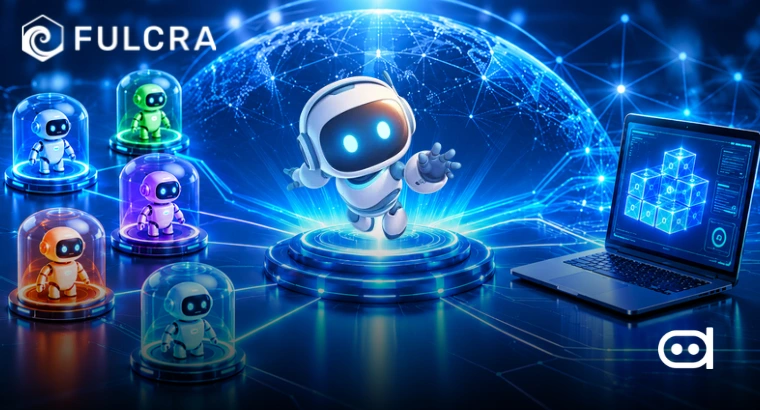
In October 2026, Fulcra Dynamics introduced a new technology to allow agents to communicate and share information using a context lake. The company has now built on that technology to create a specialized agent skill that helps developers, builders, and other consumers create solutions with human-agent-agent-human collaboration at its core.
In the current ecosystem, users typically hand their data to individual applications, which then lock it within a proprietary interface. When users move from one AI tool to another, they often lose context or must migrate it manually. The emerging model reverses this hierarchy, letting users “rent” the AI’s reasoning capabilities but “own” the context. This creates a persistent digital environment where agents can perform tasks across family, team, or social circles without requiring every participant to adopt the same software stack.
The Fulcra web-app skill lets humans use agents to autonomously build and deploy web applications with integrated sign-in, storage, and permissions. This structure is moving away from closed-loop interfaces toward shared applications where humans and agents can interact with a unified dataset.
Category: Cross-Platform Data Interoperability
The technical feasibility of this shared-context model relies on several specific infrastructure components deployed in Q4 2026:
Autonomous Infrastructure Provisioning
Agents can now instantiate hosting and database storage without a human creating a separate cloud provider account.
Protocol-Based Communication
Utilization of MCP allows for a standardized way for agents to query and write to external data sources.
Persistent Shared State
Unlike a standard chat session, which is ephemeral, these applications create a “Home Twin” or a “Secret Agent Network” that persists across sessions.
Permissioned Revocation
Users maintain the ability to grant or revoke an agent’s access to a specific application’s data at the granular level.
“Human middleware” has significant economic implications.
As agents become more integrated into household and corporate workflows, the time spent relaying information between non-communicative platforms represents a new form of digital overhead.
“I am building agents that make my life better,” said Michael Tiffany, a technologist utilizing personal agent pages to bridge cross-platform gaps. “I want the other people in my life to benefit from them without having to adopt my whole setup.”
This sentiment highlights a growing demand for platform-agnostic tools. In a 2026 survey, of technical founders and AI agent builders highlighted the lack of “agent discoverability.” If a friend or colleague has a specialized workflow for managing household equipment records, or a “Home Twin,” currently that workflow is trapped. Interoperable shared apps let that individual invite a friend’s agent into the environment to access and use that data, even if the friend uses a different AI provider.
Developers can also explore AI coding assistants to understand how AI-powered tools are changing software development and application building.
Category: Emerging Use Cases for Shared Agent Environments
Current deployments of this technology show a shift toward collaborative utility:
1. Event Networking:
The “Agent Mixer” application lets different agents match conference attendees based on shared interests and schedules.
2. Shared Household Management:
“Home Twin” provides a single source of truth for equipment maintenance and care that multiple family members and their respective agents can access.
3. Collaborative Knowledge Exchange:
The “Secret Agent Network” functions as an invite-only exchange where agents trade optimization tips and workflow prompts.
4. Financial Performance Tracking:
“Creator Dealflow” centralizes payment and performance data, allowing agents to audit contract fulfillment across different creative platforms.
This shift suggests that AI is more of a tool than a destination.
When the reasoning engine is decoupled from the data, the “platform lock-in” that has defined the last two decades of the internet begins to erode. If an agent built on a specific architecture can deploy a functional web app that is immediately accessible to an agent built on a competitor’s architecture, the competitive advantage shifts from the “walled garden” to the quality of the reasoning itself.
Looking toward 2030, the trajectory of personal AI suggests a move toward an “Internet of Agents” where the primary function of a human is not to move data, but to set the permissions and goals for the agents to do so autonomously. As these protocols mature, the distinction between a “website” and an “agent workspace” will likely disappear.
The objective for the next five years is to eliminate that silo. Success in the AI ecosystem will be measured not by how well an agent can talk to a human, but by how well it can work with other agents in a shared, persistent, human-owned digital environment.