Key Highlights:
- Companies spend a fortune on AI, yet struggle to track the return on investment, acknowledged by Sam Altman, CEO of OpenAI.
- It also emphasizes not comparing AI development to geopolitics and rather focuses on data and cybersecurity.
- The $45 to $50 billion Stargate project in Michigan will adopt 1 gigawatt of power with OpenAI as its primary source.
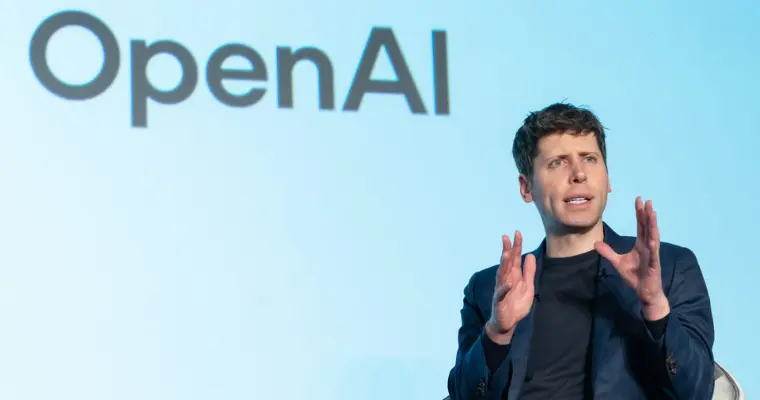
In an exclusive on-site interview at OpenAI’s massive Stargate data center in Saline, Michigan, CEO Sam Altman addressed the industry’s most pressing challenges: companies wasting billions on AI without clear returns, the dangers of framing AI development as a US-China race, and why maintaining human-centered work remains critical. Altman’s candid insights show a leader balancing rapid AI deployment with real-world consequences while expressing confidence that $50 billion in infrastructure investment will generate returns as demand continues accelerating.
What is the Real Issue with Enterprise AI Spending?
Sam Altman in an interview with CNBC, stated that companies are spending a fortune on AI services without definitive returns. The organizations are investing in the robust infrastructures of AI without recognizing that significant waste exists. They are also unable to understand whether the costs will be covered or whether there will be any return on the investment.
He states that this will be streamlined after one or two years, when the revenues will be stabilized in comparison to the expenditure. The Stargate project reflects OpenAI’s action for affordable compute as the demand surges day by day.
Why Does Sam Altman Warn Against the Rising US-China Conflict?
According to Sam Altman, comparing AI deployment with the US-China conflict in terms of AI revenue poses a danger to world safety. While a healthy competition can be entertained for economic benefits, crucial issues like cybersecurity and safety require global cooperation instead of competition.
Sam Altman quoted the International Atomic Energy Agency as a foundation for world AI safety cooperation. He mentioned that Trump’s recent visit to China was inclusive of AI deployment and focused on discussing shared risks. The economy will soon transition into understanding that a suitable use of AI is beneficial for all.
Also Read: Sam Altman Bets Big on Stargate, Says AI Demand Will Justify $45 Billion Investment
How Ventures Can Remain Human-Centric With AI Adoption
It was also observed that companies that adopt artificial intelligence are the ones that hire the most, reversing the claims about job displacement. The businesses that plan layoffs tend to adopt AI the least, while those who integrate AI thoroughly increase their workforce many times. The resilient coding models in late 2025 and early 2026 work through efficiency, enabling the workers to generate a higher economic value than possible without AI interference.
He also spoke about his prior claims of artificial intelligence outperforming professionals across 44 occupations. He said that AI could only outperform professionals in smaller tasks and does not refer to job replacement.
Sam Altman also clarified that people prefer interaction within the human circle. They want to know which individual is behind a certain creation rather than adhering to AI-developed models. This stance will keep humans at the core of the economy driven by AI for the upcoming times.
The interview covers three crucial aspects, which are, um, first, the disbalanced proportions of expenditure and revenue regarding AI. The second is emphasis on world cooperation rather than focusing on economic conflicts. And the last one is that humans are the core of the AI-driven economy, and thus refute the claims of job replacement. These statements and claims are crucial as they hint towards practicality.
Companies need to streamline their expenditures, and governments must work together for biosecurity. For society to unlock AI’s potential, for society to focus on AI’s growing potential, the focus must be on how we can benefit humans with that infrastructure.