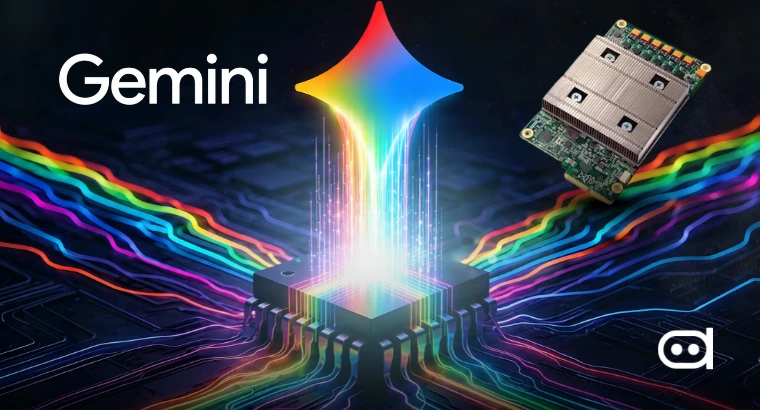
Google is reportedly developing a new AI chip designed specifically for its Gemini AI models. Unlike a new chatbot or software update that users can interact with directly, this development is focused on the hardware powering AI. The reported chip, internally named Frozen v2, is aimed at making Gemini faster, more efficient and less expensive to run.
The move also reflects a broader shift in the AI industry. Over the past few years, the focus has mostly been on building more capable AI models. Now, companies are investing in the chips that run those models, as the cost and computing power required to serve millions of AI requests continues to grow. Google’s reported project fits into this trend of pairing software with custom built hardware.
What Is Frozen v2 and Why Does It Matter?
The report surfaced just days before Alphabet’s quarterly earnings with the company’s stock rising around 3% following the news. Investors are expected to closely watch Google’s AI spending and infrastructure plans, especially as competition in generative AI intensifies. According to the report, Google is developing a server chip internally known as “Frozen v2” with a possible launch timeline of 2028.
Unlike Google’s existing Tensor Processing Units (TPUs), which are designed to support a variety of AI workloads, Frozen v2 is being built specifically for Gemini. Reports suggest that instead of simply running the AI model, the new chip could have parts of Gemini’s architecture built directly into the hardware. In simple terms, the chip is being designed around the model it is meant to run rather than serving as a general purpose AI processor.
The main objective here is efficiency. By tailoring the hardware for Gemini’s core tasks, Google wants faster responses while using fewer computing resources. Frozen v2 could be six to ten times more efficient than existing custom chips and that is a big deal if you are running massive AI services at scale as it saves money and speeds up the process.
JUST IN: 🇺🇸 Alphabet $GOOGL is developing a new chip called “Frozen v2,” according to The Information.
— CryptoTweets (@CryptoTweets) July 20, 2026
The pitch: 6 to 10 times more efficient than Google’s current TPUs.
The trick isn’t more power. It’s less waste.
Frozen v2 permanently embeds parts of Gemini’s architecture… pic.twitter.com/d230gK4Bp9
How Does Google’s Chip Compare to Microsoft and Amazon?
Google is not alone in developing custom AI chips. Microsoft, Amazon and Meta have all introduced their own hardware, but their approaches differ in terms of what the chips are designed to do. Google’s reported strategy stands out because Frozen v2 is being developed around a single AI model, Gemini. Instead of creating hardware that can handle a broad range of AI tasks, Google is designing the chip specifically for Gemini’s workload. By integrating parts of Gemini’s architecture into the chip itself, the company expects to see faster, cheaper AI results.
Microsoft has taken a cloud focused approach with its Maia AI chips. Maia is built to speed up any AI workloads on Microsoft Azure, including Copilot. Amazon has divided its AI chip strategy into two products with different purposes. Trainium is built to train large AI models, while Inferentia focuses on inference, which is the stage where trained models generate responses for users. Meta’s Meta Training and Inference Accelerator (MTIA) follows another route. Meta wants to power AI across Facebook, Instagram, and WhatsApp using the same chips, just like Microsoft and Amazon.
Another difference is Google’s experience in custom AI silicon. The company has been developing TPUs for years. Frozen v2 would build on that foundation instead of replacing it. Despite these differences, all four companies share a common objective: less reliance on outside chips, more efficiency, and lower operating costs for complex AI workloads.
Read More: AI Model Evolution: The Complete Timeline of Every Major AI Family
Google’s reported work on Frozen v2 shows that the AI race is no longer limited to building better chatbots or larger language models. Now, companies are competing over the hardware that powers those models, as efficiency and infrastructure become just as important as software capabilities. However several questions still remain. If Frozen v2 launches in 2028, will it really make Google’s AI cheaper and faster? Will this “one chip, one model” approach catch on, or will general purpose hardware keep dominating? As Google and its competitors continue to invest in custom silicon, the answers to these questions could shape the next phase of AI development.