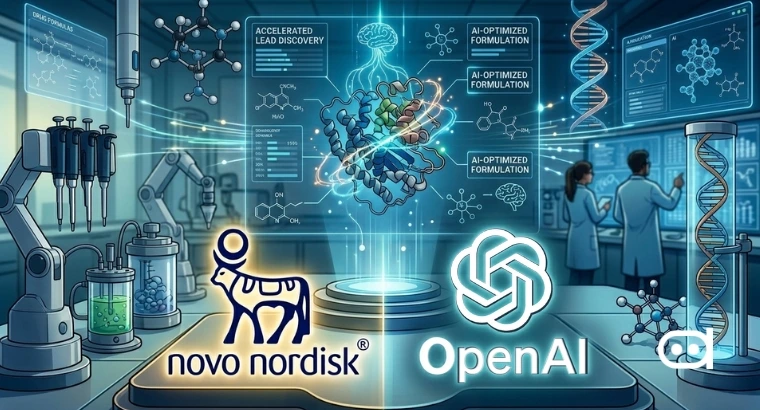
- Novo Nordisk has reportedly partnered with OpenAI to speed up drug development with the help of artificial intelligence across research, trials, and operations.
- The collaboration was announced in April 2026 aiming to reduce the time and cost of bringing new medicines to market.
- The company is attempting to enhance scientific productivity by integrating AI end to end rather than replacing researchers.
The pharmaceutical sector has historically been characterized by slow, costly, and uncertain innovation cycles. Creating a single drug can easily take more than a decade, and it requires billions of dollars in investment with no certain return. Novo Nordisk’s new deal with OpenAI represents a shift not only in tools but also mindset. Artificial intelligence is no longer being treated as an add-on, it’s becoming crucial to how new drugmakers do business.
This partnership comes at a time when the demand for obesity and diabetes treatments is increasing worldwide, and competition among the leading pharmaceutical companies is getting intense. Novo Nordisk, who is already a leader in this space, is now betting that AI can give it a decisive edge, by optimizing every stage of the drug lifecycle, from early research to distribution and not just by speeding up discovery.
From Lab Experiment to Core Strategic Planning
Pharma companies have been figuring out various forms of artificial intelligence for years, screening molecules, crunching genetic data, or forecasting outcomes. The scale is what makes this partnership interesting. Rather than limiting itself to a research lab only, Novo Nordisk is going to embed AI into its entire value chain.
AI can analyze huge amounts of biological datasets in drug discovery way quicker than human teams which helps in pinpointing potential compounds and targets with greater accuracy. This could save a lot of time early in research, which is usually the most uncertain part of any new development. In clinical trials, AI can help in identifying suitable participants, optimizing trial design, and even predicting potential risks which results in making studies more efficient and potentially more successful.
The way pharmaceutical companies think about technology is changing. Artificial intelligence is not just something used in a small part of the business anymore, it’s becoming a key part of everything they do. This shift shows that companies are starting to see AI as a fundamental tool that can help them work better and make decisions based on data.
Drug Development: Speed vs Certainty
Making new medicines faster is great only if they are safe and work well. The companies that make medicines have to follow a lot of rules for safety purposes, and any new technology has to fit within those rules. It is important to make sure that AI doesn’t compromise the safety and quality of medicines, just because it makes things faster.
Novo Nordisk thinks that artificial intelligence will only make the work easier, not take the place of what humans can do. Scientists are still important for understanding results, making choices, and making sure that things are done in a fair and safe way. This way of working, where people are involved every step of the way is necessary for building trust.
AI is really good at recognizing patterns and analyzing data, but biology is a complex and unpredictable field. Making small changes can add up to make a big difference. Cutting down the time it takes to develop new treatments even by just a year or two could mean that people get the help they need sooner and at a lower cost.
Also read: OpenAI Upgrades ChatGPT Shopping While Retreating From Checkout
Conclusion
Novo Nordisk is teaming up with OpenAI, and this partnership is not just about making one big discovery but about changing the way medicines are made. The whole industry is shifting towards using data and AI to get things done faster, better, and on a bigger scale, all while still making sure everything is done properly and with careful attention to detail.
It’s still early days, so we can’t say for sure if this approach will give us completely new medicines or just improve the way we make them. One thing we do know is that artificial intelligence is becoming a bigger and bigger part of healthcare, and companies that can make it a central part of what they do may be the ones that shape the future of the pharmaceutical industry.