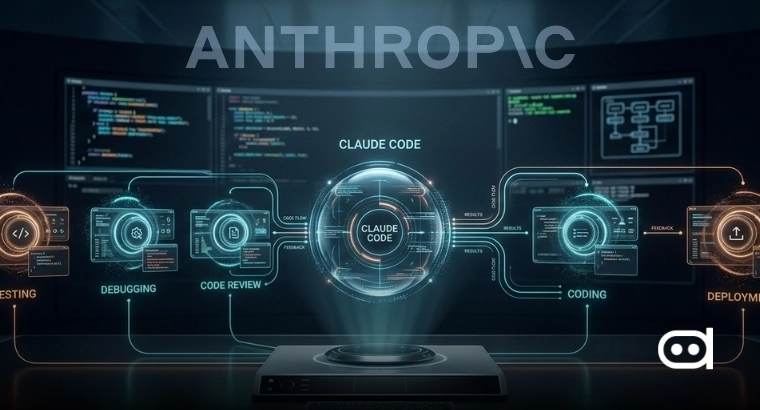
- Anthropic just rolled out Claude Opus 4.8, its latest AI model focused on making coding, reasoning, and transparency better, all while improving enterprise workflows. They’re keeping the price the same as the last Opus release.
- One big thing with this update is what Anthropic calls ‘honesty’ behaviour, which means the model does a better job of admitting uncertainty instead of pretending to know everything.
- It spots coding errors more reliably and new effort controls let users choose between faster responses, lower costs, or deeper reasoning, depending on what they need.
Anthropic released some upgrades alongside the new model: Dynamic Workflows let Claude coordinate multiple tasks at once, effort control settings are now available inside claude.ai and Cowork; and the Messages API can finally handle system entries right in the messages array, which makes the developer’s life easier.
Anthropic’s launch of Claude Opus 4.8 marks a real shift. AI companies now want to prove their value to enterprise and professional clients, not just win benchmark tests or create chatbots. Anthropic claims Claude Opus 4.8 is specifically tuned to help teams that need AI to handle coding, research, or big business processes. It’s all about smarter reasoning and building more trust with users.
What is Claude Opus 4.8?
Introducing Claude Opus 4.8: it builds on Opus 4.7 with sharper judgment, more honesty about its own progress, and the ability to work independently for longer than its predecessors.
— Claude (@claudeai) May 28, 2026
Available today at the same price. pic.twitter.com/EufxL7T1kb
Claude Opus 4.8 is Anthropic’s newest large language model, available through Claude AI, their platform API, and enterprise integrations. The price matches the previous Opus, but the features are improved for developers, knowledge workers, and anybody who needs accuracy and reliability.
Claude Opus 4.8 doesn’t act overconfident and freely admits when it’s not sure. For coding, Anthropic says the model is about four times better at catching errors in its own code output compared to its older models.
Advanced reasoning is another focus. The new effort controls let you decide how much computational power the model puts into each task. Users can prioritize faster responses for simpler queries or more processing effort for deeper analysis and complex problem-solving.
One standout upgrade is Claude’s improved orchestration system. It can handle multi-step workflows and parallel tasks, so companies can use it for big, ongoing processes, instead of just asking isolated questions.
How does Claude Opus 4.8 Compare with Earlier Opus Models?
Compared to the older Opus models, 4.8 appears less focused on raw performance and more centered on workflow efficiency and dependability. Previous Opus versions were known for sharp reasoning and coding skills, but Anthropic is now addressing an industry-wide issue which is AI confidently making things up. The push for ‘honesty’ means Claude communicates when it’s not certain which would help users trust the technology more.
User control is another clear improvement. Earlier models were sort of rigid in their reasoning. Now, effort controls let users pick how deeply the model should process each task.
This version is being marketed ready for enterprise especially coding teams, analysts, and any business that wants to put AI at the core of its operations. Anthropic has also indicated that while Opus 4.8 is a major upgrade, it still sits below the company’s future high-tier “Mythos” system currently in development.
Also read: Claude Opus 4.7 Launched: Is It Safer Than Mythos & How it Compares to Opus 4.6
What Else is Anthropic Launching Today?
Dynamic Workflows: Claude can now handle multiple AI-driven subtasks at the same time, coordinating parallel processes for bigger, more complex jobs. No more waiting for it to finish one step at a time.
Expanded effort controls in claude.ai and Cowork: Users now get more choices on balancing speed, reasoning depth, and compute use, which helps keep operations efficient, especially at scale.
Messages API update: Developers can now place system entries right in the messages array. This cleans up code and makes it easier to manage instructions and keep conversational context inside applications.
Read More: The Evolution of Claude AI Models: From Early Versions to the Latest Releases
Conclusion
With Claude Opus 4.8, Anthropic is signaling a bigger shift in AI: reliability and integration now matter as much as benchmark performance. By putting transparency, user controls, and practical features first, Anthropic is trying to differentiate itself in a crowded market.
Future battles between AI companies may be less about who builds the most powerful model, and more about who delivers tools that can actually integrate smoothly into day-to-day business. As more businesses adopt generative AI for everything from development to automation, Anthropic wants Claude Opus 4.8 to be the backbone of real operations, not just an experiment.