Key highlights:
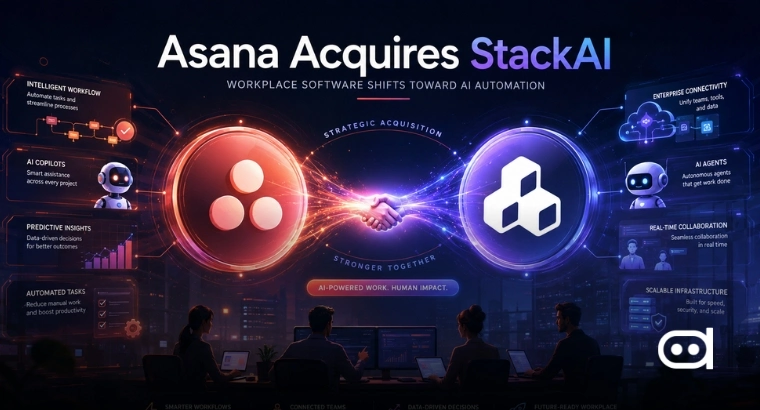
- Asana just bought the no-code AI startup StackAI for around $75 million, stepping up its focus on enterprise AI automation and workflow orchestration.
- The deal was announced on May 28, 2026 bringing StackAI’s no-code, agent-building platform into Asana’s ecosystem.
- Now, businesses can create AI-powered workflows that connect with tools like Salesforce, Slack, and Google Workspace.
With StackAI, Asana is staking a new claim in the fast-evolving enterprise AI market, where software companies are racing to turn ordinary platforms into intelligent operating systems. Asana plans to move beyond project management and become a more influential force in workplace automation.
Before the purchase, StackAI, focused on no-code AI agent development, had raised close to $20 million. Its technology lets companies build AI agents without deep programming skills, making it possible to automate repetitive tasks and link AI workflows across enterprise systems. By bringing StackAI onboard, Asana is positioning itself at the center of a growing demand for AI-powered workplace coordination tools.
Asana Boosts AI Workflow Capabilities by Acquiring StackAI
Asana acquires no-code agent-builder Stack AI https://t.co/ZtN3sCIe6X
— TechCrunch (@TechCrunch) May 28, 2026
This is a crucial moment for enterprise software firms. Ever since generative AI platforms like ChatGPT have been introduced, businesses have felt the need to use AI tools that boost efficiency and work right alongside the software their teams already use daily. They’re no longer satisfied with standalone AI assistants, they want solutions that fit naturally into existing workflows.
StackAI is a no-code platform that lets businesses build AI agents that actually interact with other enterprise applications like Salesforce, Slack, Google Workspace, etc. No need to depend on busy engineering teams, companies can set up their own AI-powered automations through an easy interface.
For Asana, this acquisition strengthens its ability to compete in an increasingly crowded enterprise AI landscape. Microsoft, Salesforce, Atlassian, they’re all racing to incorporate AI into their own ecosystems, hoping to make them smarter and more essential to enterprise customers.
The future is looking more and more like a human-agent workplace model. Instead of just replacing employees, a lot of companies now see value in systems where AI agents tackle repetitive chores, while people focus on strategy, approvals, and big decisions. Workplace platforms are shifting fast, acting as the control centers that help people and digital agents work together.
Asana has already said it wants to build for “human-agent teams”. StackAI’s no-code approach is a perfect fit for that vision. With this acquisition, Asana brings in tech that lets businesses scale automation while keeping humans in the loop.
Why No-Code AI Platforms are Attracting Major Software Companies
Every business wants AI, but putting advanced automation in place usually means you need serious technical expertise that companies may not have internally. No-code solutions help clear that hurdle. Instead of writing lots of code, businesses can build workflows, connect their systems, and roll out automation using simple interfaces. This accessibility has turned startups like StackAI into attractive acquisition targets for larger enterprise software firms.
Enterprise platforms like Asana already manage project plans, approve processes, handle communication, etc. Embedding AI into those environments, allows automation to actually get smarter because it understands the work at hand.
Also read: Meta is quietly testing premium subscription plans for its AI chatbot
Conclusion
AI isn’t just some side project or chatbot anymore, it’s becoming part of the core infrastructure that runs businesses. A no-code AI agent builder picked up for around $75 million, shows Asana is betting that the future of workplace software depends on how well companies can tie new automation into their current systems. The deal also highlights the rising value of platforms that let organizations activate AI without needing an army of engineers.