In an ever-changing landscape, Anthropic released Claude Opus 4.8 as a model that claims to be swift and transparent. It talks about honesty and accountability compared to its previous versions, which can also be seen as a pseudo-claim for appeal.
In the AI environment, which is consistently changing with new narratives and regulations, honesty sounds like a branded technique rather than a technical development. The question arises as to whether anthropics framing acts as a genuine development or a way to facilitate reliability.
It is a claim that garners the audience’s attention, especially at a time when LLMs keep experimenting. But it also raises a question. When we speak about honesty, is it about being more accurate or about acting more human-like to give a false reassurance?
The Cause of Polished Uncertainty
Anthropic states that honesty is an aspect that can be embedded in the system, like following a command. It shows that they are trying to prove that this model qualifies as an answer and produces a correct and confident response. It sounds too good to be true, but it also signals truth with alignment. It talks about it being partially correct, where honesty is treated as an output rather than a development.
One of the ideas that Anthropic is pushing further for Opus 4.8 is that it is better than its previous versions. But there is a fine line between certainty and uncertainty. When a model is trained to be aware, it does not signal that it is trustworthy. This also makes it harder to detect.
A pseudo-claim is easily detected, but a carefully placed pseudo-claim, which is subtle in nature, is more dangerous to interpret. It shows honesty as an aspect that only caters to presentation and does not signify complete knowledge.
Also Read: Anthropic’s Project Glasswing Uncovers 10,000+ Critical Software Vulnerabilities
Clash of Corporate Values and Accuracy
Anthropic has considered security, uniformity, and responsibility for its AI. The claim of honesty does fit in, but the question also arises as to whether the honesty claim is genuine or just redefining corporate value into language.
When a model says that I am not certain or that I can make mistakes, it shows how companies communicate risk. It is reassuring, but it is not on the same wavelength as reliability. There is a chance that we will witness the rise of truthful models, but what makes them distinct is that they are ethically self-aware.
From the user’s point of view, the most basic need is correctness. A Claude AI model that betwills answer may be safer but not useful. On the other hand, a model that is wrong, even if it’s blunt, delivers the opposite.
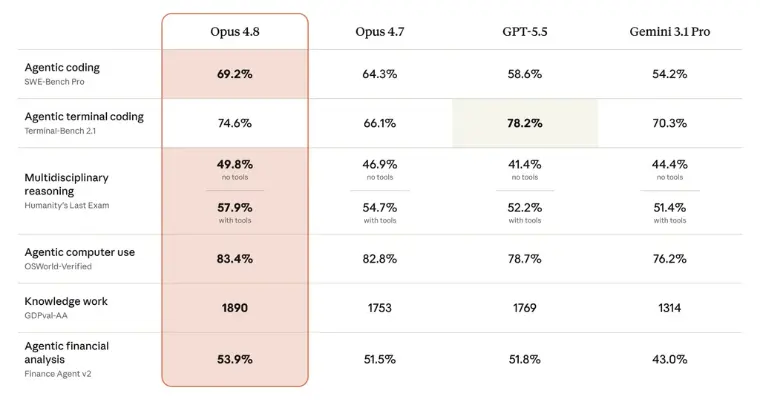
Anthropic’s challenge is proving that Opus 4.8 aligns with measurable improvements in accuracy and accountability, not just true words. Without any methodology or benchmarks, honesty sounds like branding rather than a capability.
Conclusion
To be specific, Anthropic’s Opus 4.8 focus on honesty is slightly misaligned. Encouraging an increase in unsorted AI-aware responses is a great initiative, but honesty should be an outcome of understanding, not after the replacement. Until it is clear that Opus 4.8 is not more careful in how it processes its output, but is genuinely reliable, the claim remains open to interpretation.
The discussion around Opus 4.8 is less about the model, but about how honesty is defined in artificial intelligence. Does it relate to self-awareness or copying human mechanisms?
In the end, the output is simple—does Opus 4.8 get its accuracy, or does it try to change itself when it does not meet the mentioned standard? That difference will be a guide as to whether the honesty in AI is a breakthrough from monotony or just an extra layer of glitter.