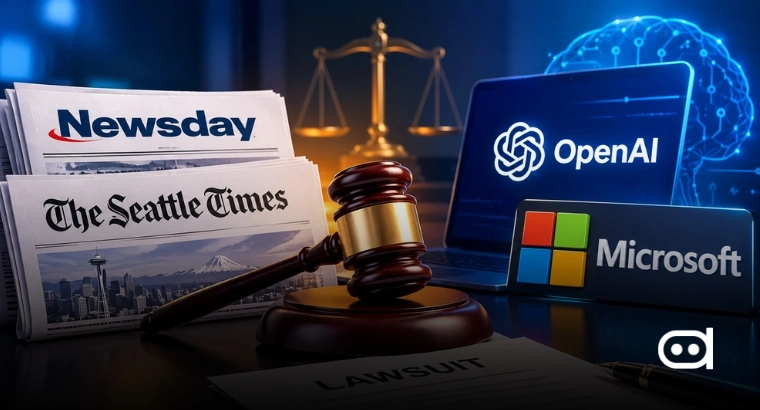
The Seattle Times and Newsday have taken legal action against OpenAI and Microsoft, claiming the tech companies used their journalism without permission to develop and run AI systems. The newspapers filed the lawsuit in the U.S. District Court for the Southern District of New York. According to the lawsuit, the companies used the news sites, including content locked behind paywalls, and added that material into datasets used to train OpenAI’s ChatGPT, Microsoft Copilot, and AI features in Bing.
This lawsuit points to a bigger problem. The newspapers say their journalists’ work costs real money to produce, but AI products let people access that information without even clicking through to the original sites or buying a subscription. This case also fuels the ongoing debate about copyright law, AI, and what all that means for the future of journalism.
Newspapers Raise Major Concerns Surrounding AI Once Again
The Seattle Times and Newsday say OpenAI and Microsoft copied hundreds of thousands of articles without asking or paying. They accuse the companies of taking stories from their sites and adding them to the data used to train AI. In their complaint, the newspapers say these AI tools can generate sections of their reporting word-for-word, closely paraphrase whole articles, and answer user questions in ways that make people less likely to visit the original websites or sign up for paid subscriptions.
One example in the lawsuit points to an 88-word excerpt from The Seattle Times’ Pulitzer Prize-winning Boeing 737 MAX coverage. The papers say AI systems reproduced this passage almost exactly.
Both newspapers want money for what happened, but their demands go further. They also want the court to order OpenAI and Microsoft to destroy all copies of their work, as well as any datasets and AI models that include their journalism. Seattle Times President and CEO Alan Fisco says the newspaper spends millions every year producing its stories and believes it must protect its content from being used without permission or compensation.
The newspapers say it is not just about their own business. They argue that generative AI relies on human-written content and gives back copies or similar versions of the originals. They warn this could affect the news organizations that make that content.
A Growing Legal Fight between News Organizations and AI Companies
The lawsuit is a part of a growing number of legal disputes between publishers and AI companies. The New York Times filed a lawsuit against OpenAI and Microsoft back in December 2023 for using millions of its articles without permission to train OpenAI’s chatbot.
In June 2026, a group representing around 400 local newspapers filed a similar lawsuit. Now, with Seattle Times and Newsday joining in, more newsrooms are challenging how AI companies get and use journalism. There is also an unusual connection between the companies being sued and the two newspapers. Both companies contributed to a $10 million AI fellowship in 2024 through the Lenfest Institute, with the Seattle Times and Newsday as participants.
OpenAI says it trains its AI models using publicly available data and believes this falls within fair use. The company’s spokesperson did not comment directly on the lawsuit. Microsoft said it was surprised by the lawsuit but acknowledged that local news matters. They said they are open to talking and finding ways to solve these disputes.
At its core, the case is about whether AI companies can use copyrighted news reporting to build and run commercial AI products without asking or paying. The newspapers say that creating original journalism requires major investment, and that AI products might make people less likely to visit their websites or pay for news.
This case adds to the broader legal debate about how copyright law applies to AI training and the use of online journalism. For news organizations, the outcome could change how their stories get used by AI companies and how they protect what they create.